Sign in
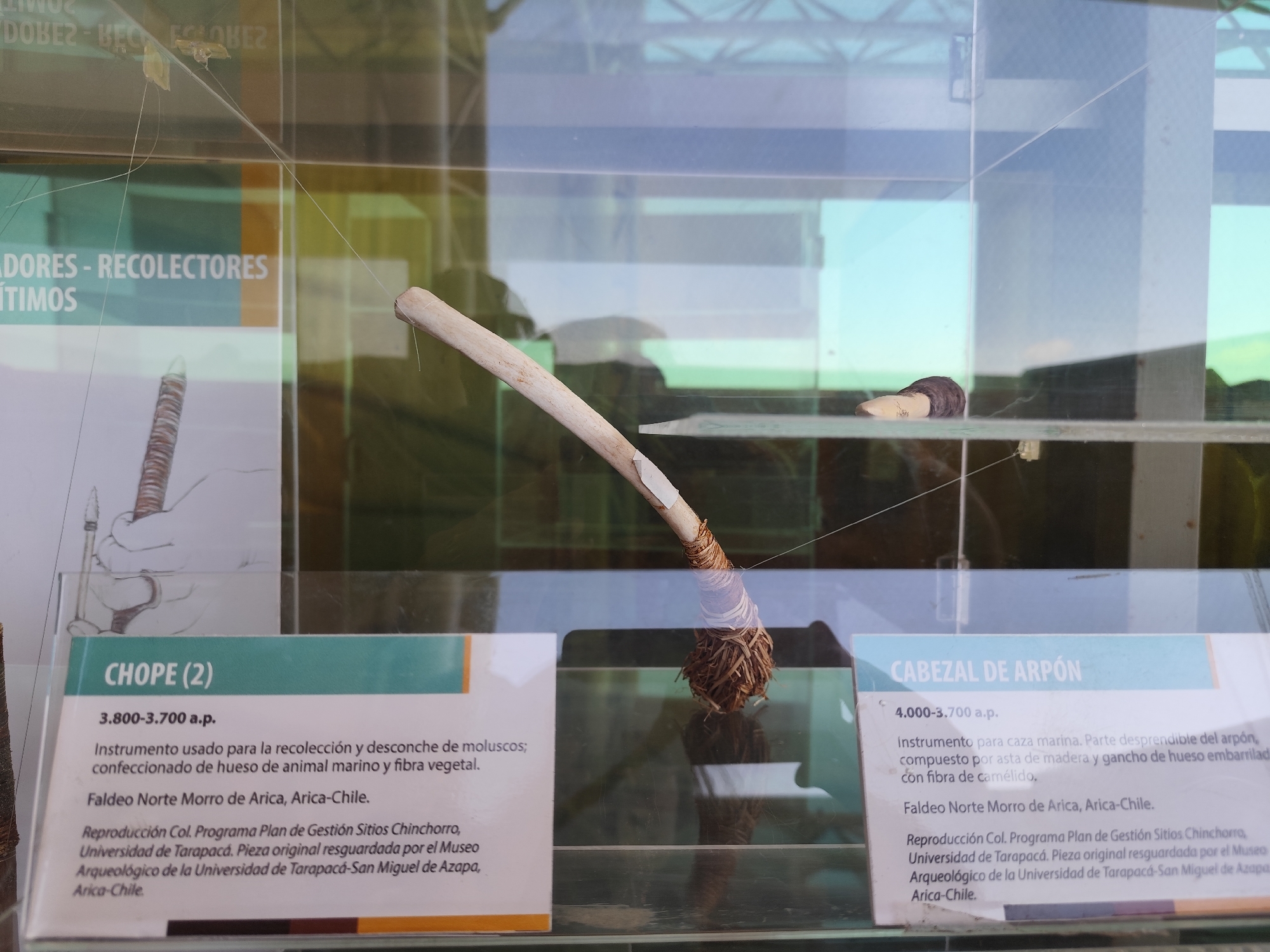
This media file depicts an exhibit inside a museum, likely in Arica, Chile, as indicated by the text. The exhibit displays reproductions of ancient tools.

The primary subjects are two artifacts presented behind glass. The artifact on the left is labeled "CHOPE (2)" and is described as an instrument used for collecting and breaking mollusks, made from marine animal bone and plant fiber. Its creation dates from 3,800-3,700 years B.P. The artifact on the right is labeled "CABEZAL DE ARPÓN" (harpoon head) and is described as a part of a harpoon for marine hunting, composed of a wooden shaft and a bone hook wrapped with camelid fiber. This artifact dates from 4,000-3,700 years B.P.

Both artifacts are shown in a display case with informational text written in Spanish. The text provides details about the origin of the pieces, stating they are reproductions from the Chinchorro Sites Management Plan Program at the University of Tarapacá, with original pieces preserved at the Archaeological Museum of the University of Tarapacá-San Miguel de Azapa. The location for both artifacts is cited as Faldeo Norte Morro de Arica, Arica-Chile.

The scene is well-lit, suggesting an indoor setting typical of a museum. The background shows reflections on the glass, including what appear to be other displays or architectural elements of the museum. The overall mood is informative and educational, focusing on the historical and cultural significance of the ancient tools. There are no people visible in the immediate foreground. The time of day and weather are not discernible from the image.
cynthia🇨🇱📈

Jun 26, 2026

Arica, Chile

Stake attention in this memory

historical
educational
reflective
curious
solemn

This media file depicts an exhibit inside a museum, likely in Arica, Chile, as indicated by the text. The exhibit displays reproductions of ancient tools. The primary subjects are two artifacts presented behind glass. The artifact on the left is labeled "CHOPE (2)" and is described as an instrument used for collecting and breaking mollusks, made from marine animal bone and plant fiber. Its creation dates from 3,800-3,700 years B.P. The artifact on the right is labeled "CABEZAL DE ARPÓN" (harpoon head) and is described as a part of a harpoon for marine hunting, composed of a wooden shaft and a bone hook wrapped with camelid fiber. This artifact dates from 4,000-3,700 years B.P. Both artifacts are shown in a display case with informational text written in Spanish. The text provides details about the origin of the pieces, stating they are reproductions from the Chinchorro Sites Management Plan Program at the University of Tarapacá, with original pieces preserved at the Archaeological Museum of the University of Tarapacá-San Miguel de Azapa. The location for both artifacts is cited as Faldeo Norte Morro de Arica, Arica-Chile. The scene is well-lit, suggesting an indoor setting typical of a museum. The background shows reflections on the glass, including what appear to be other displays or architectural elements of the museum. The overall mood is informative and educational, focusing on the historical and cultural significance of the ancient tools. There are no people visible in the immediate foreground. The time of day and weather are not discernible from the image.

transactions
revenues
stakers
Earliest
Latest
Highest stake

No transactions found

More from this user

More from Arica

cynthia🇨🇱📈

Jun 26, 2026

Arica, Chile

Licensed under Creative Commons Attribution 4.0 International License. You are free to share and adapt this content with proper attribution.