Sign in
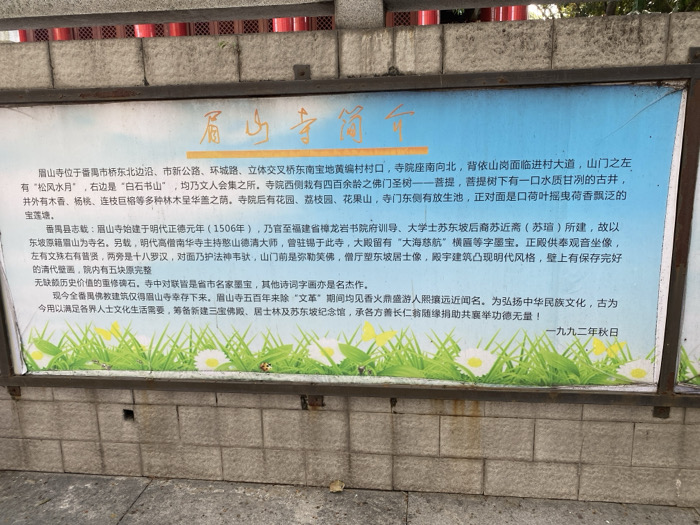
An outdoor image displays a large, rectangular information board with Chinese text, likely made of a rigid material with a protective cover, attached to a wall. The wall behind the board appears to be made of concrete or stone blocks. At the very bottom of the image, below the board, some small green plants or weeds are visible, suggesting a natural ground level. The lighting indicates it is daytime.

The visible text, titled "眉山寺简介" (Brief Introduction to Meishan Temple), provides a detailed description of Meishan Temple. It states the temple's location in Huangbian Village, Panyu City Bridge, by the Xin Highway and Ring Road. The text highlights natural features like a 400-year-old Bodhi tree, various fruit trees, a garden, and a lotus pond. Historically, it was founded in 1506 by Su Jinzhai, a descendant of Su Dongpo, and housed significant artifacts like a "大海慈航" plaque and Ming Dynasty-style architecture with Qing Dynasty murals. The text notes the temple's cultural importance as the only remaining Buddhist architecture in Panyu, having survived the "Cultural Revolution," and outlines plans for new constructions like a Three Treasures Hall and a Su Dongpo Memorial Hall. The board is dated "一九九二年秋日" (Autumn Day, 1992).
F
FM-CaIMM2

Jan 6, 2025, 7:07 AM

Guang Zhou Shi, China

Stake attention in this memory

An outdoor image displays a large, rectangular information board with Chinese text, likely made of a rigid material with a protective cover, attached to a wall. The wall behind the board appears to be made of concrete or stone blocks. At the very bottom of the image, below the board, some small green plants or weeds are visible, suggesting a natural ground level. The lighting indicates it is daytime. The visible text, titled "眉山寺简介" (Brief Introduction to Meishan Temple), provides a detailed description of Meishan Temple. It states the temple's location in Huangbian Village, Panyu City Bridge, by the Xin Highway and Ring Road. The text highlights natural features like a 400-year-old Bodhi tree, various fruit trees, a garden, and a lotus pond. Historically, it was founded in 1506 by Su Jinzhai, a descendant of Su Dongpo, and housed significant artifacts like a "大海慈航" plaque and Ming Dynasty-style architecture with Qing Dynasty murals. The text notes the temple's cultural importance as the only remaining Buddhist architecture in Panyu, having survived the "Cultural Revolution," and outlines plans for new constructions like a Three Treasures Hall and a Su Dongpo Memorial Hall. The board is dated "一九九二年秋日" (Autumn Day, 1992).

Loading AttnAds…

transactions
revenues
stakers
Earliest
Latest
Highest stake

No transactions found

More from this user

More from Guang Zhou Shi

FFM-CaIMM2

Jan 6, 2025, 7:07 AM

Guang Zhou Shi, China

Licensed under Creative Commons Attribution 4.0 International License. You are free to share and adapt this content with proper attribution.