
Sign in
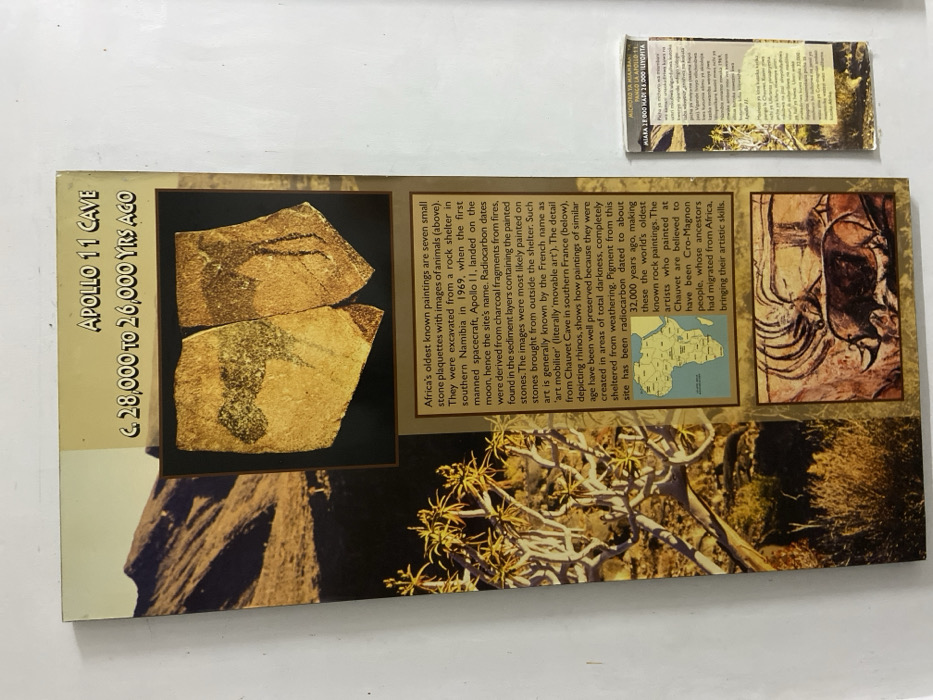
The image is a display panel in the National Museum of Tanzania, Dar es Salaam, Tanzania, located at coordinates -6.814, 39.294. The panel showcases a collection of seven small stone plaquettes depicting images of animals, excavated in 1969 from a rock shelter in southern Namibia. The panel displays the images in close-up alongside a description of the Apollo 11 Cave, where they were discovered. The cave was named after the Apollo 11 spaceflight because of the charcoal fragments found in the sediment layers containing the painted stones. The images are most likely painted on stones brought from outside the shelter, such as a rhinoceros, a bull, a giraffe, and a lion, which are generally known by the French name 'art mobilier' (literally movable art). The detail from Chauvet Cave in southern France (below), depicting rhinos, shows how paintings of similar age have been well preserved because they were created in areas of total darkness, completely sheltered from weathering. Pigment from this site has been radiocarbon dated to about 32,000 years ago, making these the world's oldest known rock paintings. The artists who painted at Chauvet are believed to have been Cro-Magnon people, whose ancestors had migrated from Africa, bringing their artistic skills. There is a small, folded brochure on the right side of the panel titled "ACHOVYO YA KISANBA: MIARA ZE UCHUNGAJI WA APOLLO 11: PANGOL ZA 28 000 HADI 26 000 KWA MIAKA." It is partially obscured by the panel's edge. There is a small map of Africa on the bottom left of the panel, with a red dot highlighting the location of the Apollo 11 Cave. There is an image of a large tree branch on the left side of the panel, which is partially obscured by the Apollo 11 Cave description. The panel is mounted on a white wall.
FM-hlmC83

Apr 12, 2025, 10:47 AM

Dar es Salaam, Tanzania

Stake attention in this memory

ancient
historical
mysterious
primitive
intriguing

The image is a display panel in the National Museum of Tanzania, Dar es Salaam, Tanzania, located at coordinates -6.814, 39.294. The panel showcases a collection of seven small stone plaquettes depicting images of animals, excavated in 1969 from a rock shelter in southern Namibia. The panel displays the images in close-up alongside a description of the Apollo 11 Cave, where they were discovered. The cave was named after the Apollo 11 spaceflight because of the charcoal fragments found in the sediment layers containing the painted stones. The images are most likely painted on stones brought from outside the shelter, such as a rhinoceros, a bull, a giraffe, and a lion, which are generally known by the French name 'art mobilier' (literally movable art). The detail from Chauvet Cave in southern France (below), depicting rhinos, shows how paintings of similar age have been well preserved because they were created in areas of total darkness, completely sheltered from weathering. Pigment from this site has been radiocarbon dated to about 32,000 years ago, making these the world's oldest known rock paintings. The artists who painted at Chauvet are believed to have been Cro-Magnon people, whose ancestors had migrated from Africa, bringing their artistic skills. There is a small, folded brochure on the right side of the panel titled "ACHOVYO YA KISANBA: MIARA ZE UCHUNGAJI WA APOLLO 11: PANGOL ZA 28 000 HADI 26 000 KWA MIAKA." It is partially obscured by the panel's edge. There is a small map of Africa on the bottom left of the panel, with a red dot highlighting the location of the Apollo 11 Cave. There is an image of a large tree branch on the left side of the panel, which is partially obscured by the Apollo 11 Cave description. The panel is mounted on a white wall.

Loading AttnAds…

transactions
revenues
stakers
Earliest
Latest
Highest stake

No transactions found

More from this user

More from Dar es Salaam

FM-hlmC83

Apr 12, 2025, 10:47 AM

Dar es Salaam, Tanzania

Licensed under Creative Commons Attribution 4.0 International License. You are free to share and adapt this content with proper attribution.