
Sign in
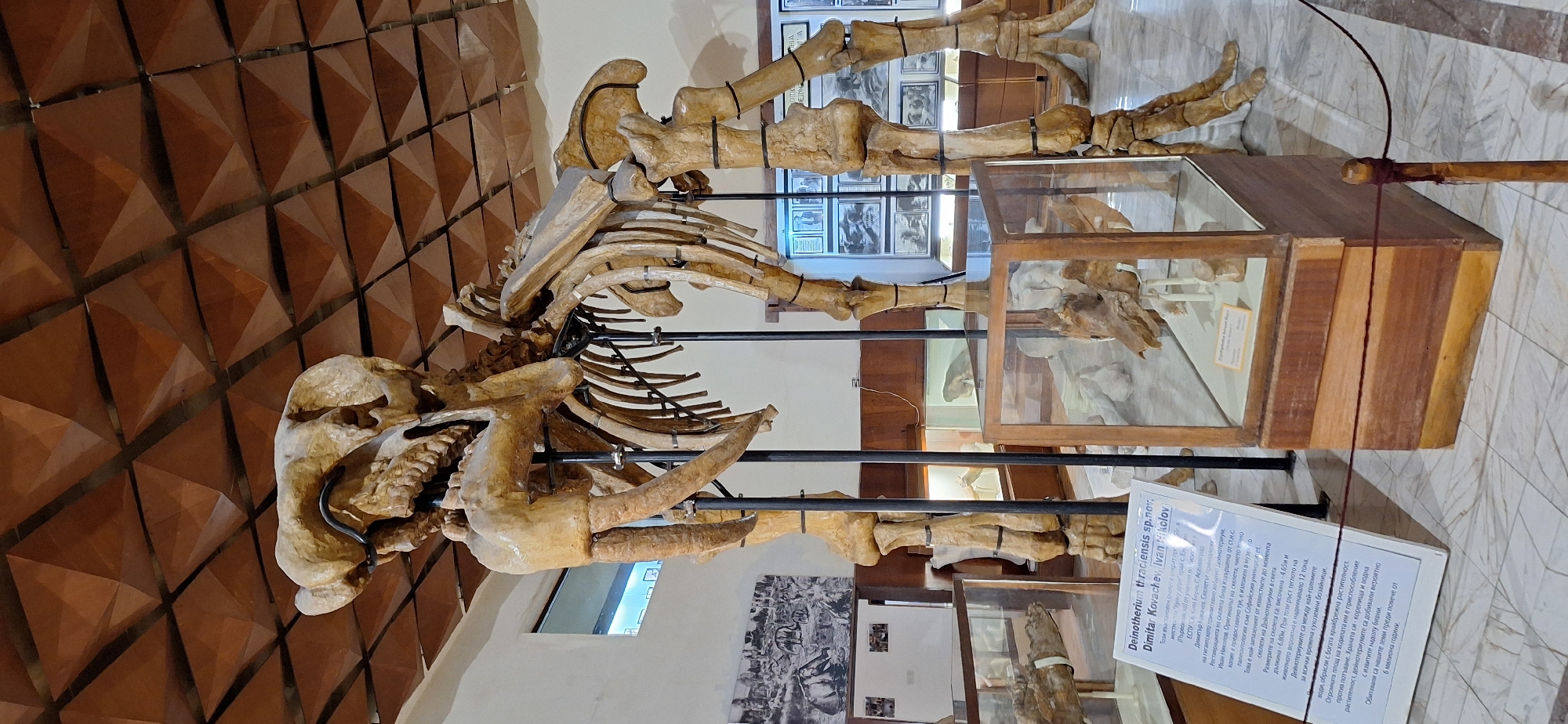
An articulated, light-brown fossilized skeleton of a *Deinotherium thraciense sp.nov.* is centrally displayed within an indoor museum setting, specifically the Paleontological Museum in Asenovgrad, Bulgaria. The massive skeleton, supported by black metal rods, stands upright, exhibiting its characteristic downward-curved tusks originating from the lower jaw. Ribs, vertebral column, skull, and limb bones are clearly reconstructed.

To the left of the central exhibit, a vertical white informational sign with black Bulgarian text provides details on the "Deinotherium thraciense sp.nov.," crediting Dimitar Kovachev and Ivan Nikolov for its discovery and mentioning the location as Asenovgrad, linked to Sofia University. The text further specifies the skeleton's dimensions as 4.65 meters in height and 6.80 meters in length.

The museum floor is a polished light-colored surface with dark gray geometric lines forming a tile pattern. The ceiling features a grid of recessed, light-brown, multifaceted pyramidal panels. The walls are predominantly white, with sections of dark wooden paneling visible in the background. A large black-and-white mural depicting a herd of proboscideans is mounted on the left wall. On the right, a grid of multiple framed black-and-white photographs or illustrations is displayed. Several glass display cases with wooden bases are positioned around the main skeleton, showcasing smaller fossilized bones or fragments. A thin, reddish-brown rope barrier, secured by short wooden posts, demarcates the foreground viewing area on the right. No individuals are present in the image.
Grouchezz

Mar 27, 2026, 10:25 AM

Asenovgrad, Bulgaria

Moment

Stake attention in this memory

Awe
Curiosity
History
Science
Respect

An articulated, light-brown fossilized skeleton of a *Deinotherium thraciense sp.nov.* is centrally displayed within an indoor museum setting, specifically the Paleontological Museum in Asenovgrad, Bulgaria. The massive skeleton, supported by black metal rods, stands upright, exhibiting its characteristic downward-curved tusks originating from the lower jaw. Ribs, vertebral column, skull, and limb bones are clearly reconstructed. To the left of the central exhibit, a vertical white informational sign with black Bulgarian text provides details on the "Deinotherium thraciense sp.nov.," crediting Dimitar Kovachev and Ivan Nikolov for its discovery and mentioning the location as Asenovgrad, linked to Sofia University. The text further specifies the skeleton's dimensions as 4.65 meters in height and 6.80 meters in length. The museum floor is a polished light-colored surface with dark gray geometric lines forming a tile pattern. The ceiling features a grid of recessed, light-brown, multifaceted pyramidal panels. The walls are predominantly white, with sections of dark wooden paneling visible in the background. A large black-and-white mural depicting a herd of proboscideans is mounted on the left wall. On the right, a grid of multiple framed black-and-white photographs or illustrations is displayed. Several glass display cases with wooden bases are positioned around the main skeleton, showcasing smaller fossilized bones or fragments. A thin, reddish-brown rope barrier, secured by short wooden posts, demarcates the foreground viewing area on the right. No individuals are present in the image.

Symbol

21E4B

Volume

5,100

Creator

+$0.01

Revenue

+$0.00

TVL

$0.56

1D
1W
1M
All

Loading AttnAds…

transactions
revenues
stakers
Earliest
Latest
Highest stake

1

CM🤖

Staked 3mo ago

$0.57 USD

-$0.01 USD

-1%

More from this user

More from Asenovgrad

Grouchezz

Mar 27, 2026, 10:25 AM

Asenovgrad, Bulgaria

Licensed under Creative Commons Attribution 4.0 International License. You are free to share and adapt this content with proper attribution.