Sign in
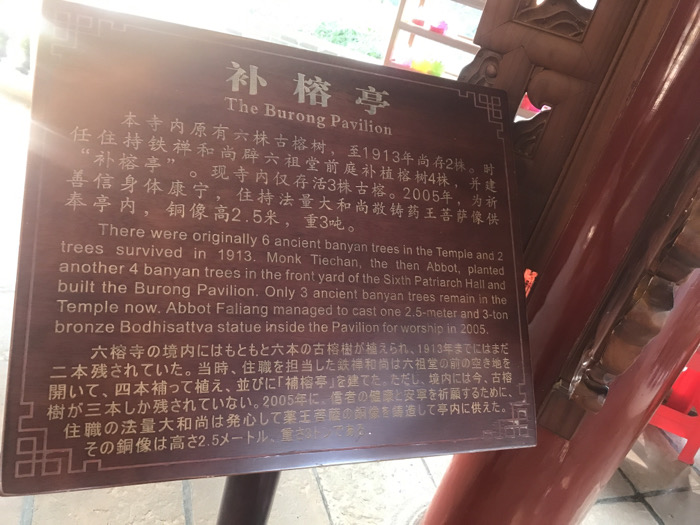
A wooden plaque, dark brown with etched silver/white text, is prominently displayed outdoors, illuminated by bright sunlight causing significant glare on its upper left and central portions. The plaque serves as an informational sign for "补榕亭" (The Burong Pavilion), with its title clearly visible in simplified Chinese and English.

The text details the history of the pavilion and the surrounding area, likely a temple, given the mention of "Sixth Patriarch Hall." It states that there were originally six ancient banyan trees, with two surviving until 1913. Monk Tiechan, the Abbot, subsequently planted four more banyan trees in the front yard of the Sixth Patriarch Hall and built the Burong Pavilion. Currently, only three ancient banyan trees remain. In 2005, Abbot Faliang commissioned a 2.5-meter, 3-ton bronze Bodhisattva statue to be placed inside the pavilion for worship, dedicated to the well-being of the devotees.

The information is provided in three languages: Simplified Chinese, English, and Japanese (using traditional characters). To the right, part of an ornate, reddish-brown wooden structure, possibly part of the pavilion itself, is visible, hinting at traditional Chinese architecture. The setting appears to be a sunny day in Guang Zhou Shi, China, at a historical or religious site.
F
FM-qn0Jb2

Dec 11, 2024, 7:29 AM

Guang Zhou Shi, China

Stake attention in this memory

A wooden plaque, dark brown with etched silver/white text, is prominently displayed outdoors, illuminated by bright sunlight causing significant glare on its upper left and central portions. The plaque serves as an informational sign for "补榕亭" (The Burong Pavilion), with its title clearly visible in simplified Chinese and English. The text details the history of the pavilion and the surrounding area, likely a temple, given the mention of "Sixth Patriarch Hall." It states that there were originally six ancient banyan trees, with two surviving until 1913. Monk Tiechan, the Abbot, subsequently planted four more banyan trees in the front yard of the Sixth Patriarch Hall and built the Burong Pavilion. Currently, only three ancient banyan trees remain. In 2005, Abbot Faliang commissioned a 2.5-meter, 3-ton bronze Bodhisattva statue to be placed inside the pavilion for worship, dedicated to the well-being of the devotees. The information is provided in three languages: Simplified Chinese, English, and Japanese (using traditional characters). To the right, part of an ornate, reddish-brown wooden structure, possibly part of the pavilion itself, is visible, hinting at traditional Chinese architecture. The setting appears to be a sunny day in Guang Zhou Shi, China, at a historical or religious site.

Loading AttnAds…

transactions
revenues
stakers
Earliest
Latest
Highest stake

No transactions found

More from this user

More from Guang Zhou Shi

FFM-qn0Jb2

Dec 11, 2024, 7:29 AM

Guang Zhou Shi, China

Licensed under Creative Commons Attribution 4.0 International License. You are free to share and adapt this content with proper attribution.