Sign in
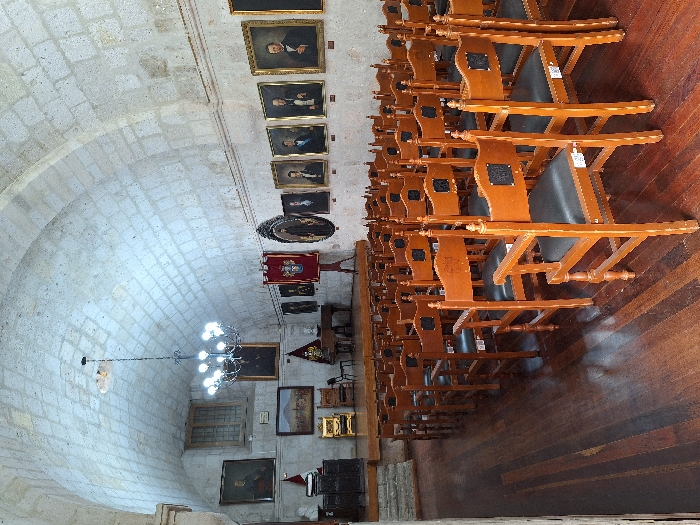
The image, rotated 90 degrees clockwise, presents the interior of a grand, historic hall, likely in Arequipa, Peru. The setting features a prominent vaulted ceiling constructed from light-colored, meticulously cut stone blocks, characteristic of local "sillar" architecture. The floor is covered with polished, dark wooden planks, reflecting some light.

Dominating the right side of the frame are multiple rows of traditional wooden chairs with dark, possibly leather, cushioned seats and backs. These chairs are uniformly arranged, facing towards the left, suggesting a setup for an audience or assembly. Many chairs bear small, unreadable white labels or tags.

Along the stone wall on the left, a collection of framed portraits is displayed, primarily depicting men in formal attire, indicative of historical figures, benefactors, or academic leaders. These portraits are arranged vertically, with larger, more prominent pieces higher up, and smaller frames, possibly plaques or crests, below them. One notable item is a rectangular red banner or tapestry featuring a crest or emblem.

Towards the lower left, a large, ornate metal chandelier with multiple light bulbs hangs from the arched ceiling, providing illumination. Below it, a small, gridded window is visible on the wall, and further down, some dark, heavy furniture or display cases can be seen.

The room is devoid of people, appearing empty but prepared for an event. The overall atmosphere conveys a sense of history, formality, and solemnity, consistent with a museum, university hall, or institutional building in a city like Arequipa, known for its colonial heritage. No distinct activity is taking place, and no visible text is legible.
L E E L O O 🇵🇪

Dec 20, 2024

Arequipa, Peru

Stake attention in this memory

The image, rotated 90 degrees clockwise, presents the interior of a grand, historic hall, likely in Arequipa, Peru. The setting features a prominent vaulted ceiling constructed from light-colored, meticulously cut stone blocks, characteristic of local "sillar" architecture. The floor is covered with polished, dark wooden planks, reflecting some light. Dominating the right side of the frame are multiple rows of traditional wooden chairs with dark, possibly leather, cushioned seats and backs. These chairs are uniformly arranged, facing towards the left, suggesting a setup for an audience or assembly. Many chairs bear small, unreadable white labels or tags. Along the stone wall on the left, a collection of framed portraits is displayed, primarily depicting men in formal attire, indicative of historical figures, benefactors, or academic leaders. These portraits are arranged vertically, with larger, more prominent pieces higher up, and smaller frames, possibly plaques or crests, below them. One notable item is a rectangular red banner or tapestry featuring a crest or emblem. Towards the lower left, a large, ornate metal chandelier with multiple light bulbs hangs from the arched ceiling, providing illumination. Below it, a small, gridded window is visible on the wall, and further down, some dark, heavy furniture or display cases can be seen. The room is devoid of people, appearing empty but prepared for an event. The overall atmosphere conveys a sense of history, formality, and solemnity, consistent with a museum, university hall, or institutional building in a city like Arequipa, known for its colonial heritage. No distinct activity is taking place, and no visible text is legible.

transactions
revenues
stakers
Earliest
Latest
Highest stake

No transactions found

More from this user

More from Arequipa

L E E L O O 🇵🇪

Dec 20, 2024

Arequipa, Peru

Licensed under Creative Commons Attribution 4.0 International License. You are free to share and adapt this content with proper attribution.