Sign in
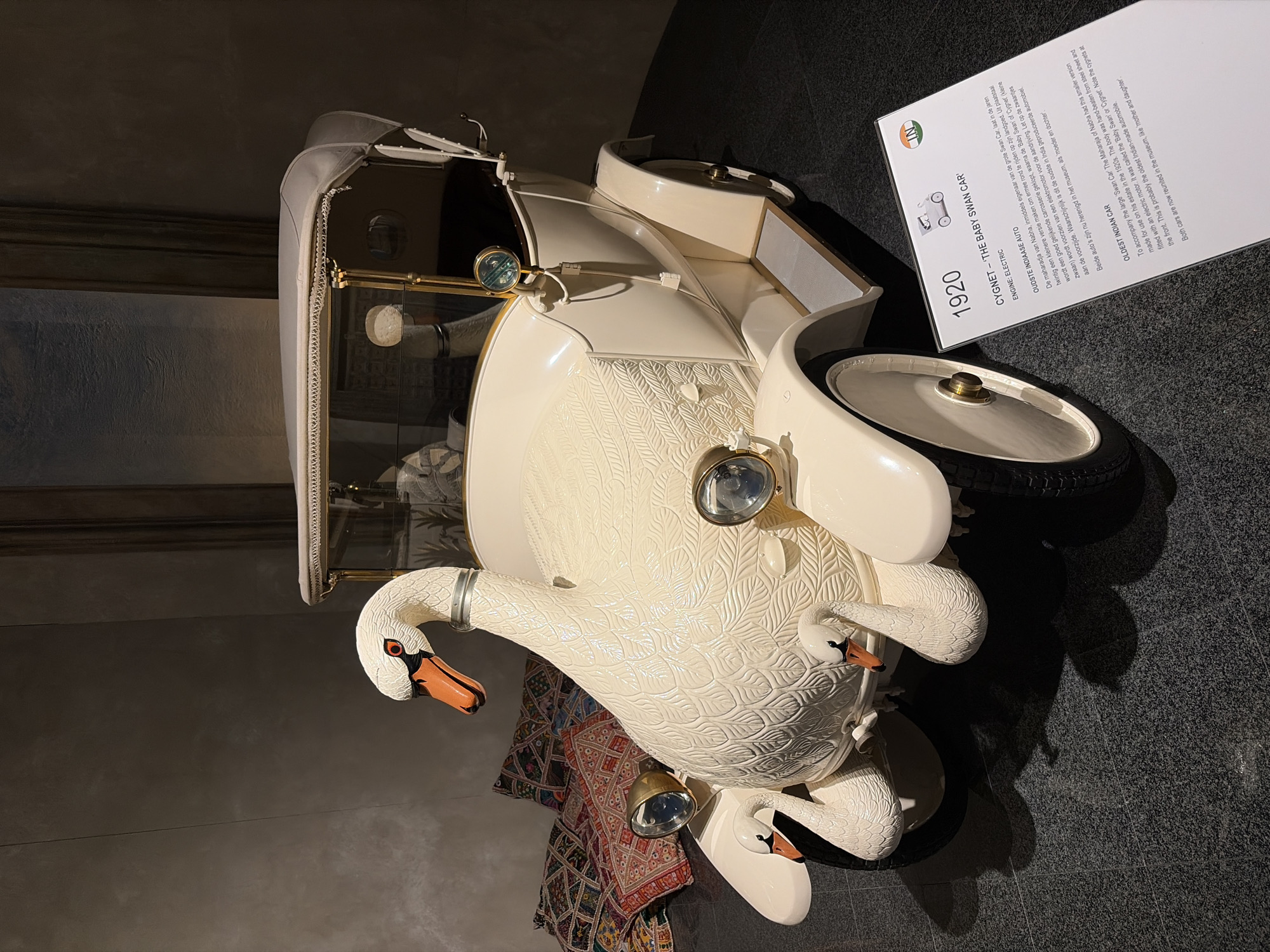
An antique, cream-colored electric car, named "CYGNET - 'THE BABY SWAN CAR'," is showcased in an indoor museum or exhibition setting. The vehicle, dated 1920, is distinctively designed to resemble a swan, featuring a large swan head with an orange beak at the front, and two smaller cygnets positioned lower down. The car's body is sculpted with intricate feather-like patterns, and it has brass accents and headlights. It appears to have a convertible-style roof or canopy.

The car is displayed on a dark grey, possibly granite, floor, with the background consisting of dark walls, suggesting a subdued exhibition environment. No people are visible in the image.

Adjacent to the car's right side, a white display sign provides detailed information. The text on the sign, in both Dutch and English, identifies the car as the "OLDEST INDIAN CAR." It states that this smaller version was commissioned by the Maharaja of Nabha in the 1920s for use on his estate, complementing a larger "Swan Car." The sign highlights its electric engine and the presence of the small cygnets at the front, noting its significance as likely the oldest Indian-made automobile. It also mentions that both the "mother and daughter" cars are now reunited in the museum.
Eugene

Jun 3, 2026

The Hague, Netherlands

Moment

Stake attention in this memory

whimsical
nostalgic
enchanting
curious
elegant

An antique, cream-colored electric car, named "CYGNET - 'THE BABY SWAN CAR'," is showcased in an indoor museum or exhibition setting. The vehicle, dated 1920, is distinctively designed to resemble a swan, featuring a large swan head with an orange beak at the front, and two smaller cygnets positioned lower down. The car's body is sculpted with intricate feather-like patterns, and it has brass accents and headlights. It appears to have a convertible-style roof or canopy. The car is displayed on a dark grey, possibly granite, floor, with the background consisting of dark walls, suggesting a subdued exhibition environment. No people are visible in the image. Adjacent to the car's right side, a white display sign provides detailed information. The text on the sign, in both Dutch and English, identifies the car as the "OLDEST INDIAN CAR." It states that this smaller version was commissioned by the Maharaja of Nabha in the 1920s for use on his estate, complementing a larger "Swan Car." The sign highlights its electric engine and the presence of the small cygnets at the front, noting its significance as likely the oldest Indian-made automobile. It also mentions that both the "mother and daughter" cars are now reunited in the museum.

Symbol

24AA9

Volume

0

Creator

+$0.40

Revenue

+$0.00

TVL

$0.00

1D
1W
1M
All
transactions
revenues
stakers
Earliest
Latest
Highest stake

1

Chelsea💕✌️

Staked 25d ago
Redeemed 23d ago

$12.83 USD

+$0.12 USD

Fee: $0.07 (0.5%)

+1.0%

2

cat_pitt

Staked 25d ago
Redeemed 21d ago

$5.70 USD

+$0.03 USD

Fee: $0.01 (0.25%)

+0.5%

3

Rev Bot 🤖💰

Injected revenue 25d ago

Revenue bonus for the last stake.

+$0.32 USD

4

Rev Bot 🤖💰

Injected revenue 25d ago

Revenue bonus for the last stake.

+$0.12 USD

5

cat_pitt

Staked 22d ago
Redeemed 14d ago

$14.09 USD

+$0.11 USD

Fee: $0.04 (0.25%)

+0.8%

6

Rev Bot 🤖💰

Injected revenue 22d ago

Revenue bonus for the last stake.

+$0.34 USD

More from this user

More from The Hague

Eugene

Jun 3, 2026

The Hague, Netherlands

Licensed under Creative Commons Attribution 4.0 International License. You are free to share and adapt this content with proper attribution.