
Stake attention in this memory
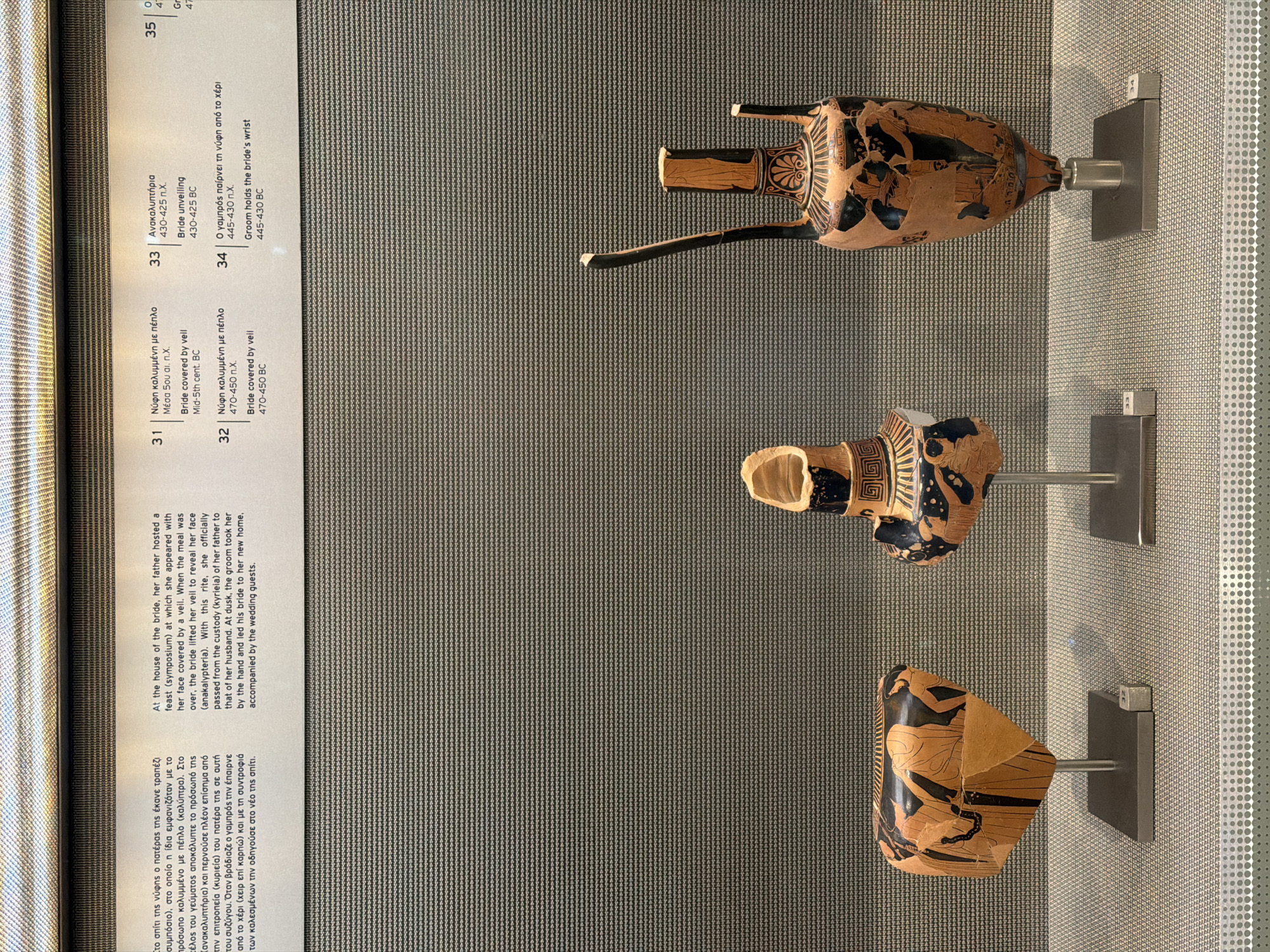
Three ancient Greek pottery pieces, likely fragments or restored vessels, are displayed within a museum case with a patterned grey background. These artifacts are part of an exhibit detailing ancient Greek wedding rituals. The top pottery piece, labeled 33 and 34, depicts "Bride unveiling" (Anakalypteria, 430-425 BC) and "Groom holds the bride's wrist" (445-430 BC). It shows figures in a dark, possibly black-figure or red-figure style, against the reddish-orange clay. One handle is clearly visible, and the vessel appears to be an amphora or a similar storage jar. Below it, a smaller, more fragmented piece, possibly a loutrophoros or a lekythos, is labeled 32, illustrating a "Bride covered by veil" (470-450 BC). This piece also features dark figures on an orange ground, depicting draped figures. The bottommost fragment, labeled 31, also portrays a "Bride covered by veil" (Mid-5th cent. BC). This piece is more distinctly a fragment of a larger vessel, showing a partially preserved figure. Accompanying text, in both Greek and English, explains the wedding ceremony: "At the house of the bride, her father hosted a feast (symposium) at which she appeared with her face covered by a veil. When the meal was over, the bride lifted her veil to reveal her face (anakalypteria). With this rite, she officially passed from the custody (kyrieia) of her father to that of her husband. At dusk, the groom took her by the hand and led his bride to her new home, accompanied by the wedding guests." The text details the sequence of events, including the bride's veiled appearance, the ritual unveiling, and the groom leading her to their new home, highlighting the transfer of custody from father to husband. The artifacts date from the mid-5th century BC to 425 BC.
Loading AttnAds…
No transactions found