
Stake attention in this memory
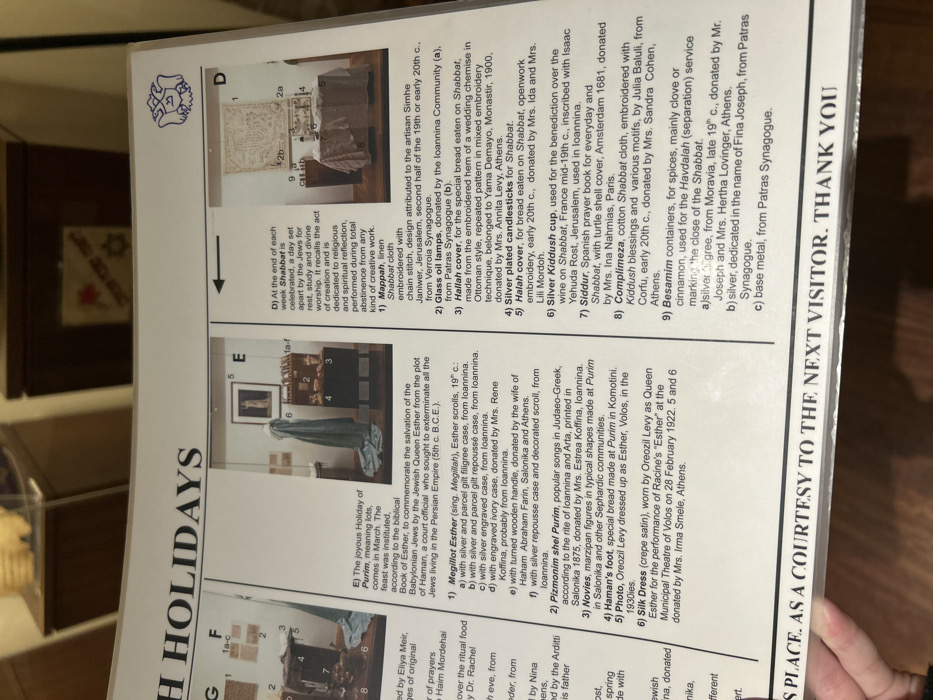
The image displays a vertically oriented information panel, likely from a museum exhibit in Athina, Greece, detailing aspects of Jewish religious life. The panel is divided into sections, with visible headings "D" and "E," focusing on "Shabbat" and "Purim Holidays" respectively. Under the "Shabbat" section (D), the text describes items used during the weekly day of rest. These include a "Mappah" (linen Shabbat cloth) with chain stitch embroidery, "Glass oil lamps," "Hallah cover" (for special bread), "Silver plated candlesticks," a "Silver Kiddush cup" for benediction, a "Siddur" (Spanish prayer book), a "Complimeza" (cotton Shabbat cloth), and "Besamim containers" (for spices) used for the Havdalah service. Small images corresponding to these items are referenced (e.g., 2a, 2b). The items' origins are varied, including Ioannina, Jerusalem, Monastir, and Patras, dating from the mid-19th to early 20th century. The "Purim Holidays" section (E) outlines artifacts and traditions related to the joyous festival of Purim. Described items include various "Megillot Esther" (Esther scrolls) housed in silver, ivory, or wooden cases, "Pizmonim shel Purim" (popular songs), "Novies" (marzipan figures), and "Haman's foot" (special bread). The section also features a "Photo" of Oreozil Levy dressed as Queen Esther in the 1930s, and the "Silk Dress" she wore for a theatrical performance. These items originate from places like Ioannina, Salonika, Komotini, and Volos. The text provides historical context, such as Purim commemorating the salvation of Babylonian Jews in the 5th century B.C.E., and details donors for many of the exhibited pieces. The overall scene is that of an informational display, offering factual details about Jewish cultural and religious practices. A footer at the bottom right reads: "S PLACE. AS A COURTESY TO THE NEXT VISITOR. THANK YOU."
No transactions found