
Stake attention in this memory
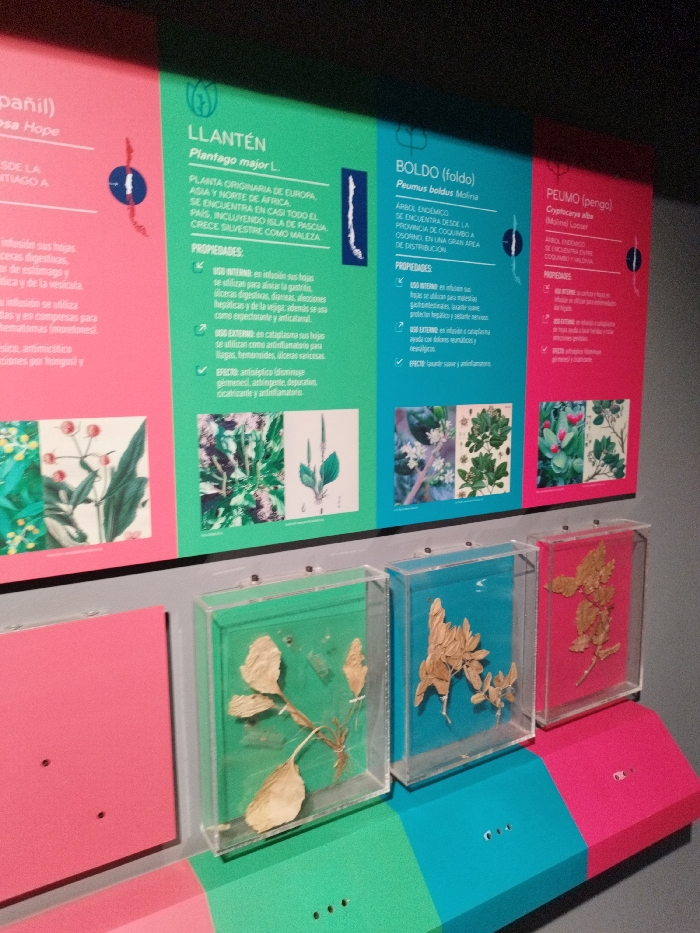
This image captures an educational museum exhibit in Santiago, Chile, showcasing various medicinal plants native to or commonly found in the region. The display is organized into colored panels, each dedicated to a specific plant, with corresponding preserved specimens in clear acrylic boxes below. The green panel highlights "LLANTÉN" (Plantago major L. - Plantain), described as originating from Europe, Asia, and North Africa, and widely found across Chile, including Easter Island, growing as a wild weed. Its properties are detailed for internal use (gastritis, digestive issues, liver/bladder ailments, expectorant, anticatarrhal) and external use (anti-inflammatory for wounds, hemorrhoids, varicose ulcers), noting antiseptic, astringent, depurative, healing, and anti-inflammatory effects. A dried Plantain specimen is displayed in a box on a green base. The blue panel features "BOLDO (foldo)" (Peumus boldus Molina - Boldo), an endemic tree found from Coquimbo to Osorno. Its leaves are used internally for gastrointestinal discomfort, as a mild laxative, and for hepatic protection. Externally, it's used for rheumatic pain, and it's noted for its mild laxative and anti-inflammatory properties. A dried Boldo specimen is in a box on a blue base. The rightmost pink panel presents "PEUMO (perigo)" (Cryptocarya alba (Molina) Looser - Chilean Laurel), another endemic tree found between Coquimbo and Valdivia. Its properties, partially visible, mention internal use for diarrhea and dysentery, referring to its bark. A dried Peumo specimen is displayed in a box on a pink base. The exhibit effectively combines textual information, illustrative images, and physical plant samples, making it an informative display on traditional medicine and local flora. The lighting suggests an indoor setting, likely a museum or botanical garden information center. No people are visible in the frame.
No transactions found