
Stake attention in this memory
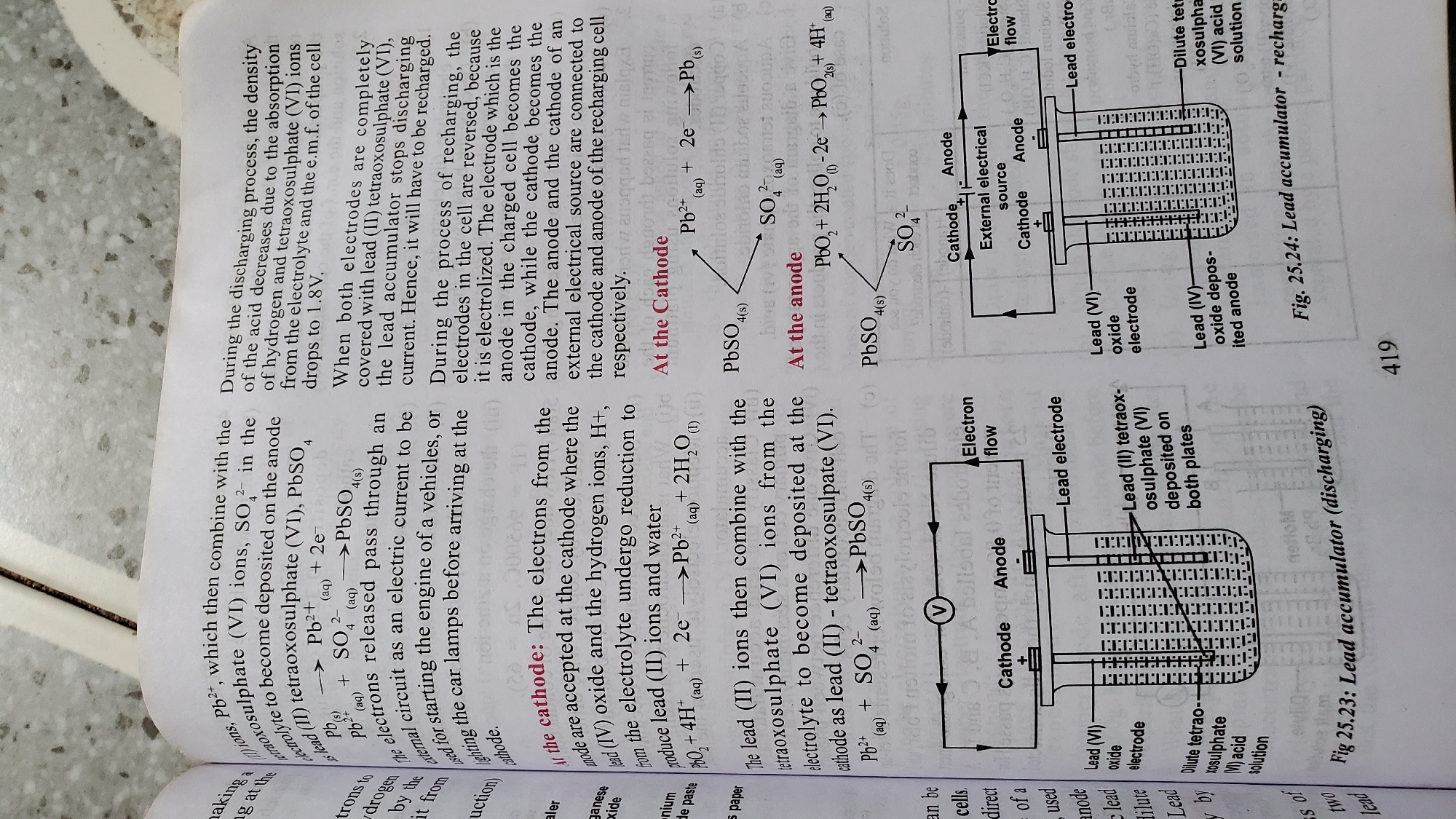
The image is a scanned page from a textbook illustrating the chemical processes of a lead-acid accumulator, both during discharging and recharging. The subjects are diagrams of the accumulator's components and chemical reaction equations. The left side of the page shows a diagram of a lead-acid accumulator in a discharging state (Fig. 25.23). It depicts lead electrodes, labeled as "Lead (VI) oxide electrode" (cathode) and "Lead (IV) oxide deposited anode" (anode), immersed in a "Dilute tetraoxosulphate (VI) acid solution." The diagram illustrates the flow of electrons from the anode to the cathode through an external circuit, indicated by a voltmeter symbol and an arrow labeled "Electron flow." Text accompanying the diagram explains the chemical reactions that occur during discharging, where lead (II) tetraoxosulphate (VI) is deposited on both plates. The right side of the page shows a similar diagram for recharging (Fig. 25.24). In this scenario, an "External electrical source" is connected to the accumulator, reversing the electron flow. The text explains that during recharging, the electrodes effectively switch roles: the anode becomes the cathode and vice versa. Chemical equations for the recharging process are also provided. Notable details include the chemical formulas and names of the substances involved (e.g., Pb, PbO2, H2SO4, PbSO4) and the respective states (s for solid, aq for aqueous). The diagrams are simplified representations to explain the fundamental principles. The page also contains a page number "419" and captions for the figures. There is no indication of time of day, weather, specific location cues within Jalingo, or any emotions as the content is purely technical and illustrative.
Loading AttnAds…
No transactions found