Sign in
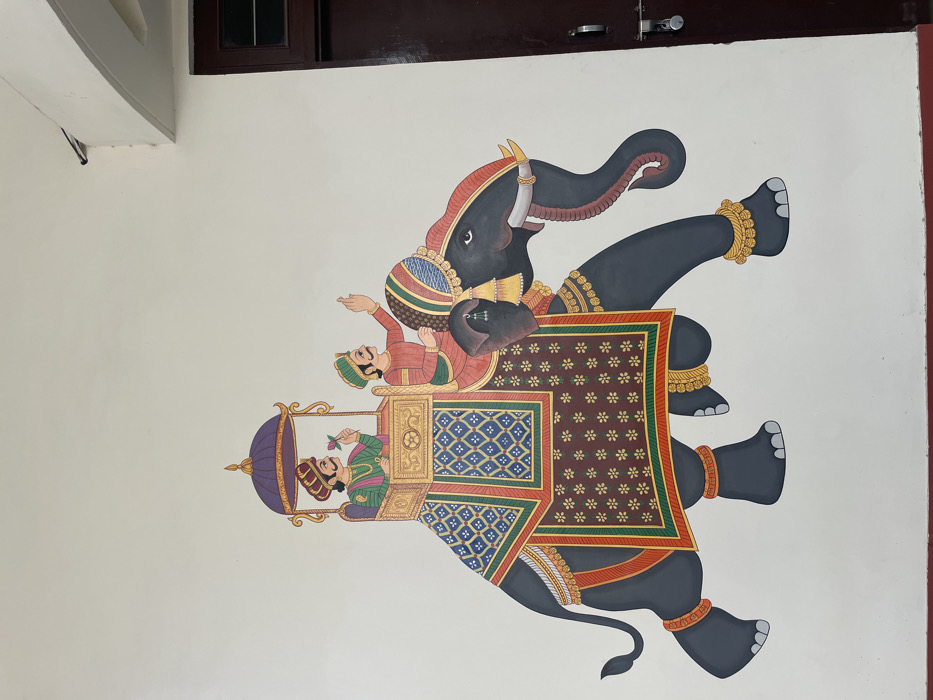
This media file features a vibrant, traditional Indian-style painting or mural applied directly onto a plain, light-colored wall. The artwork depicts an elaborately adorned elephant carrying two riders, suggesting a royal or ceremonial procession.

The central subject is a large, dark grey elephant, richly decorated with gold and red patterns on its head, ears, and legs, including ornate anklets. It wears a magnificent caparison (blanket) over its back, which is dark brown with intricate gold floral motifs and bordered with red, green, and gold strips. The elephant's trunk is gracefully raised, and its tusks are visible.

Two male figures are seated on the elephant. The first, presumably the mahout, is positioned on the elephant's neck, wearing a red tunic and a striped turban. His right arm is slightly raised, possibly in a gesture of command or greeting. The second figure, likely a royal or noble, sits within a grand, intricately designed howdah (seat) on the elephant's back. This rider is dressed in a green tunic, a red turban, and holds a delicate red flower. The howdah itself is a masterpiece of design, featuring golden accents, blue panels with geometric patterns, red borders, and a purple domed canopy supported by golden pillars.

The painting exhibits the distinct characteristics of traditional Indian miniature art, particularly reminiscent of Rajasthani paintings, known for their fine details, vibrant color palette, and depictions of courtly life. The colors are rich and bold, including golds, reds, greens, blues, purple, and dark grey, set against the light background of the wall. There is no visible text within the artwork. The style strongly aligns with the provided context of Jaipur, India. Architectural elements like a window frame are visible in the surrounding wall, indicating the painting is an indoor or sheltered mural.
F
FM-FvqkU2

Jan 2, 2025

Jaipur, India

Stake attention in this memory

This media file features a vibrant, traditional Indian-style painting or mural applied directly onto a plain, light-colored wall. The artwork depicts an elaborately adorned elephant carrying two riders, suggesting a royal or ceremonial procession. The central subject is a large, dark grey elephant, richly decorated with gold and red patterns on its head, ears, and legs, including ornate anklets. It wears a magnificent caparison (blanket) over its back, which is dark brown with intricate gold floral motifs and bordered with red, green, and gold strips. The elephant's trunk is gracefully raised, and its tusks are visible. Two male figures are seated on the elephant. The first, presumably the mahout, is positioned on the elephant's neck, wearing a red tunic and a striped turban. His right arm is slightly raised, possibly in a gesture of command or greeting. The second figure, likely a royal or noble, sits within a grand, intricately designed howdah (seat) on the elephant's back. This rider is dressed in a green tunic, a red turban, and holds a delicate red flower. The howdah itself is a masterpiece of design, featuring golden accents, blue panels with geometric patterns, red borders, and a purple domed canopy supported by golden pillars. The painting exhibits the distinct characteristics of traditional Indian miniature art, particularly reminiscent of Rajasthani paintings, known for their fine details, vibrant color palette, and depictions of courtly life. The colors are rich and bold, including golds, reds, greens, blues, purple, and dark grey, set against the light background of the wall. There is no visible text within the artwork. The style strongly aligns with the provided context of Jaipur, India. Architectural elements like a window frame are visible in the surrounding wall, indicating the painting is an indoor or sheltered mural.

transactions
revenues
stakers
Earliest
Latest
Highest stake

No transactions found

More from this user

More from Jaipur

FFM-FvqkU2

Jan 2, 2025

Jaipur, India

Licensed under Creative Commons Attribution 4.0 International License. You are free to share and adapt this content with proper attribution.