Sign in
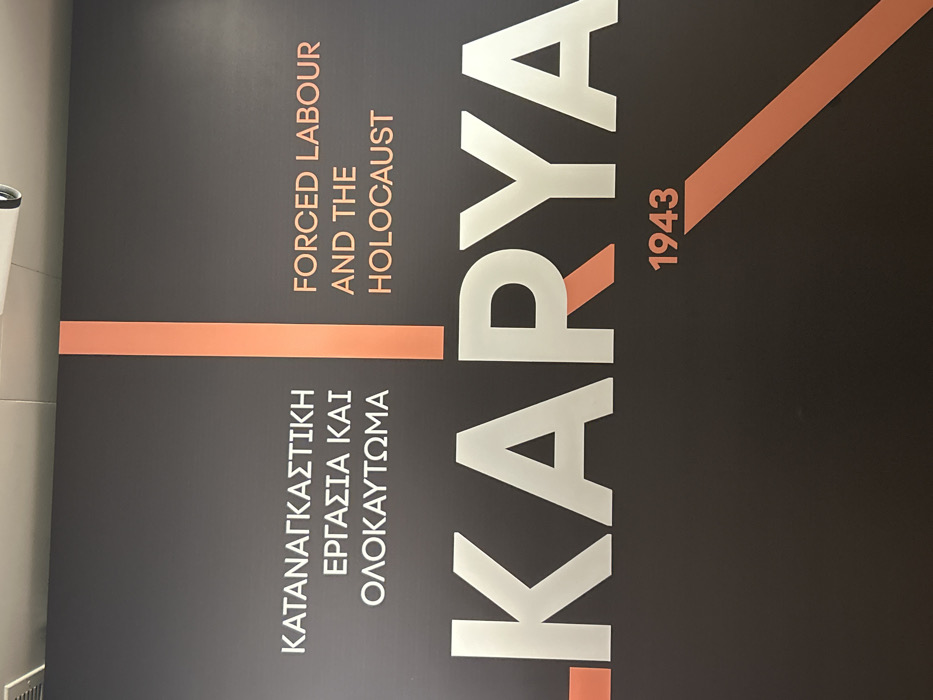
The image displays a dark gray or black vertical sign or wall panel, likely part of an exhibition or memorial. The text on the sign is oriented vertically, appearing rotated 90 degrees clockwise in the photograph.

The primary subjects are historical themes conveyed through text. No people or specific objects other than the sign itself are visible. The setting appears to be indoors, possibly within a museum, educational institution, or a public display area.

The sign features text in both English and Greek, suggesting a bilingual presentation. In white capital letters, a large word "KARYA" is prominently displayed, partially outlined or shadowed in an orange/peach color, and with some internal sections in the same orange/peach hue. Below and to the right of "KARYA," the year "1943" is inscribed diagonally in the same orange/peach color.

To the left of the large "KARYA" text, two vertical columns of smaller text are presented. The right column, in orange/peach capital letters, reads "FORCED LABOUR AND THE HOLOCAUST." Parallel to this, on the left, is the Greek translation in white capital letters: "ΚΑΤΑΝΑΓΚΑΣΤΙΚΗ ΕΡΓΑΣΙΑ ΚΑΙ ΟΛΟΚΑΥΤΩΜΑ," which translates to "FORCED LABOR AND HOLOCAUST."

A thick, vertical orange/peach stripe runs down the left side of the sign, aligning with the Greek text. Another thinner, diagonal orange/peach line extends from the top right corner downwards, passing near the "1943" date. The contrasting dark background, light text, and vivid orange/peach lines create a striking and somber aesthetic, appropriate for the serious historical topic discussed. The content suggests an event related to forced labor and the Holocaust around the year 1943, potentially specifically linked to a location or group named "Karya" in Greece.
FM-zLJPr2

Jan 12, 2025

Athina, Greece

Stake attention in this memory

The image displays a dark gray or black vertical sign or wall panel, likely part of an exhibition or memorial. The text on the sign is oriented vertically, appearing rotated 90 degrees clockwise in the photograph. The primary subjects are historical themes conveyed through text. No people or specific objects other than the sign itself are visible. The setting appears to be indoors, possibly within a museum, educational institution, or a public display area. The sign features text in both English and Greek, suggesting a bilingual presentation. In white capital letters, a large word "KARYA" is prominently displayed, partially outlined or shadowed in an orange/peach color, and with some internal sections in the same orange/peach hue. Below and to the right of "KARYA," the year "1943" is inscribed diagonally in the same orange/peach color. To the left of the large "KARYA" text, two vertical columns of smaller text are presented. The right column, in orange/peach capital letters, reads "FORCED LABOUR AND THE HOLOCAUST." Parallel to this, on the left, is the Greek translation in white capital letters: "ΚΑΤΑΝΑΓΚΑΣΤΙΚΗ ΕΡΓΑΣΙΑ ΚΑΙ ΟΛΟΚΑΥΤΩΜΑ," which translates to "FORCED LABOR AND HOLOCAUST." A thick, vertical orange/peach stripe runs down the left side of the sign, aligning with the Greek text. Another thinner, diagonal orange/peach line extends from the top right corner downwards, passing near the "1943" date. The contrasting dark background, light text, and vivid orange/peach lines create a striking and somber aesthetic, appropriate for the serious historical topic discussed. The content suggests an event related to forced labor and the Holocaust around the year 1943, potentially specifically linked to a location or group named "Karya" in Greece.

transactions
revenues
stakers
Earliest
Latest
Highest stake

No transactions found

More from this user

More from Athina

FM-zLJPr2

Jan 12, 2025

Athina, Greece

Licensed under Creative Commons Attribution 4.0 International License. You are free to share and adapt this content with proper attribution.