
Sign in
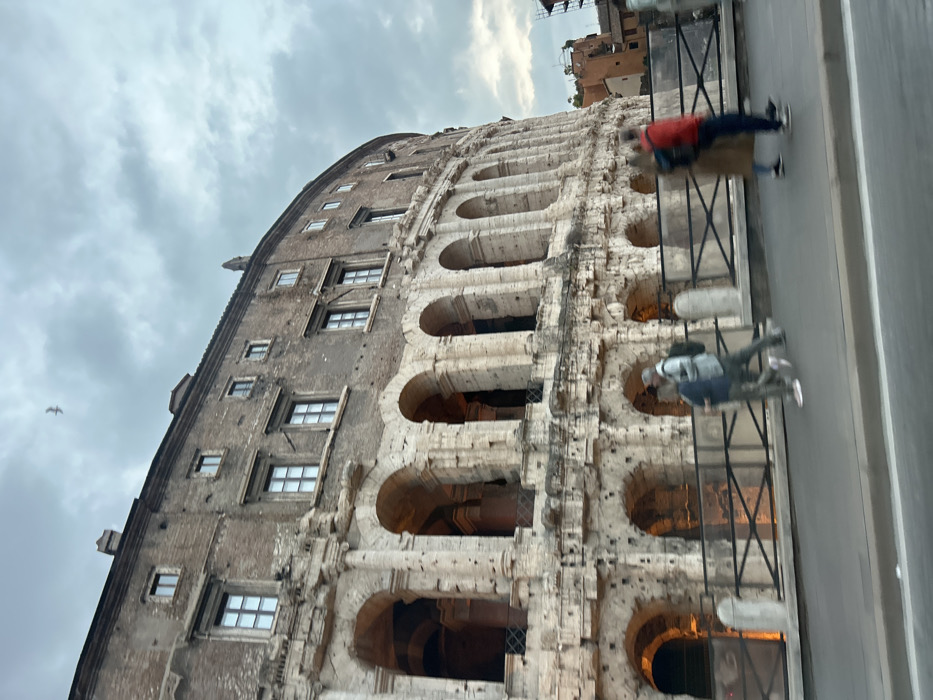
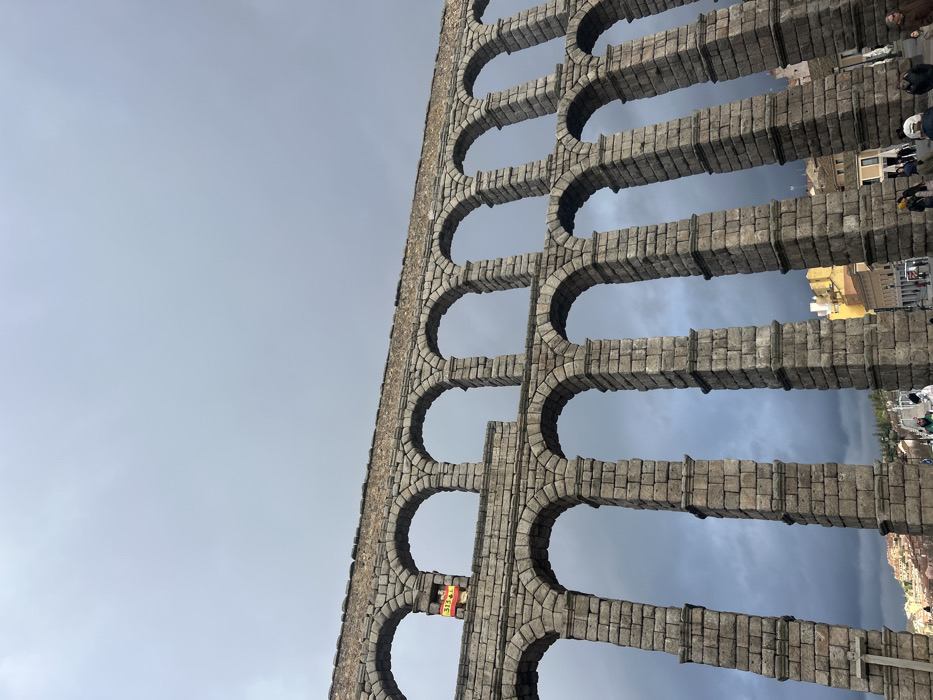
The image captures a monumental section of the Roman Aqueduct of Segovia, Spain, viewed from a low angle, emphasizing its towering structure against an overcast sky. The aqueduct, constructed from large, precisely cut granite blocks without mortar, features multiple tiers of arches. The perspective is tilted, showing the aqueduct diagonally across the frame, extending from the bottom left towards the top right.

The subjects include the ancient stone aqueduct itself, people in the distant background, and buildings visible through the arches. The scene depicts a significant historical landmark in a city setting.

Activity visible includes people walking and gathering on what appears to be a street or plaza beneath and alongside the aqueduct on the right side of the frame. They are mostly blurred or small figures, suggesting a public space for sightseeing or daily life.

Notable details include the time of day, which appears to be daytime, under an overcast sky with patches of darker, possibly stormy, clouds visible through the aqueduct's openings. The construction showcases remarkable Roman engineering with its double-tiered arches and dry-stone masonry. A small, colorful plaque or sign, yellow and red, is affixed within one of the lower arches on the left side.

Visible text on this small sign reads "3173 A.D." and another line of text below it, starting with "S..." and containing "TVAN" or "IVAN," which is difficult to fully decipher. This plaque serves as a historical marker on the ancient structure. The overall impression is one of historical grandeur and architectural marvel, enduring through time.
FM-rCzL43

Jan 28, 2025, 3:41 PM

Segovia, Spain

Stake attention in this memory

The image captures a monumental section of the Roman Aqueduct of Segovia, Spain, viewed from a low angle, emphasizing its towering structure against an overcast sky. The aqueduct, constructed from large, precisely cut granite blocks without mortar, features multiple tiers of arches. The perspective is tilted, showing the aqueduct diagonally across the frame, extending from the bottom left towards the top right. The subjects include the ancient stone aqueduct itself, people in the distant background, and buildings visible through the arches. The scene depicts a significant historical landmark in a city setting. Activity visible includes people walking and gathering on what appears to be a street or plaza beneath and alongside the aqueduct on the right side of the frame. They are mostly blurred or small figures, suggesting a public space for sightseeing or daily life. Notable details include the time of day, which appears to be daytime, under an overcast sky with patches of darker, possibly stormy, clouds visible through the aqueduct's openings. The construction showcases remarkable Roman engineering with its double-tiered arches and dry-stone masonry. A small, colorful plaque or sign, yellow and red, is affixed within one of the lower arches on the left side. Visible text on this small sign reads "3173 A.D." and another line of text below it, starting with "S..." and containing "TVAN" or "IVAN," which is difficult to fully decipher. This plaque serves as a historical marker on the ancient structure. The overall impression is one of historical grandeur and architectural marvel, enduring through time.

Loading AttnAds…

transactions
revenues
stakers
Earliest
Latest
Highest stake

No transactions found

More from this user

More from Segovia

FM-rCzL43

Jan 28, 2025, 3:41 PM

Segovia, Spain

Licensed under Creative Commons Attribution 4.0 International License. You are free to share and adapt this content with proper attribution.