Sign in
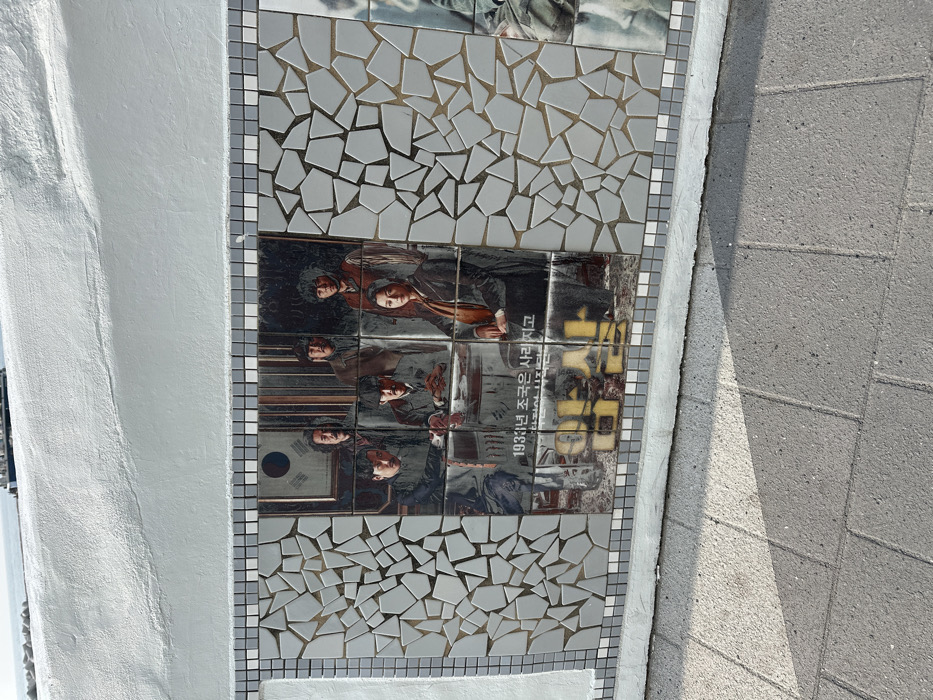
A section of a white, textured concrete wall, characteristic of coastal structures in Busan's Gamcheon Culture Village, South Korea, is depicted under direct daylight. The wall features a horizontal mosaic art installation. This installation consists of a central, rectangular image composed of nine square tiles (3x3 grid) bordered by irregularly broken light gray tiles and a thin, multi-row border of small square dark gray and white tiles.

The central tiled image is a movie poster or scene from the South Korean film "Assassination" (암살). It displays seven individuals in period attire. In the upper half, four figures are arranged: three men from left to right, followed by a woman on the far right. The leftmost man has a mustache; the middle man wears a hat; the rightmost man has long, dark, curly hair; and the woman on the far right has a serious expression. In the lower half, three figures are visible: a man in a dark suit and hat on the left, a man in a hat and glasses seated at a table in the center, and a woman in a dark coat and brown scarf seated on the right, looking directly forward. A framed, monochromatic image of the South Korean flag (Taegeukgi) is visible behind the upper figures. Korean text, "1933년 조국은 사라지고..." (In 1933, the homeland disappeared...), is present on a tile below the top row of figures. Below this, large, bold yellow Korean characters spell "암살" (Assassination).

The foreground shows a paved walkway constructed from large, rectangular light gray concrete pavers. A distinct diagonal shadow from an unseen structure or object bisects the walkway, creating a bright, sunlit area on the left and a darker, shaded area on the right. Above the white wall, a clear, light blue sky is visible, meeting the horizon line of the sea. A rock breakwater (tetrapods) is discernible in the distant water, with a portion of a boat or structure visible beyond it.
dori

Mar 17, 2026

Busan, South Korea

Stake attention in this memory

Historical
Somber
Reflective
Intrigue
Respect

A section of a white, textured concrete wall, characteristic of coastal structures in Busan's Gamcheon Culture Village, South Korea, is depicted under direct daylight. The wall features a horizontal mosaic art installation. This installation consists of a central, rectangular image composed of nine square tiles (3x3 grid) bordered by irregularly broken light gray tiles and a thin, multi-row border of small square dark gray and white tiles. The central tiled image is a movie poster or scene from the South Korean film "Assassination" (암살). It displays seven individuals in period attire. In the upper half, four figures are arranged: three men from left to right, followed by a woman on the far right. The leftmost man has a mustache; the middle man wears a hat; the rightmost man has long, dark, curly hair; and the woman on the far right has a serious expression. In the lower half, three figures are visible: a man in a dark suit and hat on the left, a man in a hat and glasses seated at a table in the center, and a woman in a dark coat and brown scarf seated on the right, looking directly forward. A framed, monochromatic image of the South Korean flag (Taegeukgi) is visible behind the upper figures. Korean text, "1933년 조국은 사라지고..." (In 1933, the homeland disappeared...), is present on a tile below the top row of figures. Below this, large, bold yellow Korean characters spell "암살" (Assassination). The foreground shows a paved walkway constructed from large, rectangular light gray concrete pavers. A distinct diagonal shadow from an unseen structure or object bisects the walkway, creating a bright, sunlit area on the left and a darker, shaded area on the right. Above the white wall, a clear, light blue sky is visible, meeting the horizon line of the sea. A rock breakwater (tetrapods) is discernible in the distant water, with a portion of a boat or structure visible beyond it.

transactions
revenues
stakers
Earliest
Latest
Highest stake

No transactions found

More from this user

More from Busan

dori

Mar 17, 2026

Busan, South Korea

Licensed under Creative Commons Attribution 4.0 International License. You are free to share and adapt this content with proper attribution.