
Stake attention in this memory
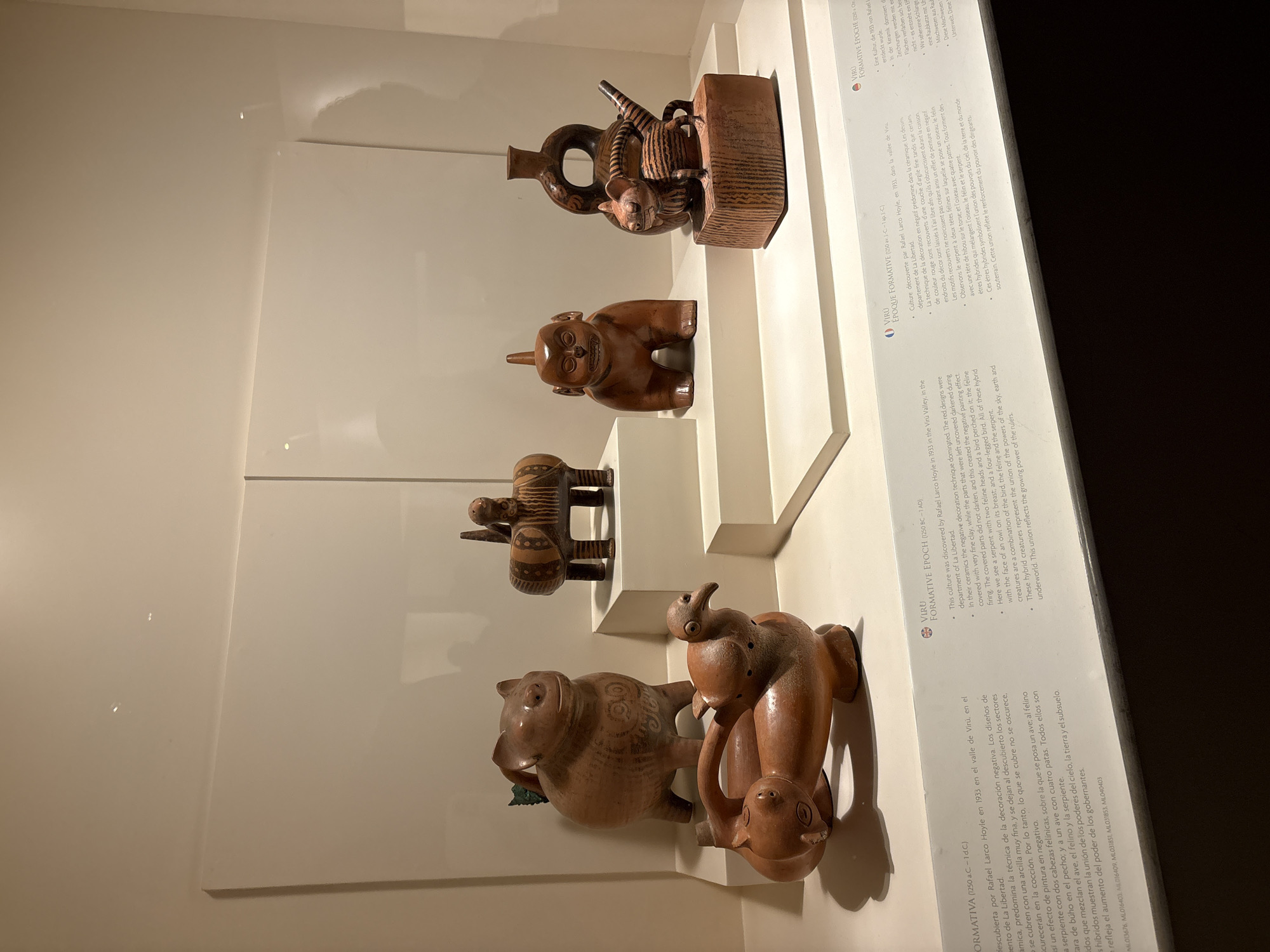
An exhibition display at the Museo Larco in Pueblo Libre, Peru, showcases five ancient ceramic artifacts from the Virú Formative Epoch (1250 BC - 1 AD). The pottery pieces, made from reddish-brown clay, are arranged on white tiered shelves, likely within a glass case, as evidenced by reflections. From left to right, the artifacts include: 1. A complex sculpture of intertwined animal figures, possibly representing a bird and other creatures, featuring rounded forms. 2. A large, stylized animal, possibly a hippopotamus or pig, with faint patterns on its body and a green element near its head. 3. An abstract, four-legged animal figure with distinct striped patterns covering its body. 4. A squat, humanoid-like figure with prominent facial features (eyes, mouth) and small horn-like protrusions on its head. 5. A vessel incorporating an animal figure (resembling a feline or dog) resting on a rectangular base adorned with striped patterns, with another vessel integrated into the design. Informational plaques visible next to the artifacts describe the "VIRÚ FORMATIVE EPOCH (1250 BC - 1 AD)." The text, presented in Spanish, English, French, and German, explains that the culture was discovered by Rafael Larco Hoyle in 1933 in the Virú Valley of La Libertad. It highlights the dominance of the negative decoration technique in their ceramics, where covered red designs remained light while uncovered areas darkened during firing. The plaques also describe some hybrid creatures depicted in Virú art, such as a "serpent with two feline heads and a bird perched on it," and a "feline with the face of an owl on its breast," as seen in the collection. These hybrid figures symbolize the "union of the powers of the sky, earth and underworld," reflecting the growing power of rulers. Museum inventory numbers (e.g., ML013676, ML016403) are also listed.
Loading AttnAds…
No transactions found