
Stake attention in this memory
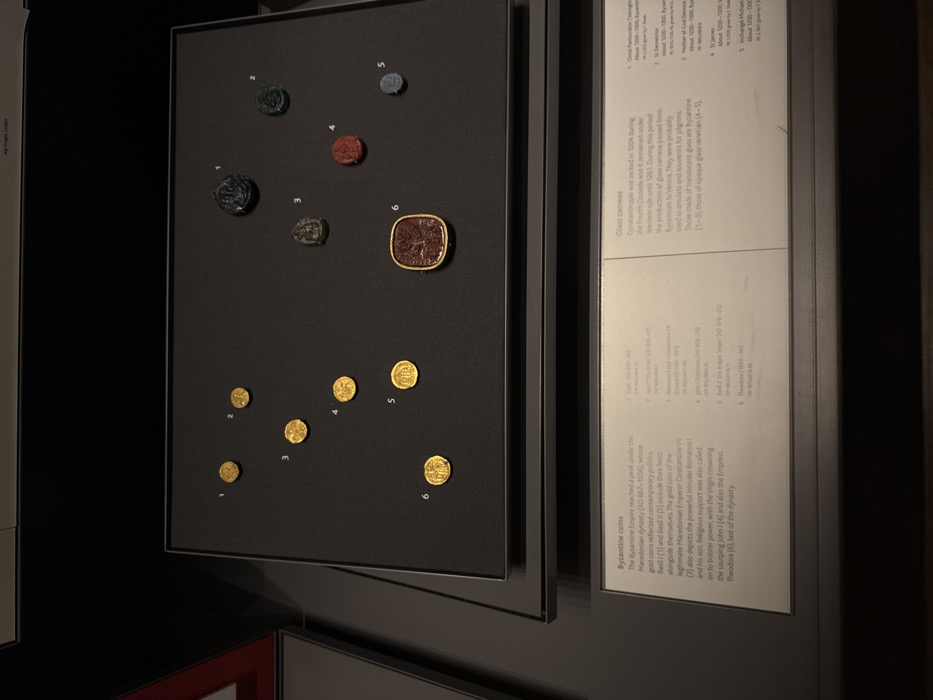
The image captures a museum display case showcasing ancient artifacts, illuminated in a dimly lit environment, likely in London, United Kingdom. The exhibit features two distinct sets of historical items presented on a dark, possibly black, background. In the upper section of the display, six glass cameos are arranged and individually numbered from 1 to 6. These cameos exhibit various colors, including dark blue, green, red, and brown. Notably, cameo number 6 is set within a prominent gold frame. Below the cameos, six gold coins are meticulously displayed, also numbered 1 through 6. These coins are round and uniformly golden, with intricate details visible on their surfaces, suggesting historical engravings or figures. To the right of the display case, two information panels provide contextual details for the artifacts. The left panel, titled "Byzantine coins," explains that the gold coins reflect the politics of the Macedonian dynasty (AD 867-1056) of the Byzantine Empire. It references emperors such as Basil I (coin 1), Leo VI (coin 2), Constantine VII (coin 3), John I Tzimiskes (coin 4), Basil II and Constantine VIII (coin 5), and Empress Theodora (coin 6). The text describes how these coins depicted rulers and religious figures like the Virgin Mary to bolster power. The right panel, titled "Glass cameos," details that these objects originated after the sacking of Constantinople in 1204, with production shifting from Byzantium to Venice. They were likely used as amulets or pilgrim souvenirs. It identifies cameos 1-3 as Byzantine (depicting Christ Pantocrator, St Demetrius, and Mother of God Eleousa) and cameos 4-5 as Venetian (depicting St James and Archangel Michael), dating them to approximately 1200-1300. No people are visible in the shot; the focus is entirely on the artifacts and their descriptive texts.
Loading AttnAds…
No transactions found