
Stake attention in this memory
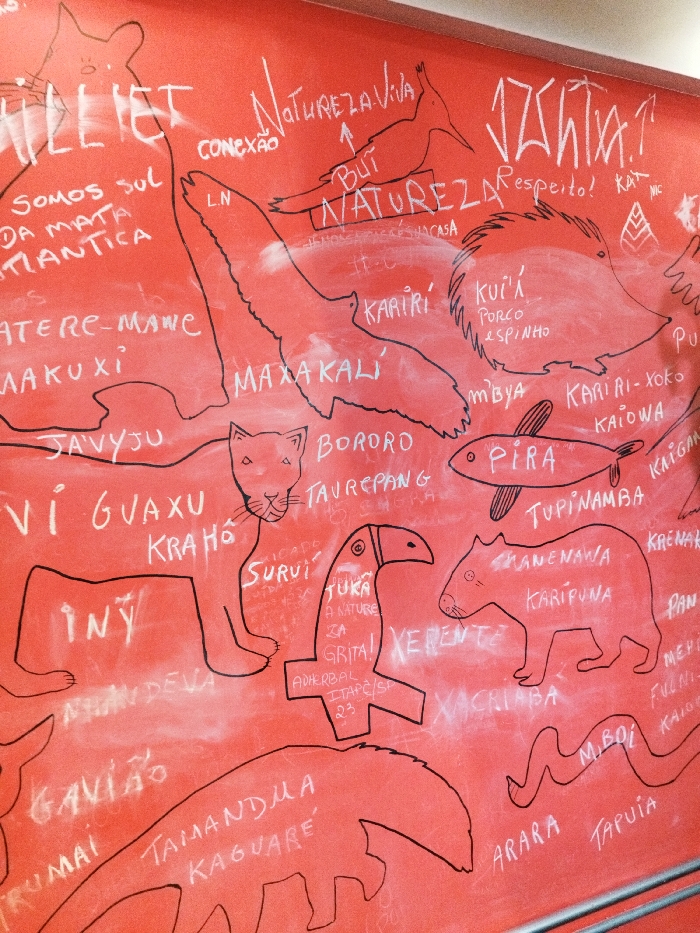
The image displays a red vertical surface, likely a wall or large board, covered with black outline drawings and white chalk text. The content of the graffiti focuses on nature, indigenous Brazilian cultures, and environmental advocacy. **Subjects and Objects:** The surface features approximately a dozen distinct black outline drawings of various South American animals, including a jaguar or puma, an anteater, a capybara, a porcupine, multiple birds (one toucan-like, others resembling birds of prey), a fish, and a snake. These animal depictions are interspersed with extensive white chalk text, predominantly in Portuguese. **Textual Elements:** The text identifies numerous indigenous Brazilian peoples and languages, such as Krahô, Bororo, Suruí, Tupinambá, Karipuna, Xacriaba, M'bya, Kariri, Kaiowa, Arara, and Tapuia. Phrases like "NATUREZA VIVA" (Living Nature), "CONEXÃO" (Connection), "RESPETO!" (Respect!), and "ZA NATUREZA GRITA!" (For Nature Cries Out!) are prominently displayed, indicating themes of environmental protection and indigenous rights. Several animal names are also written in Portuguese or indigenous languages next to their corresponding drawings (e.g., "KU'IA PORCO ESPINHO" for the porcupine, "PIRA" for the fish). **Environment and Location:** The red surface exhibits faint white residue, suggesting previous erasures. A narrow brown border runs along the top edge, and a horizontal metallic bar or rail is visible at the bottom right. A crucial textual detail, "ADHERBAL ITAPE/SP," identifies the location. "Itape/SP" refers to Itapevi, a municipality within the Greater São Paulo Metropolitan Area, in the state of São Paulo, Brazil. "ADHERBAL" likely refers to E.E. Adherbal de Castro, a state school located in Itapevi. **People, Actions, Interactions:** No people are visible in the image. The actions of creating the graffiti are implied. The scene depicts a static visual communication medium.
Loading AttnAds…
No transactions found