Sign in
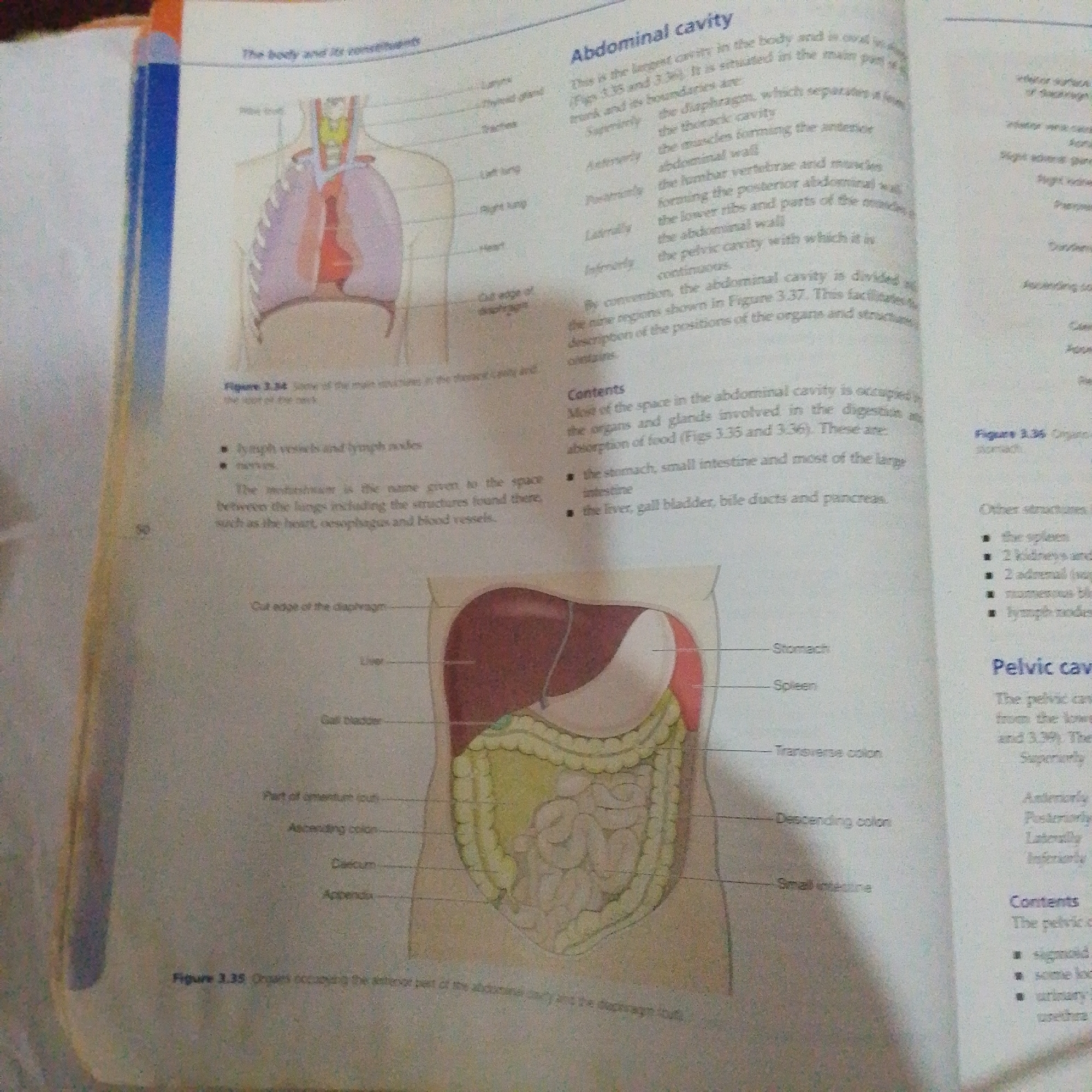
This media file depicts an open textbook page, illustrating human anatomy. The left side features a diagram of the upper torso showing the lungs and heart, with labels pointing to various organs like the trachea, left lung, right lung, and heart. Below this, a diagram of the abdominal cavity is shown, with labels for the diaphragm, liver, gall bladder, stomach, spleen, and parts of the large and small intestines. The text on the left side discusses the "thoracic cavity" and "abdominal cavity" and mentions figures 3.34 and 3.35.

The right side of the page focuses on the "Abdominal cavity," providing a textual description of its location, boundaries, and contents. It details the relationship of the abdominal cavity to the thoracic cavity and pelvic cavity and explains its division into nine regions for anatomical reference. A section titled "Contents" lists organs and glands found within the abdominal cavity, including the stomach, small intestine, liver, gall bladder, bile ducts, and pancreas. There are also references to figures 3.36 and 3.39. Further down, it begins to describe "Other structures" and the "Pelvic cavity."

The overall scene is that of a learning environment, likely a classroom or study area, where anatomical concepts are being explored through text and illustrations. There are no people or specific environmental details like time of day or weather visible. The focus is entirely on the educational content presented on the page. The visible text is predominantly in English, detailing human anatomy.
FM-66btC3

Jun 30, 2026, 12:58 PM

Jalingo, Nigeria

Stake attention in this memory

educational
informative
anatomical
scientific
detailed

This media file depicts an open textbook page, illustrating human anatomy. The left side features a diagram of the upper torso showing the lungs and heart, with labels pointing to various organs like the trachea, left lung, right lung, and heart. Below this, a diagram of the abdominal cavity is shown, with labels for the diaphragm, liver, gall bladder, stomach, spleen, and parts of the large and small intestines. The text on the left side discusses the "thoracic cavity" and "abdominal cavity" and mentions figures 3.34 and 3.35. The right side of the page focuses on the "Abdominal cavity," providing a textual description of its location, boundaries, and contents. It details the relationship of the abdominal cavity to the thoracic cavity and pelvic cavity and explains its division into nine regions for anatomical reference. A section titled "Contents" lists organs and glands found within the abdominal cavity, including the stomach, small intestine, liver, gall bladder, bile ducts, and pancreas. There are also references to figures 3.36 and 3.39. Further down, it begins to describe "Other structures" and the "Pelvic cavity." The overall scene is that of a learning environment, likely a classroom or study area, where anatomical concepts are being explored through text and illustrations. There are no people or specific environmental details like time of day or weather visible. The focus is entirely on the educational content presented on the page. The visible text is predominantly in English, detailing human anatomy.

Loading AttnAds…

transactions
revenues
stakers
Earliest
Latest
Highest stake

No transactions found

More from this user

More from Jalingo

FM-66btC3

Jun 30, 2026, 12:58 PM

Jalingo, Nigeria

Licensed under Creative Commons Attribution 4.0 International License. You are free to share and adapt this content with proper attribution.