Sign in
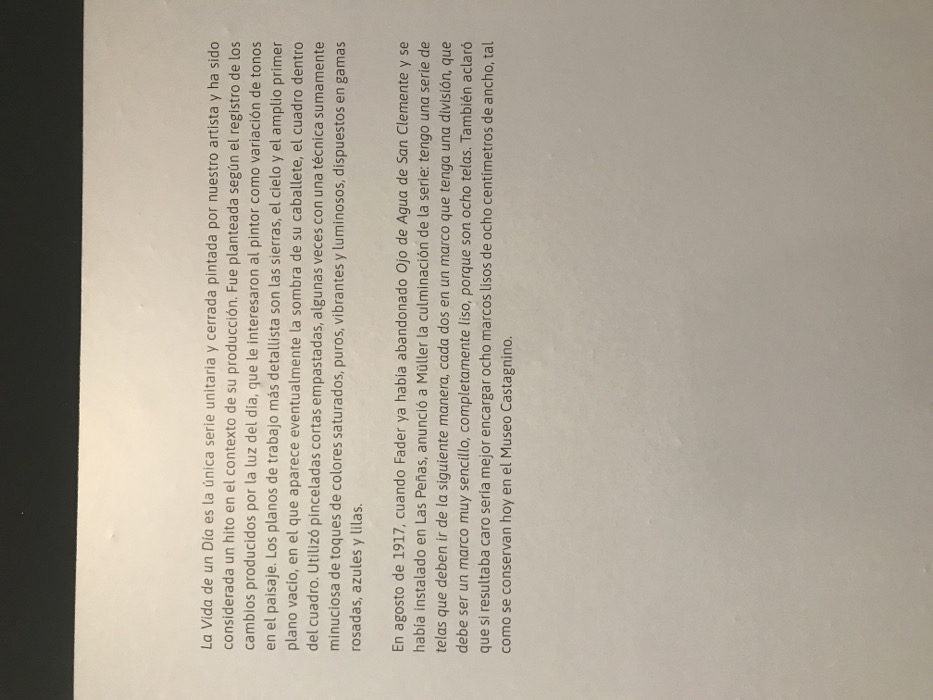
The image displays a slightly angled photograph of a text document, likely an informational plaque or catalog entry, set against a plain, light-colored background. The document is printed in Spanish, describing an art series.

The visible text details "La Vida de un Día," a unique and complete series by an unnamed artist (implied to be Fader from the text), considered a milestone in his work. The series aimed to capture the tonal shifts in a landscape caused by daylight. The artist's technique involved short, impasto brushstrokes, sometimes with meticulous touches of saturated, pure, vibrant, and luminous colors, predominantly in pinks, blues, and lilacs, especially in the detailed areas of mountains, sky, and foreground. The text mentions that in August 1917, after relocating to Las Peñas from Ojo de Agua de San Clemente, the artist informed Müller about the series' completion. He specified that the eight canvases should be displayed in simple, smooth frames, with two canvases per frame, and suggested ordering eight plain frames of eight centimeters in width if custom frames were too costly. The description concludes by stating that these works are currently preserved in the Museo Castagnino, located in Rosario, Argentina.

The document appears to be printed on white paper, with clear black text. No people or specific events are depicted in the photograph itself, which focuses solely on the descriptive text. The lighting is even, suggesting an indoor setting.
F
FM-pWi952

Jan 11, 2025

Rosario, Argentina

Stake attention in this memory

The image displays a slightly angled photograph of a text document, likely an informational plaque or catalog entry, set against a plain, light-colored background. The document is printed in Spanish, describing an art series. The visible text details "La Vida de un Día," a unique and complete series by an unnamed artist (implied to be Fader from the text), considered a milestone in his work. The series aimed to capture the tonal shifts in a landscape caused by daylight. The artist's technique involved short, impasto brushstrokes, sometimes with meticulous touches of saturated, pure, vibrant, and luminous colors, predominantly in pinks, blues, and lilacs, especially in the detailed areas of mountains, sky, and foreground. The text mentions that in August 1917, after relocating to Las Peñas from Ojo de Agua de San Clemente, the artist informed Müller about the series' completion. He specified that the eight canvases should be displayed in simple, smooth frames, with two canvases per frame, and suggested ordering eight plain frames of eight centimeters in width if custom frames were too costly. The description concludes by stating that these works are currently preserved in the Museo Castagnino, located in Rosario, Argentina. The document appears to be printed on white paper, with clear black text. No people or specific events are depicted in the photograph itself, which focuses solely on the descriptive text. The lighting is even, suggesting an indoor setting.

transactions
revenues
stakers
Earliest
Latest
Highest stake

No transactions found

More from this user

More from Rosario

FFM-pWi952

Jan 11, 2025

Rosario, Argentina

Licensed under Creative Commons Attribution 4.0 International License. You are free to share and adapt this content with proper attribution.