
Sign in
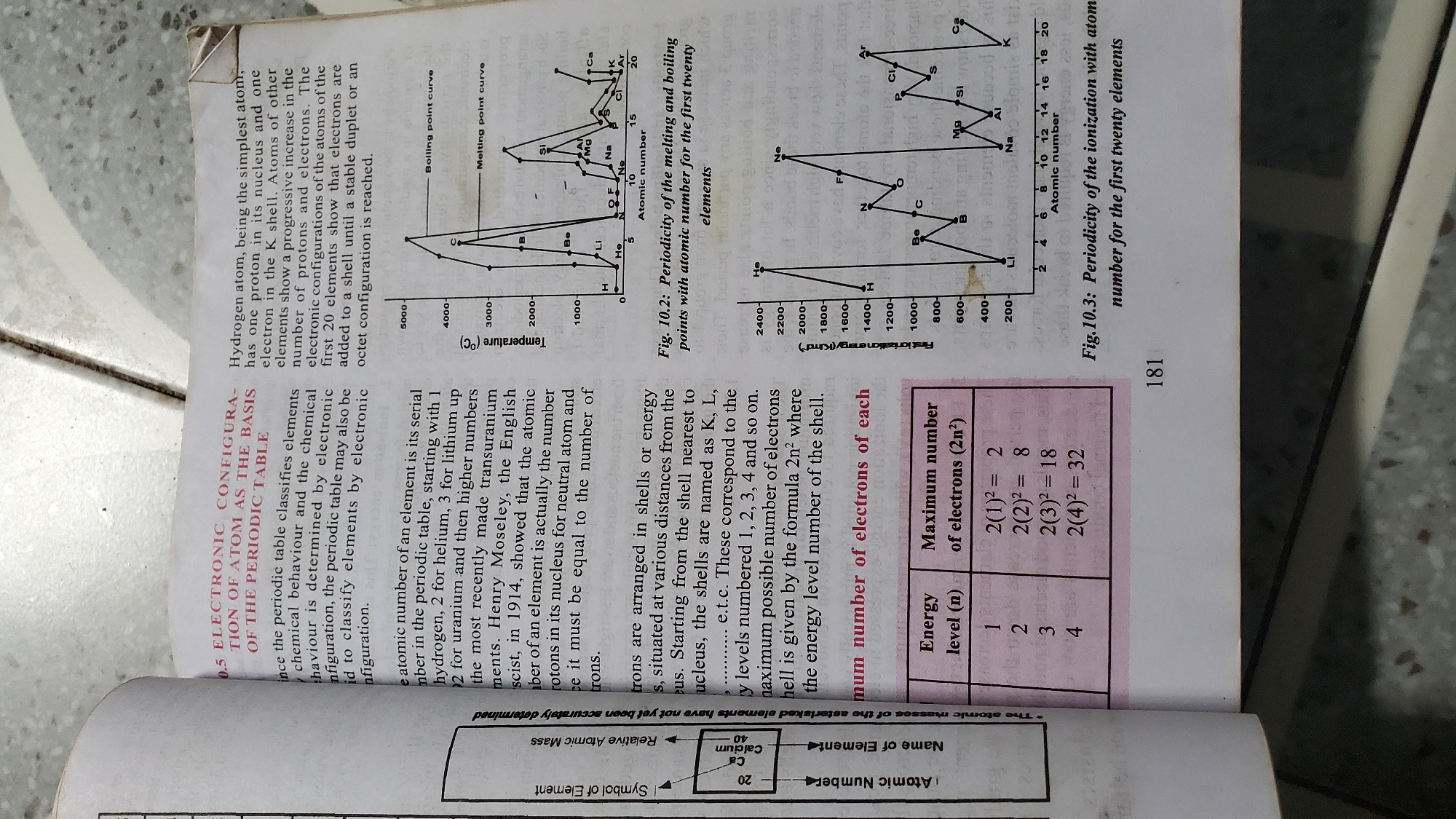
The image displays an open book, with text and graphs pertaining to chemistry. The book appears to be placed on a table or desk, likely in an educational setting. The pages are slightly curved, suggesting a natural light source from the side, possibly a window.

On the left page, a section titled "0.5 ELECTRON CONFIGURA- TION OF ATOM AS THE BASIS OF THE PERIODIC TABLE" discusses how the periodic table classifies elements based on their electronic configuration and chemical behavior. It mentions Henry Moseley's contribution to understanding atomic numbers. Below this text, a table is partially visible, listing "Name of Element", "Symbol of Element", "Atomic Number", and "Relative Atomic Mass". The visible entries include "Calcium" with symbol "Ca" and atomic number "20".

The right page features two graphs, labeled "Fig. 10.2: Periodicity of the melting and boiling points with atomic number for the first twenty elements" and "Fig. 10.3: Periodicity of the ionization with atomic number for the first twenty elements". These graphs illustrate trends in physical and chemical properties of elements as their atomic number increases. Text beneath the graphs elaborates on electron shells and the formula for the maximum number of electrons in a shell. A table showing the maximum number of electrons for different energy levels (n) is also present, with calculations for n=1, 2, 3, and 4. The number "181" is visible at the bottom of the right page, likely a page number. The overall context is educational, focusing on atomic structure and the periodic classification of elements.
FM-Ssetp2

Jun 30, 2026, 11:44 AM

Jalingo, Nigeria

Stake attention in this memory

academic
intellectual
focused
curious
studious

The image displays an open book, with text and graphs pertaining to chemistry. The book appears to be placed on a table or desk, likely in an educational setting. The pages are slightly curved, suggesting a natural light source from the side, possibly a window. On the left page, a section titled "0.5 ELECTRON CONFIGURA- TION OF ATOM AS THE BASIS OF THE PERIODIC TABLE" discusses how the periodic table classifies elements based on their electronic configuration and chemical behavior. It mentions Henry Moseley's contribution to understanding atomic numbers. Below this text, a table is partially visible, listing "Name of Element", "Symbol of Element", "Atomic Number", and "Relative Atomic Mass". The visible entries include "Calcium" with symbol "Ca" and atomic number "20". The right page features two graphs, labeled "Fig. 10.2: Periodicity of the melting and boiling points with atomic number for the first twenty elements" and "Fig. 10.3: Periodicity of the ionization with atomic number for the first twenty elements". These graphs illustrate trends in physical and chemical properties of elements as their atomic number increases. Text beneath the graphs elaborates on electron shells and the formula for the maximum number of electrons in a shell. A table showing the maximum number of electrons for different energy levels (n) is also present, with calculations for n=1, 2, 3, and 4. The number "181" is visible at the bottom of the right page, likely a page number. The overall context is educational, focusing on atomic structure and the periodic classification of elements.

Loading AttnAds…

transactions
revenues
stakers
Earliest
Latest
Highest stake

No transactions found

More from this user

More from Jalingo

FM-Ssetp2

Jun 30, 2026, 11:44 AM

Jalingo, Nigeria

Licensed under Creative Commons Attribution 4.0 International License. You are free to share and adapt this content with proper attribution.