
Stake attention in this memory
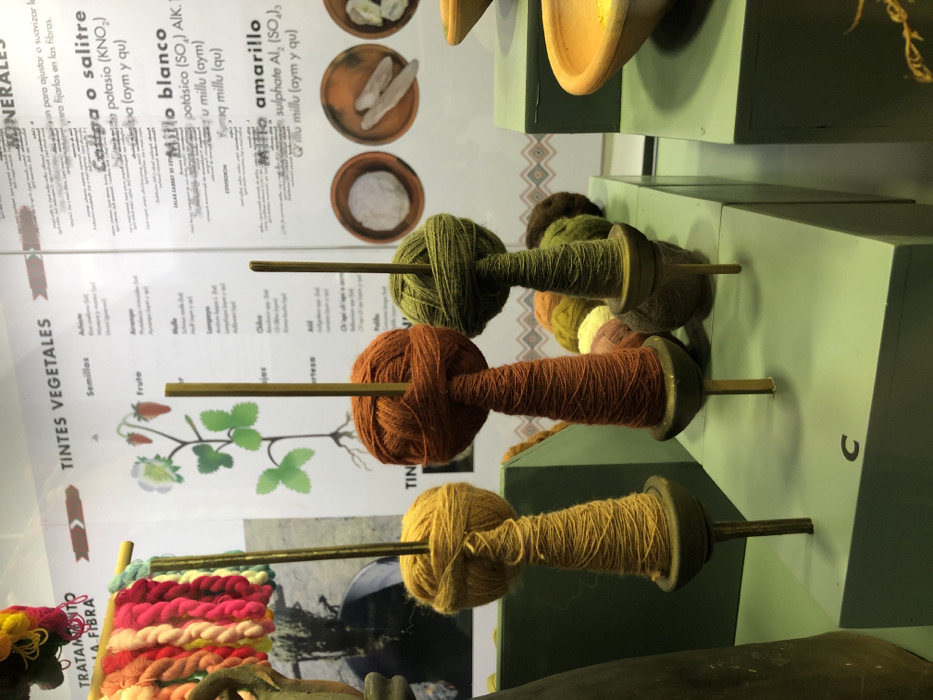
This image captures an indoor museum or exhibit display, likely located in La Paz, Bolivia, showcasing traditional textile dyeing materials and processes. The foreground features three wooden spindles, each heavily wound with naturally dyed yarn in distinct colors: yellowish-brown, reddish-brown, and olive green. These spindles are presented on light green, block-like stands. Further back, more spindles with yarn in various natural hues are visible, suggesting a broader collection of dyed threads. To the left, a small, vibrant sample display exhibits a range of multi-colored yarn bundles, including shades of pink, red, yellow, green, and blue, arranged on a wooden rack. This segment likely demonstrates the array of colors achievable through the methods presented. A large informational poster, partially visible and oriented vertically, serves as a backdrop. Written primarily in Spanish, with references to Aymara and Quechua terms ("aym y qu"), it details the sources of dyes. Sections titled "TINTES VEGETALES" (Vegetable Dyes) and "MINERALES" (Minerals) explain the origins of coloring agents. Specific substances mentioned include "Caliga o salitre" (potash or saltpeter), "nitrato de potasio (KNO₂)," "Millu blanco" (white millu, potassium aluminum sulfate), and "Millu amarillo" (yellow millu, aluminum sulfate). An illustration of a strawberry plant under "Fruto" (Fruit) and "Semillas" (Seeds) further indicates vegetable dye sources. Small clay bowls containing raw mineral or vegetable dye materials are also shown on the poster. Text at the bottom left reads "TRATAMIENTO DE LA FIBRA" (Fiber Treatment), indicating the exhibit's scope covers the entire process from fiber preparation to dyeing. The display effectively illustrates the rich heritage of Andean textile craftsmanship and natural resource utilization.
Loading AttnAds…
No transactions found