Sign in
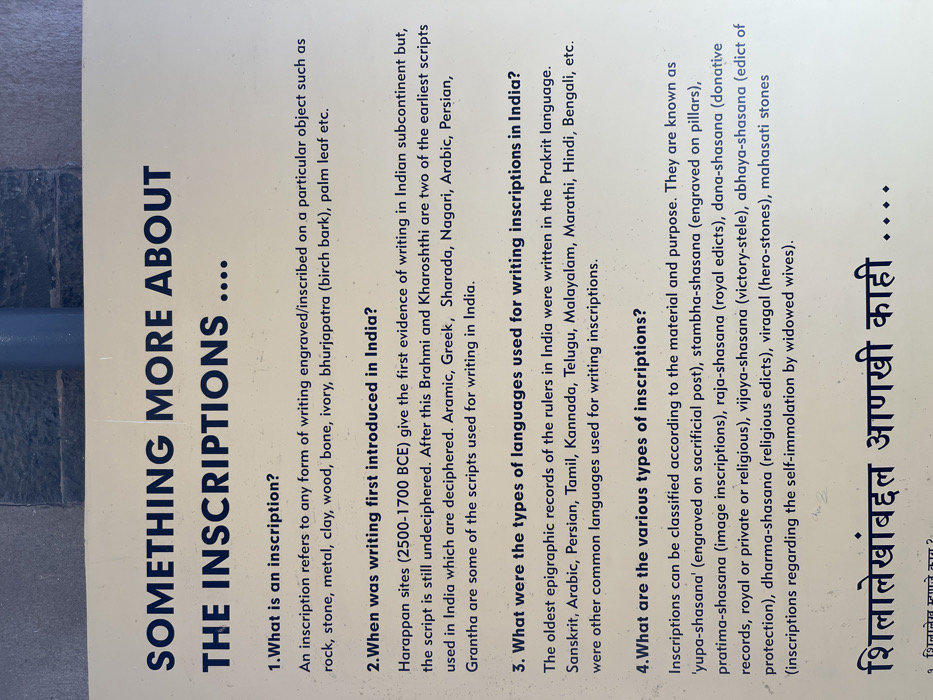
A slightly rotated close-up shot displays a rectangular informational display panel, predominantly white, set against a dark, textured background that suggests a wall or pillar. The panel presents information in a question-and-answer format, primarily in English, with a prominent Marathi title to the right.

The large English title, "SOMETHING MORE ABOUT THE INSCRIPTIONS," is displayed in blue capital letters. Below this, four questions about inscriptions are posed and answered:
1.  **What is an inscription?** Defined as writing engraved or inscribed on objects like rock, stone, metal, clay, wood, bone, ivory, birch bark (bhurjapatra), or palm leaf.
2.  **When was writing first introduced in India?** Mentions Harappan sites (2500-1700 BCE) with an undeciphered script, followed by deciphered scripts like Brahmi and Kharoshthi, and other scripts including Aramic, Greek, Sharada, Nagari, Arabic, Persian, and Grantha.
3.  **What were the types of languages used for writing inscriptions in India?** States that the oldest records were in Prakrit, with other common languages being Sanskrit, Arabic, Persian, Tamil, Kannada, Telugu, Malayalam, Marathi, Hindi, and Bengali.
4.  **What are the various types of inscriptions?** Classifies inscriptions by material and purpose, listing examples such as 'yupa-shasana' (sacrificial post), 'stambha-shasana' (pillars), 'pratima-shasana' (image), 'raja-shasana' (royal edicts), 'dana-shasana' (donative records), 'vijaya-shasana' (victory-stele), 'abhaya-shasana' (protection edict), 'dharma-shasana' (religious edicts), 'viragal' (hero-stones), and 'mahasati stones' (self-immolation by widowed wives).

To the right of the English text, a large Marathi title reads "शिलालेखांबद्दल आणखी काही" (meaning "Something more about inscriptions"). Part of the first question in Marathi, "१ शिलालेख स्याजे काय?", is also visible below it. The panel is well-lit, making all the text clearly legible. The presence of both English and Marathi suggests a public informational display, likely in a museum or historical site in a Marathi-speaking region like Mumbai.
FM-OhtiC3

Dec 10, 2024

Mumbai, India

Stake attention in this memory

A slightly rotated close-up shot displays a rectangular informational display panel, predominantly white, set against a dark, textured background that suggests a wall or pillar. The panel presents information in a question-and-answer format, primarily in English, with a prominent Marathi title to the right. The large English title, "SOMETHING MORE ABOUT THE INSCRIPTIONS," is displayed in blue capital letters. Below this, four questions about inscriptions are posed and answered: 1. **What is an inscription?** Defined as writing engraved or inscribed on objects like rock, stone, metal, clay, wood, bone, ivory, birch bark (bhurjapatra), or palm leaf. 2. **When was writing first introduced in India?** Mentions Harappan sites (2500-1700 BCE) with an undeciphered script, followed by deciphered scripts like Brahmi and Kharoshthi, and other scripts including Aramic, Greek, Sharada, Nagari, Arabic, Persian, and Grantha. 3. **What were the types of languages used for writing inscriptions in India?** States that the oldest records were in Prakrit, with other common languages being Sanskrit, Arabic, Persian, Tamil, Kannada, Telugu, Malayalam, Marathi, Hindi, and Bengali. 4. **What are the various types of inscriptions?** Classifies inscriptions by material and purpose, listing examples such as 'yupa-shasana' (sacrificial post), 'stambha-shasana' (pillars), 'pratima-shasana' (image), 'raja-shasana' (royal edicts), 'dana-shasana' (donative records), 'vijaya-shasana' (victory-stele), 'abhaya-shasana' (protection edict), 'dharma-shasana' (religious edicts), 'viragal' (hero-stones), and 'mahasati stones' (self-immolation by widowed wives). To the right of the English text, a large Marathi title reads "शिलालेखांबद्दल आणखी काही" (meaning "Something more about inscriptions"). Part of the first question in Marathi, "१ शिलालेख स्याजे काय?", is also visible below it. The panel is well-lit, making all the text clearly legible. The presence of both English and Marathi suggests a public informational display, likely in a museum or historical site in a Marathi-speaking region like Mumbai.

transactions
revenues
stakers
Earliest
Latest
Highest stake

No transactions found

More from this user

More from Mumbai

FM-OhtiC3

Dec 10, 2024

Mumbai, India

Licensed under Creative Commons Attribution 4.0 International License. You are free to share and adapt this content with proper attribution.