
Stake attention in this memory
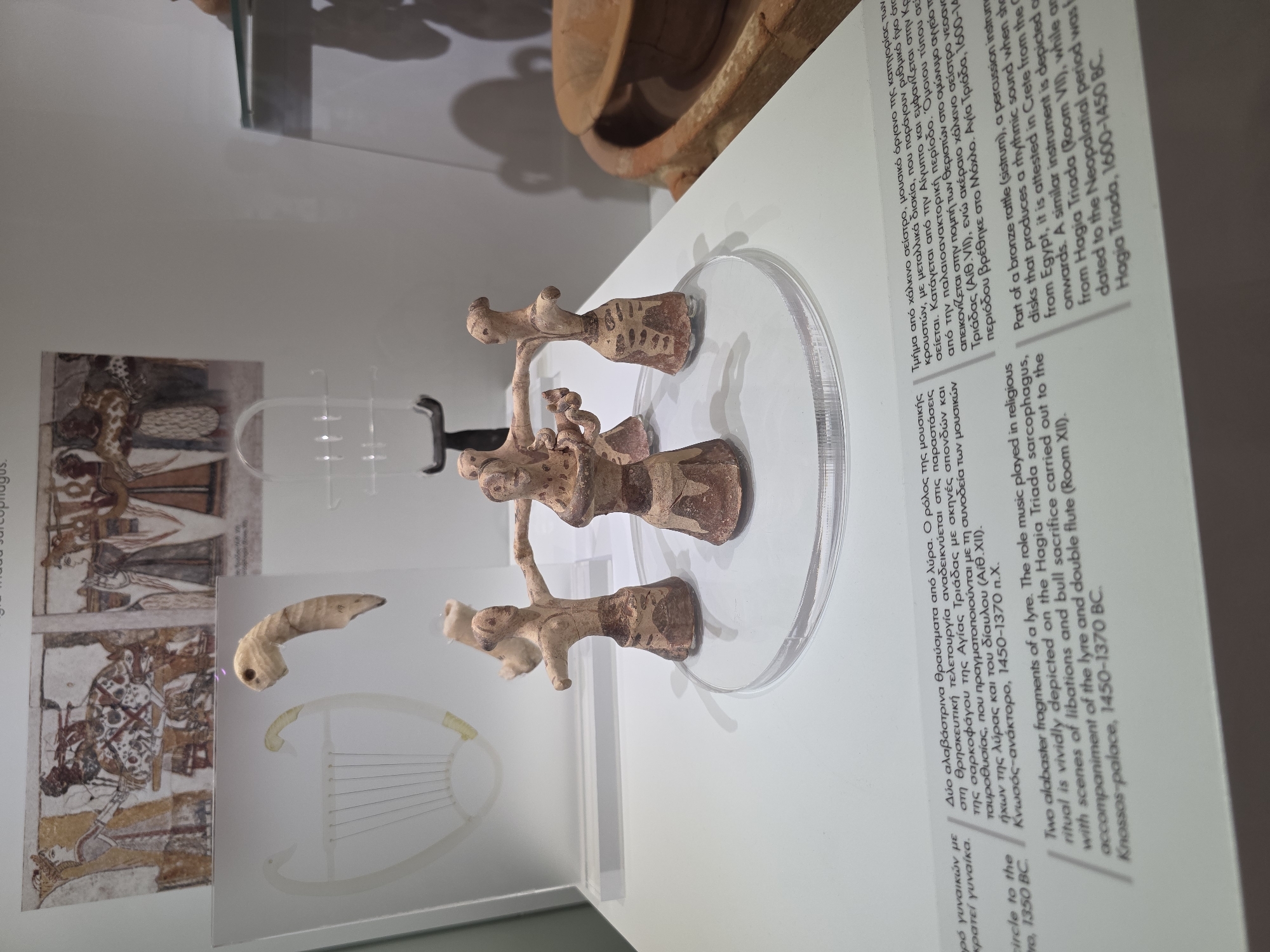
The image shows a museum display case containing artifacts related to ancient Cretan culture. In the foreground, several small, anthropomorphic clay figures are arranged on a clear acrylic stand, appearing to be in a circular dance or ritual. These figures have simplified features and are decorated with painted patterns. Behind them, a white outline of a lyre is displayed, suggesting a musical element associated with the figures. Further back, a portion of a wall painting is visible, depicting figures in procession with what appears to be a chariot. The painting style is characteristic of Minoan art. Other objects in the display include what looks like a fragment of bone or ivory and a large pottery vessel. The text accompanying the display is in both Greek and English. The English text describes "Two alabaster fragments of a lyre. The role music played in religious ritual is vividly depicted on the Hagia Triada sarcophagus, with scenes of libations and bull sacrifice carried out to the accompaniment of the lyre and double flute (Room XII). Knossos-palace, 1450-1370 BC." Another section of text describes a "bronze rattle (sistrum), a percussion instrument from Egypt, it is attested in Crete from the 3rd millennium BC onwards. A similar instrument is depicted on the Hagia Triada (Room VII), while another dated to the Neopalatial period was found in the Hagia Triada, 1600-1450 BC." The overall environment is a well-lit museum exhibition space with plain white walls and display surfaces. The perspective of the image is from a slightly elevated viewpoint, looking down at the artifacts. The location is identified by the text as Knossos Palace and Hagia Triada, both significant archaeological sites in Crete. While not explicitly stated, these artifacts are likely housed in a museum in or near Heraklion, Crete, such as the Heraklion Archaeological Museum, which is renowned for its Minoan collection.
Loading AttnAds…
No transactions found