
Sign in
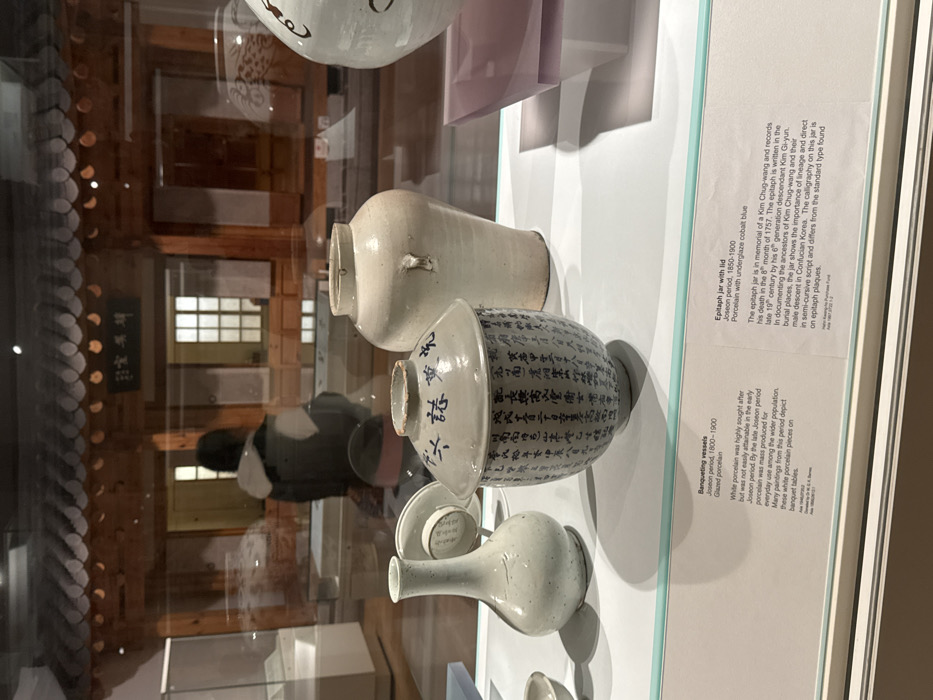
The image displays a museum exhibition in London, United Kingdom, featuring Korean porcelain vessels within a glass display case. In the foreground, several ceramic pieces are showcased. A large, off-white glazed jar with small handles is positioned upright, and beneath it, a prominent blue and white porcelain jar with extensive Korean script in underglaze cobalt blue rests on its side. Below this, a smaller, elegant white porcelain vase with a slender neck is also visible.

Informational labels are partially visible through the glass. One label describes "Banqueting vessels" from the Joseon period (1800-1900), highlighting that white glazed porcelain, initially highly sought, became mass-produced for everyday use and featured in banquet scenes. Another label details an "Epitaph jar with lid" from the Joseon period (1850-1900), crafted from porcelain with underglaze cobalt blue. This jar serves as a memorial for Kim Chug-wang, recording his death in 1757, with the epitaph written by his 6th-generation descendant, Kim Gi-yun, in the late 19th century. The text emphasizes lineage and male descent in Confucian Korea, noting the jar's semi-cursive calligraphy differs from standard epitaph plaques.

Reflections in the display case show a warm, wooden interior with traditional Korean architectural details, including a curved, tiled roof edge, wooden beams, and windows, suggesting either a complementary exhibition backdrop or elements from the surrounding museum environment. A blurred reflection of a person is also discernible. The lighting indicates an indoor setting.
punit03

Dec 13, 2024, 3:39 PM

London, UK

Stake attention in this memory

The image displays a museum exhibition in London, United Kingdom, featuring Korean porcelain vessels within a glass display case. In the foreground, several ceramic pieces are showcased. A large, off-white glazed jar with small handles is positioned upright, and beneath it, a prominent blue and white porcelain jar with extensive Korean script in underglaze cobalt blue rests on its side. Below this, a smaller, elegant white porcelain vase with a slender neck is also visible. Informational labels are partially visible through the glass. One label describes "Banqueting vessels" from the Joseon period (1800-1900), highlighting that white glazed porcelain, initially highly sought, became mass-produced for everyday use and featured in banquet scenes. Another label details an "Epitaph jar with lid" from the Joseon period (1850-1900), crafted from porcelain with underglaze cobalt blue. This jar serves as a memorial for Kim Chug-wang, recording his death in 1757, with the epitaph written by his 6th-generation descendant, Kim Gi-yun, in the late 19th century. The text emphasizes lineage and male descent in Confucian Korea, noting the jar's semi-cursive calligraphy differs from standard epitaph plaques. Reflections in the display case show a warm, wooden interior with traditional Korean architectural details, including a curved, tiled roof edge, wooden beams, and windows, suggesting either a complementary exhibition backdrop or elements from the surrounding museum environment. A blurred reflection of a person is also discernible. The lighting indicates an indoor setting.

Loading AttnAds…

transactions
revenues
stakers
Earliest
Latest
Highest stake

No transactions found

More from this user

More from London

punit03

Dec 13, 2024, 3:39 PM

London, UK

Licensed under Creative Commons Attribution 4.0 International License. You are free to share and adapt this content with proper attribution.