Sign in
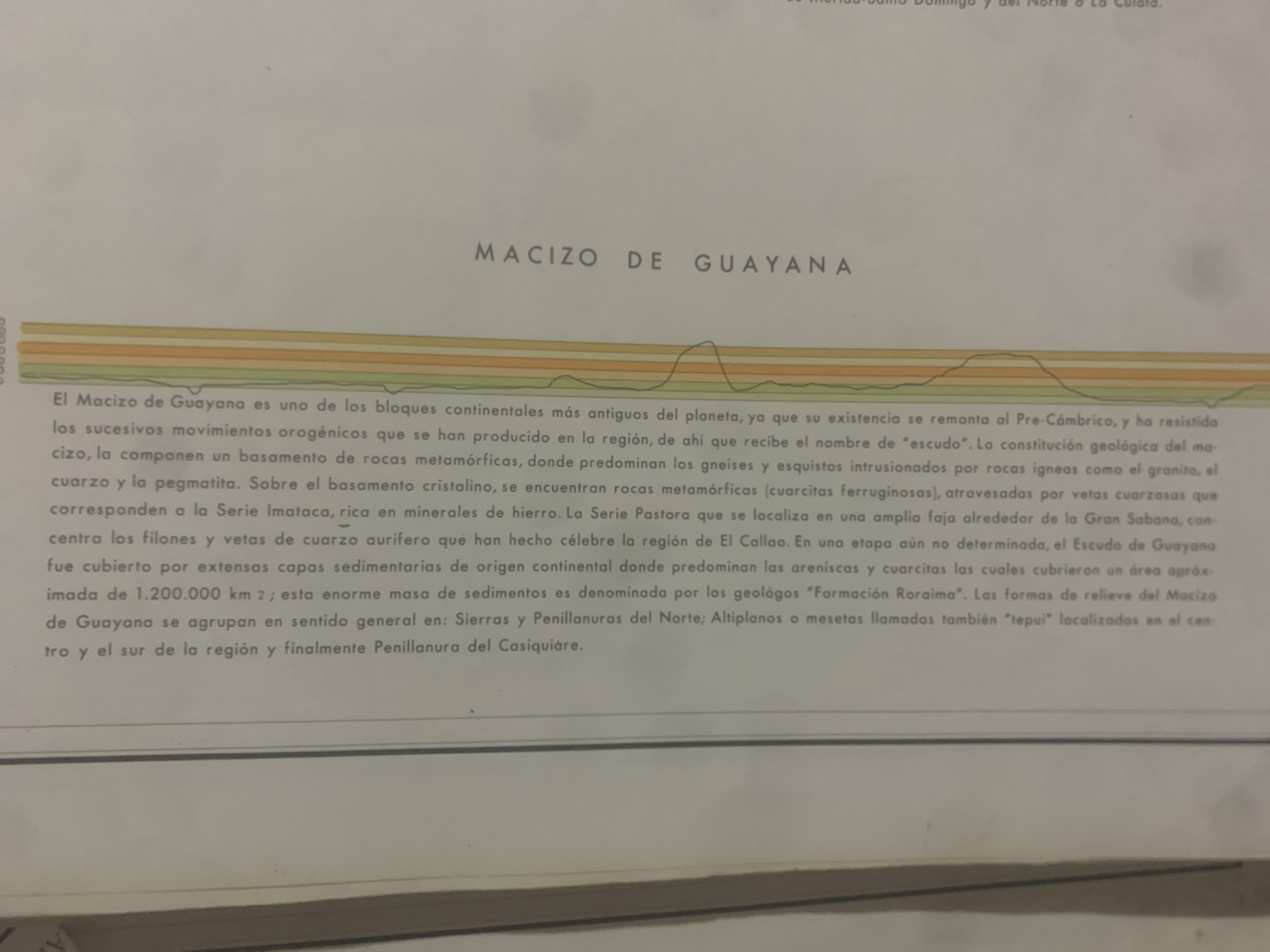
This media file is a photograph of a printed document discussing the geology of the Guayana Massif. The primary subject is the text itself, which is presented in Spanish. The document features a title, "MACIZO DE GUAYANA", and a diagram at the top illustrating geological layers.

The text describes the Guayana Massif as one of the planet's oldest continental blocks, dating back to the Pre-Cambrian era, and refers to it as an "escudo" (shield). It details the massif's geological composition, including metamorphic rocks like gneisses and schists, igneous rocks such as granite, and mentions the presence of quartz and pegmatite. It also highlights the Imataca Series, rich in iron minerals, and the Pastora Series, known for its gold-bearing quartz veins in the El Callao region. The document further explains that the Guayana Shield was later covered by sedimentary layers, forming the "Roraima Formation," and describes the general landforms of the Guayana Massif, including northern sierras and peninsulas, altiplanos or plateaus known as "tepui," and the Casiquiare penillanura in the central and southern parts of the region.

The photograph appears to be taken indoors, with natural lighting. There are no people visible in the image. The focus is on the printed page, which shows a clear, readable text and a simple line graph depicting geological strata. The overall setting is an academic or informational context, likely related to geography or geology. The visible text is predominantly in Spanish.
bombolico

Jun 25, 2026, 2:04 PM

La Tagua, Venezuela

Moment

Stake attention in this memory

informative
academic
geological
scientific
textual

This media file is a photograph of a printed document discussing the geology of the Guayana Massif. The primary subject is the text itself, which is presented in Spanish. The document features a title, "MACIZO DE GUAYANA", and a diagram at the top illustrating geological layers. The text describes the Guayana Massif as one of the planet's oldest continental blocks, dating back to the Pre-Cambrian era, and refers to it as an "escudo" (shield). It details the massif's geological composition, including metamorphic rocks like gneisses and schists, igneous rocks such as granite, and mentions the presence of quartz and pegmatite. It also highlights the Imataca Series, rich in iron minerals, and the Pastora Series, known for its gold-bearing quartz veins in the El Callao region. The document further explains that the Guayana Shield was later covered by sedimentary layers, forming the "Roraima Formation," and describes the general landforms of the Guayana Massif, including northern sierras and peninsulas, altiplanos or plateaus known as "tepui," and the Casiquiare penillanura in the central and southern parts of the region. The photograph appears to be taken indoors, with natural lighting. There are no people visible in the image. The focus is on the printed page, which shows a clear, readable text and a simple line graph depicting geological strata. The overall setting is an academic or informational context, likely related to geography or geology. The visible text is predominantly in Spanish.

Symbol

34270

Volume

0

Creator

+$0.08

Revenue

+$0.00

TVL

$0.00

1D
1W
1M
All

Loading AttnAds…

transactions
revenues
stakers
Earliest
Latest
Highest stake

1

Ramón

Staked 12d ago
Redeemed 8d ago

$6.64 USD

+$0.03 USD

Fee: $0.02 (0.25%)

+0.5%

2

Rev Bot 🤖💰

Injected revenue 12d ago

Revenue bonus for the last stake.

+$0.13 USD

More from this user

More from La Tagua

bombolico

Jun 25, 2026, 2:04 PM

La Tagua, Venezuela

Licensed under Creative Commons Attribution 4.0 International License. You are free to share and adapt this content with proper attribution.