
Sign in
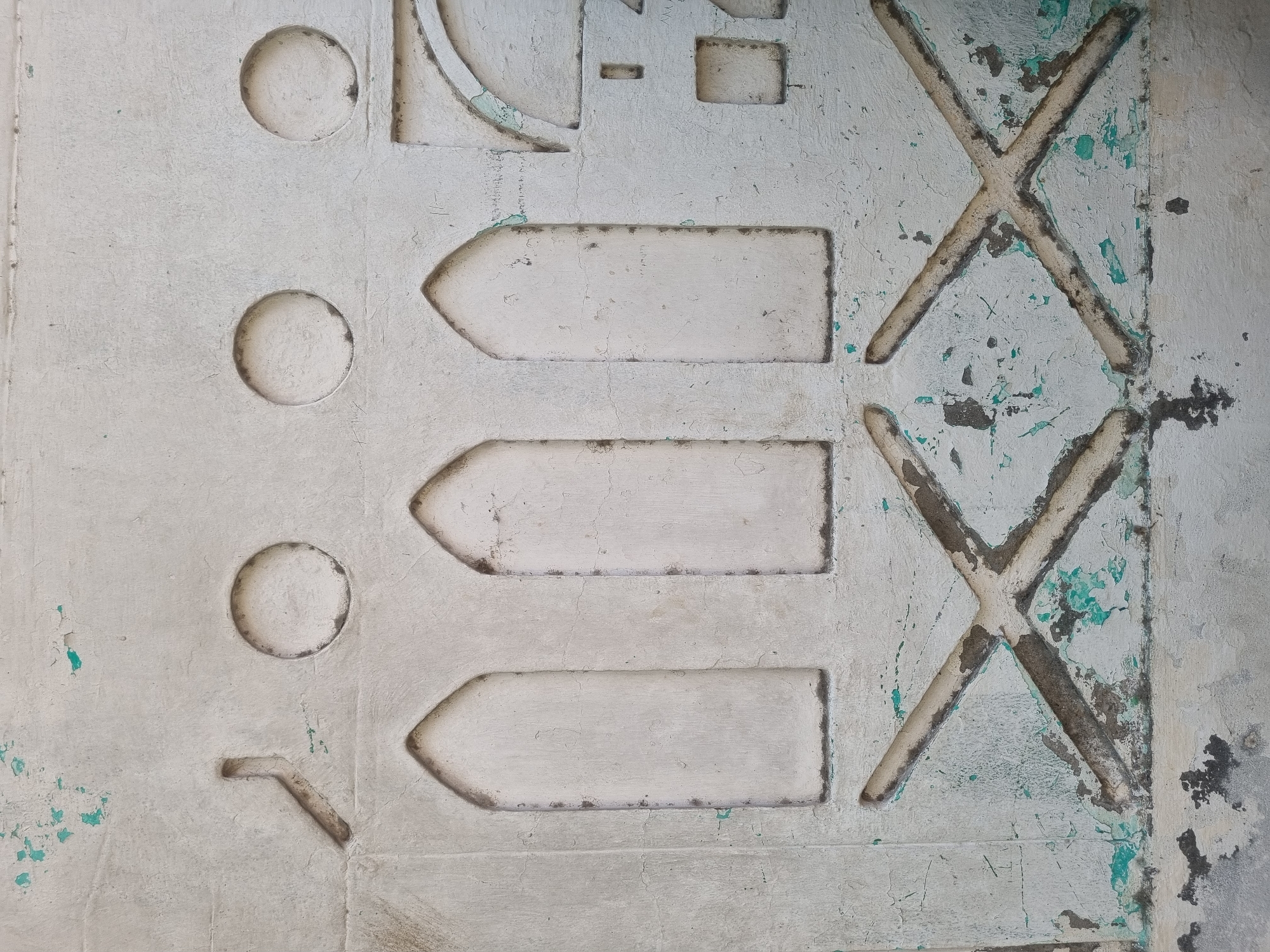
The image displays a weathered, light-colored wall surface, specifically located in Pedda Kammavaripalli, India. The wall is constructed of a material resembling stucco or plaster, coated in an off-white or light beige paint. Significant deterioration is evident, characterized by extensive paint peeling, revealing patches of faded teal or greenish-blue undertone and a darker greyish substrate. Fine cracks traverse the surface, and dark, irregular stains, possibly dirt or mold, are visible, particularly along the bottom edge and within recessed areas.

Geometric patterns are carved or indented into the wall's surface. From left to right, the top section features a distinctive hooked shape, followed by three circular indentations of uniform size, and a partial, larger circular or curved shape on the far right. Below these, a row presents three prominent, vertically oriented, arched rectangular indentations, each tapering to a point at the top, reminiscent of Gothic or Islamic archways. To the right of the third archway, a smaller, curved indentation partially frames a rectangular recess. The bottom section of the wall features large 'X' shapes, formed by intersecting diagonal grooves. Two complete 'X' forms are visible, with a partial third 'X' on the far left. All carved elements exhibit shadowed edges, indicating their recessed nature and depth. No people, animate subjects, or explicit actions are present within the frame. The environment is implied as an exterior or interior space with significant exposure to elements, contributing to the wall's aged condition.
Vera Uliantseva

Mar 27, 2026

Pedda Kammavaripalli, India

Stake attention in this memory

Aged
Industrial
Structured
Neutral
Abstract

The image displays a weathered, light-colored wall surface, specifically located in Pedda Kammavaripalli, India. The wall is constructed of a material resembling stucco or plaster, coated in an off-white or light beige paint. Significant deterioration is evident, characterized by extensive paint peeling, revealing patches of faded teal or greenish-blue undertone and a darker greyish substrate. Fine cracks traverse the surface, and dark, irregular stains, possibly dirt or mold, are visible, particularly along the bottom edge and within recessed areas. Geometric patterns are carved or indented into the wall's surface. From left to right, the top section features a distinctive hooked shape, followed by three circular indentations of uniform size, and a partial, larger circular or curved shape on the far right. Below these, a row presents three prominent, vertically oriented, arched rectangular indentations, each tapering to a point at the top, reminiscent of Gothic or Islamic archways. To the right of the third archway, a smaller, curved indentation partially frames a rectangular recess. The bottom section of the wall features large 'X' shapes, formed by intersecting diagonal grooves. Two complete 'X' forms are visible, with a partial third 'X' on the far left. All carved elements exhibit shadowed edges, indicating their recessed nature and depth. No people, animate subjects, or explicit actions are present within the frame. The environment is implied as an exterior or interior space with significant exposure to elements, contributing to the wall's aged condition.

transactions
revenues
stakers
Earliest
Latest
Highest stake

No transactions found

More from this user

More from Pedda Kammavaripalli

Vera Uliantseva

Mar 27, 2026

Pedda Kammavaripalli, India

Licensed under Creative Commons Attribution 4.0 International License. You are free to share and adapt this content with proper attribution.