Stake attention in this memory
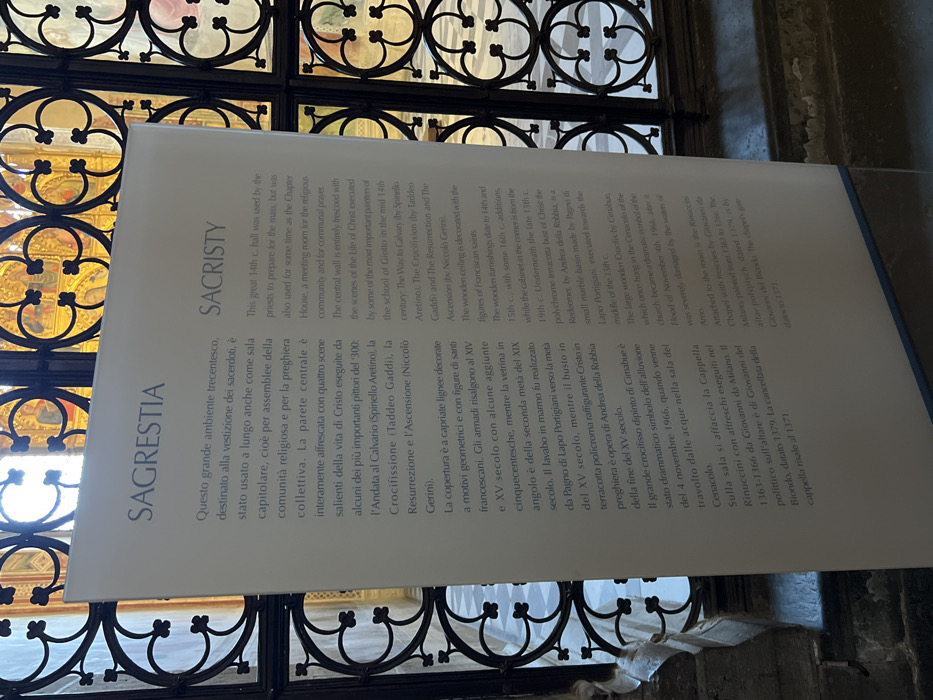
The image features a white informational panel, prominently displayed, with text in both Italian ("SAGRESTIA") and English ("SACRISTY"). Behind this sign, intricate black wrought iron metalwork, possibly part of a window or screen, is visible. Through the metalwork, a brightly lit interior space can be seen, characterized by ornate, possibly frescoed or painted ceilings or walls, suggesting a grand and historical architectural setting. The visible text on the sign describes the sacristy as a large 14th-century hall, originally used by priests and later as a chapter house for religious gatherings. It highlights frescoes on the central wall depicting scenes from the Life of Christ, attributed to prominent 14th-century painters such as Spinello Aretino (The Way to Calvary), Taddeo Gaddi (The Crucifixion), and Niccolò Gerini (The Resurrection and The Ascension). The description also mentions a wooden ceiling adorned with Franciscan saints, 14th and 15th-century wooden furnishings, a 19th-century corner cabinet, and a late 15th-century polychrome terracotta bust of Christ the Redeemer by Andrea della Robbia, alongside a marble basin by Pagno di Lapo Portigiani. Notably, the text refers to a large wooden Crucifix by Cimabue, which became a dramatic symbol of the 1966 Florence flood. It also details the adjacent Rinuccini Chapel, featuring frescoes by Giovanni da Milano (1363-1366), an altarpiece by Giovanni del Biondo (1379), and a chapel gate dating to 1371. The bright light illuminating the background suggests it is daytime. The historical context and the specific artistic and architectural references strongly indicate a significant cultural site in Florence, Italy, likely a church or cathedral. No people are visible, and the scene is static, focused on conveying historical and artistic information about the sacristy.
No transactions found