
Stake attention in this memory
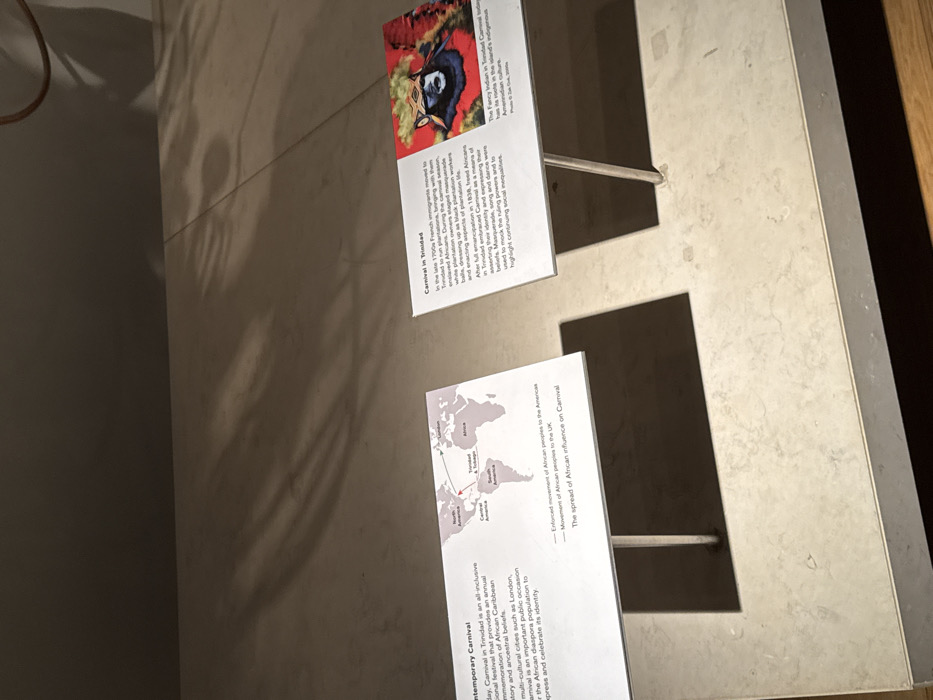
The image displays an indoor exhibition setting, likely a museum or gallery, featuring two information panels on stands. The background consists of a light-colored wall or floor, with prominent, soft shadows resembling foliage cast upon it, possibly from artificial lighting or decorative elements. A faint brown strap or cable is visible in the upper left corner. The two white rectangular panels, supported by metal stands, provide information about Carnival. The bottom panel, titled "Contemporary Carnival," describes Carnival in Trinidad as an all-inclusive festival commemorating African Caribbean history. It also notes its importance in multicultural cities like London for the African diaspora to express identity. This panel features a map illustrating the "Enforced movement of African peoples to the Americas," "Movement of African peoples to the UK," and "The spread of African influence on Carnival." The top panel, titled "Carnival in Trinidad," details the historical origins of Carnival. It explains that in the late 1700s, French migrants brought enslaved Africans to Trinidad. Post-emancipation in 1838, freed Africans adopted Carnival as a means of asserting their identity, using masquerade, song, and dance to mock ruling powers and highlight social inequalities. This panel includes a colorful image of a person in an elaborate "Fancy Indian Trinidad Carnival" costume, with text noting its roots in indigenous Amerindian culture and attributing the photo to Zak Ové, 2005. The scene suggests a static display for educational purposes within London, United Kingdom.
Loading AttnAds…
No transactions found