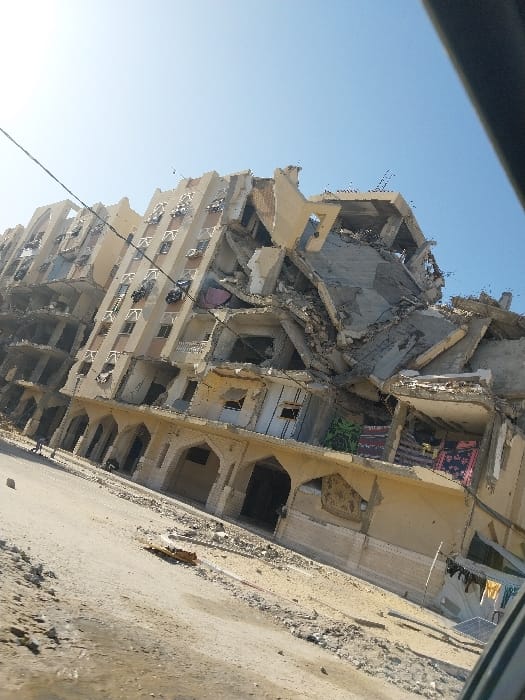
![The image presents a high-angle, top-down view of a severely damaged multi-story building, likely an apartment complex. The building itself is a light tan or beige color, showing extensive structural compromise, particularly on its right side, which appears to be partially collapsed or blown open, exposing the interiors of numerous rooms across multiple floors.
On the left side of the building, which seems relatively less destroyed but still significantly impacted, several balconies with distinct arched openings are visible. On these balconies, laundry lines are set up with clothes hanging to dry, including shirts, pants, and colorful garments, suggesting recent human presence or an attempt to maintain normalcy amidst the destruction. The exterior walls on this side are pockmarked with numerous small holes, consistent with bullet impacts or shrapnel. Some windows are either shattered or missing.
Moving towards the right, the damage becomes increasingly severe. Entire sections of outer walls are missing, revealing the complete layouts of apartments. Inside these exposed rooms, a chaotic scene of debris, broken furniture, and scattered personal belongings is evident. Items such as beds with mattresses, chairs, tables, and what appear to be storage units are overturned, broken, or covered in dust and rubble. Various textiles, including blankets, rugs, and tarps, are scattered throughout, with some seemingly used as makeshift covers or partitions within the damaged structures.
The far right edge of the building shows even more catastrophic destruction, with entire floor slabs and internal walls collapsed into a vast field of rubble. This debris field extends beyond the building itself, filling the ground to the right, composed of shattered concrete, metal, and other remnants. In the upper right corner of the image, amidst this extensive debris, a severely damaged and overturned vehicle, possibly a car, is visible.
Within some of the exposed rooms on the lower right floors, further details can be observed:
* In one room, a white tarp or sheet is visible, upon which partial text, "UNICE[F]," can be discerned, indicating the presence of humanitarian aid materials.
* Other rooms contain jumbled personal items, including what look like suitcases, boxes, and clothing.
The lighting suggests it is daytime, with bright, clear conditions, indicated by the absence of heavy shadows and the overall illumination of the scene. The pervasive damage, bullet holes, and the extensive debris field point to a major destructive event, most likely a result of conflict or heavy shelling, rather than a natural disaster. The juxtaposition of hanging laundry on one side and catastrophic destruction on the other paints a grim picture of resilience in the face of widespread devastation.](https://firebasestorage.googleapis.com/v0/b/patr-3a75e.appspot.com/o/uploads%2Fimage_picker_38cdcaa6-1efe-4088-a.jpg?alt=media)
Stake attention in this memory
The image presents a high-angle, top-down view of a severely damaged multi-story building, likely an apartment complex. The building itself is a light tan or beige color, showing extensive structural compromise, particularly on its right side, which appears to be partially collapsed or blown open, exposing the interiors of numerous rooms across multiple floors. On the left side of the building, which seems relatively less destroyed but still significantly impacted, several balconies with distinct arched openings are visible. On these balconies, laundry lines are set up with clothes hanging to dry, including shirts, pants, and colorful garments, suggesting recent human presence or an attempt to maintain normalcy amidst the destruction. The exterior walls on this side are pockmarked with numerous small holes, consistent with bullet impacts or shrapnel. Some windows are either shattered or missing. Moving towards the right, the damage becomes increasingly severe. Entire sections of outer walls are missing, revealing the complete layouts of apartments. Inside these exposed rooms, a chaotic scene of debris, broken furniture, and scattered personal belongings is evident. Items such as beds with mattresses, chairs, tables, and what appear to be storage units are overturned, broken, or covered in dust and rubble. Various textiles, including blankets, rugs, and tarps, are scattered throughout, with some seemingly used as makeshift covers or partitions within the damaged structures. The far right edge of the building shows even more catastrophic destruction, with entire floor slabs and internal walls collapsed into a vast field of rubble. This debris field extends beyond the building itself, filling the ground to the right, composed of shattered concrete, metal, and other remnants. In the upper right corner of the image, amidst this extensive debris, a severely damaged and overturned vehicle, possibly a car, is visible. Within some of the exposed rooms on the lower right floors, further details can be observed: * In one room, a white tarp or sheet is visible, upon which partial text, "UNICE[F]," can be discerned, indicating the presence of humanitarian aid materials. * Other rooms contain jumbled personal items, including what look like suitcases, boxes, and clothing. The lighting suggests it is daytime, with bright, clear conditions, indicated by the absence of heavy shadows and the overall illumination of the scene. The pervasive damage, bullet holes, and the extensive debris field point to a major destructive event, most likely a result of conflict or heavy shelling, rather than a natural disaster. The juxtaposition of hanging laundry on one side and catastrophic destruction on the other paints a grim picture of resilience in the face of widespread devastation.
Loading AttnAds…
No transactions found