
Sign in
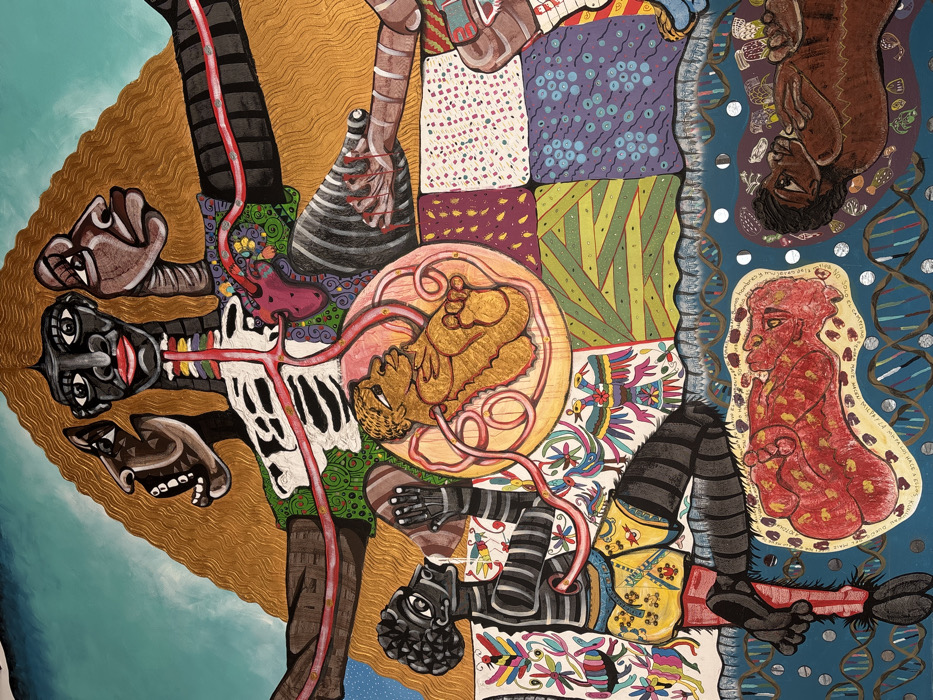
This painting, titled "Origen del Maíz" by Manuel Miguel, is located in the Museo Nacional de los Ferrocarriles Mexicanos in Puebla, Puebla, Mexico.

The artwork depicts a complex, multi-layered scene with stylized figures and biological motifs. At the top, a large, dark-skinned anthropomorphic figure features three distinct heads; the central head faces forward with red lips and wide white eyes, flanked by two profile heads. Long, textured golden hair frames the figure. Its torso displays a white skeletal ribcage and spine, overlaid with a prominent red cardiovascular system that includes a heart and extends into red vessels throughout the composition. The figure's right hand, positioned mid-frame, has red drips on its fingertips.

Below, the background transitions into a patchwork of distinct geometric and floral patterns in various colors. On the left, a dark-skinned kneeling figure with striped limbs and yellow shorts clasps its hands, exhibiting white liquid emanating from its mouth. A red tube connects from its chest to a central, light pink oval containing a golden, curled fetus. This fetus is also connected by multiple red tubes to the main figure's cardiovascular system.

The lower portion of the painting features a deep blue background adorned with silver double helix DNA strands and scattered silver crescent moons. An irregular red shape on the left contains numerous golden, organic forms and white Spanish text reading, "QUE SI NO NACEN HUMANOS HOMBRES Y MUJERES, NO SOLO EL CAMPESINO... NACE MAIZ, MIELPA Y LA LUNA LOS HACE A ELLOS..." (If human men and women are not born, not only the farmer... corn is born, honeycomb, and the moon makes them...). To the right, a dark-skinned figure lies on its back, holding several small, colorful, oval objects, surrounded by smaller cellular shapes.
Tatoo

Mar 12, 2026, 10:03 PM

Puebla, Mexico

Moment

Stake attention in this memory

Complex
Birth
Surreal
Anxiety
Intrigue

This painting, titled "Origen del Maíz" by Manuel Miguel, is located in the Museo Nacional de los Ferrocarriles Mexicanos in Puebla, Puebla, Mexico. The artwork depicts a complex, multi-layered scene with stylized figures and biological motifs. At the top, a large, dark-skinned anthropomorphic figure features three distinct heads; the central head faces forward with red lips and wide white eyes, flanked by two profile heads. Long, textured golden hair frames the figure. Its torso displays a white skeletal ribcage and spine, overlaid with a prominent red cardiovascular system that includes a heart and extends into red vessels throughout the composition. The figure's right hand, positioned mid-frame, has red drips on its fingertips. Below, the background transitions into a patchwork of distinct geometric and floral patterns in various colors. On the left, a dark-skinned kneeling figure with striped limbs and yellow shorts clasps its hands, exhibiting white liquid emanating from its mouth. A red tube connects from its chest to a central, light pink oval containing a golden, curled fetus. This fetus is also connected by multiple red tubes to the main figure's cardiovascular system. The lower portion of the painting features a deep blue background adorned with silver double helix DNA strands and scattered silver crescent moons. An irregular red shape on the left contains numerous golden, organic forms and white Spanish text reading, "QUE SI NO NACEN HUMANOS HOMBRES Y MUJERES, NO SOLO EL CAMPESINO... NACE MAIZ, MIELPA Y LA LUNA LOS HACE A ELLOS..." (If human men and women are not born, not only the farmer... corn is born, honeycomb, and the moon makes them...). To the right, a dark-skinned figure lies on its back, holding several small, colorful, oval objects, surrounded by smaller cellular shapes.

Symbol

38D2F

Volume

9,037

Creator

+$0.01

Revenue

+$0.00

TVL

$1.40

1D
1W
1M
All

Loading AttnAds…

transactions
revenues
stakers
Earliest
Latest
Highest stake

1

CM🤖

Staked 5mo ago

$1.41 USD

-$0.01 USD

-1%

More from this user

More from Puebla

Tatoo

Mar 12, 2026, 10:03 PM

Puebla, Mexico

Licensed under Creative Commons Attribution 4.0 International License. You are free to share and adapt this content with proper attribution.