Sign in
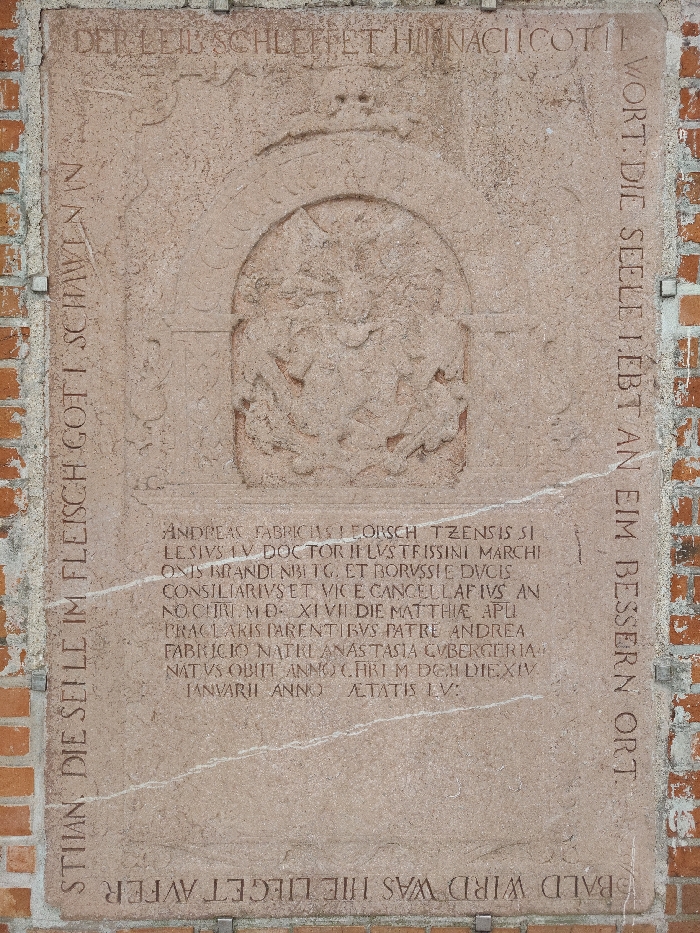
A weathered rectangular stone epitaph, predominantly pinkish-grey in color, is securely affixed to a red-orange brick wall in Kaliningrad, Russia. The stone exhibits surface erosion, chipping, and a prominent diagonal crack extends across its lower right section. Metal clips are visible along the left and right edges, anchoring the plaque to the brickwork.

Centered on the upper half of the plaque is a recessed, arched niche containing a bas-relief carving. This carving depicts multiple human-like figures, possibly religious or allegorical, rendered with softened details due to wear. A central figure is flanked by others, suggesting a scene of ascension or resurrection.

Above the central carving, inscribed horizontally in German, is "DER LEIB SCHLEFET HIN NACH GOTT." Vertical German inscriptions frame the central section: "STIAN. DIE SEELE IM FLEISCH GOTT I SCHAWEN IN" runs down the left side, and "VORT. DIE SEELE LEBT AN EIM BESSERN ORT." runs down the right side. Along the bottom, an inverted German inscription reads "BALD WIRD WAS HIE LIEGET AUFER".

Below the carved relief, a multi-line inscription in Latin details the life of Andreas Fabricius. It identifies him as "ANDREAS FABRICIVS LEORSCH TZENSIS SI LESIVS LV DOCTOR ILVSTRISSINI MARCHI ONIS BRANDINIB TG. ET BORVSSIE DVCIS CONSILJARIVS ET VICE CANCELLARIIVS." It further notes his parents, Andreas Fabricio and Anastasia Gvbergeria, and indicates his birth in 1517 ("ANNO CHRI. M D. XI VII DIE MATTHIA") and death at age 55 ("AETATIS LV"), with a partially visible death date around January 14th ("M DGM DIEXIV JANVARII ANNO"). The text is worn but legible.
sus306

Mar 1, 2026

Kaliningrad, Russia

Moment

Stake attention in this memory

solemn
historical
religious
melancholic
reverent

A weathered rectangular stone epitaph, predominantly pinkish-grey in color, is securely affixed to a red-orange brick wall in Kaliningrad, Russia. The stone exhibits surface erosion, chipping, and a prominent diagonal crack extends across its lower right section. Metal clips are visible along the left and right edges, anchoring the plaque to the brickwork. Centered on the upper half of the plaque is a recessed, arched niche containing a bas-relief carving. This carving depicts multiple human-like figures, possibly religious or allegorical, rendered with softened details due to wear. A central figure is flanked by others, suggesting a scene of ascension or resurrection. Above the central carving, inscribed horizontally in German, is "DER LEIB SCHLEFET HIN NACH GOTT." Vertical German inscriptions frame the central section: "STIAN. DIE SEELE IM FLEISCH GOTT I SCHAWEN IN" runs down the left side, and "VORT. DIE SEELE LEBT AN EIM BESSERN ORT." runs down the right side. Along the bottom, an inverted German inscription reads "BALD WIRD WAS HIE LIEGET AUFER". Below the carved relief, a multi-line inscription in Latin details the life of Andreas Fabricius. It identifies him as "ANDREAS FABRICIVS LEORSCH TZENSIS SI LESIVS LV DOCTOR ILVSTRISSINI MARCHI ONIS BRANDINIB TG. ET BORVSSIE DVCIS CONSILJARIVS ET VICE CANCELLARIIVS." It further notes his parents, Andreas Fabricio and Anastasia Gvbergeria, and indicates his birth in 1517 ("ANNO CHRI. M D. XI VII DIE MATTHIA") and death at age 55 ("AETATIS LV"), with a partially visible death date around January 14th ("M DGM DIEXIV JANVARII ANNO"). The text is worn but legible.

Symbol

39311

Volume

0

Creator

+$0.00

Revenue

+$0.00

TVL

$0.00

1D
1W
1M
All
transactions
revenues
stakers
Earliest
Latest
Highest stake

1

sus306

Staked 4mo ago
Redeemed 2mo ago

$0.01 USD

-$0.00 USD

Fee: $0.00 (0.25%)

-0.3%

More from this user

More from Kaliningrad

sus306

Mar 1, 2026

Kaliningrad, Russia

Licensed under Creative Commons Attribution 4.0 International License. You are free to share and adapt this content with proper attribution.