Sign in
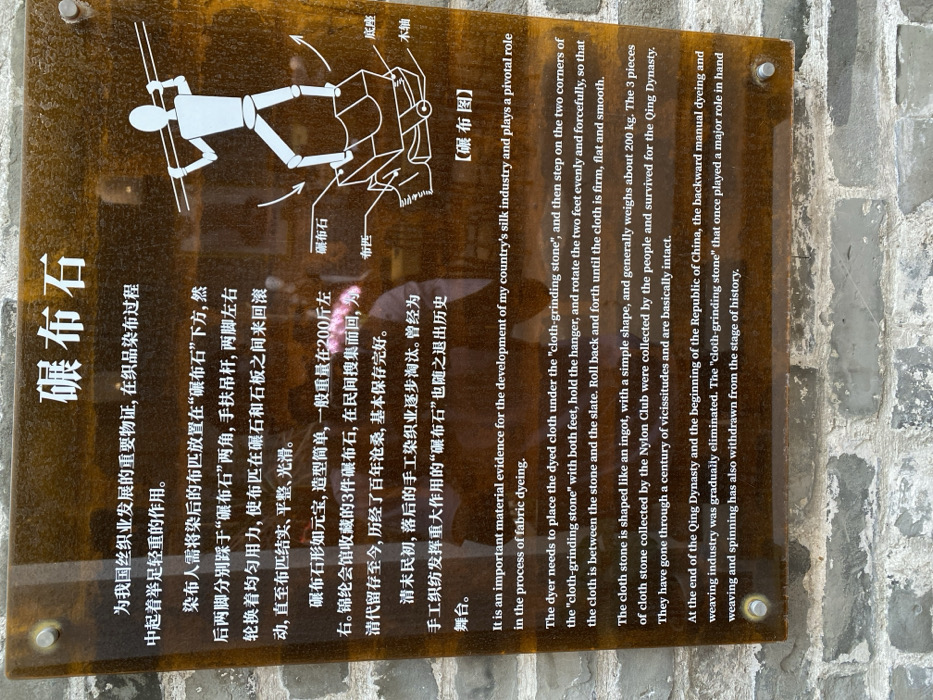
The image displays a weathered, rectangular brown acrylic sign attached to a grey brick wall, likely in Guang Zhou Shi, China. The sign features text in both Chinese and English, alongside a white line diagram illustrating the use of a "cloth-grinding stone" (碾布石).

The sign details the process and historical significance of the cloth-grinding stone in China's silk industry and fabric dyeing. The diagram shows a stick figure person standing on two "碾布石" (cloth-grinding stones), holding a hanger, with labels for "底座" (base), "木轴" (wooden axle), and "布匹" (cloth).

According to the visible text, a dyer places dyed cloth under the stone, steps on its corners, holds a hanger, and rotates their feet to roll the cloth between the stone and a slate until it becomes firm, flat, and smooth. The cloth stone is described as ingot-shaped, simple, and weighing around 200 kg. Three such stones, collected by the Nylon Club, survived the Qing Dynasty and are noted to be intact despite a century of use. The text concludes by stating that this manual dyeing and weaving tool, once pivotal, was phased out at the end of the Qing Dynasty and the beginning of the Republic of China due to the advancement of industry.

The sign itself appears somewhat aged, with visible reflections on its surface, suggesting an outdoor setting in daylight. The brick wall provides a rustic backdrop.
F
FM-CaIMM2

Dec 19, 2024, 6:51 AM

Guang Zhou Shi, China

Stake attention in this memory

The image displays a weathered, rectangular brown acrylic sign attached to a grey brick wall, likely in Guang Zhou Shi, China. The sign features text in both Chinese and English, alongside a white line diagram illustrating the use of a "cloth-grinding stone" (碾布石). The sign details the process and historical significance of the cloth-grinding stone in China's silk industry and fabric dyeing. The diagram shows a stick figure person standing on two "碾布石" (cloth-grinding stones), holding a hanger, with labels for "底座" (base), "木轴" (wooden axle), and "布匹" (cloth). According to the visible text, a dyer places dyed cloth under the stone, steps on its corners, holds a hanger, and rotates their feet to roll the cloth between the stone and a slate until it becomes firm, flat, and smooth. The cloth stone is described as ingot-shaped, simple, and weighing around 200 kg. Three such stones, collected by the Nylon Club, survived the Qing Dynasty and are noted to be intact despite a century of use. The text concludes by stating that this manual dyeing and weaving tool, once pivotal, was phased out at the end of the Qing Dynasty and the beginning of the Republic of China due to the advancement of industry. The sign itself appears somewhat aged, with visible reflections on its surface, suggesting an outdoor setting in daylight. The brick wall provides a rustic backdrop.

Loading AttnAds…

transactions
revenues
stakers
Earliest
Latest
Highest stake

No transactions found

More from this user

More from Guang Zhou Shi

FFM-CaIMM2

Dec 19, 2024, 6:51 AM

Guang Zhou Shi, China

Licensed under Creative Commons Attribution 4.0 International License. You are free to share and adapt this content with proper attribution.