Sign in
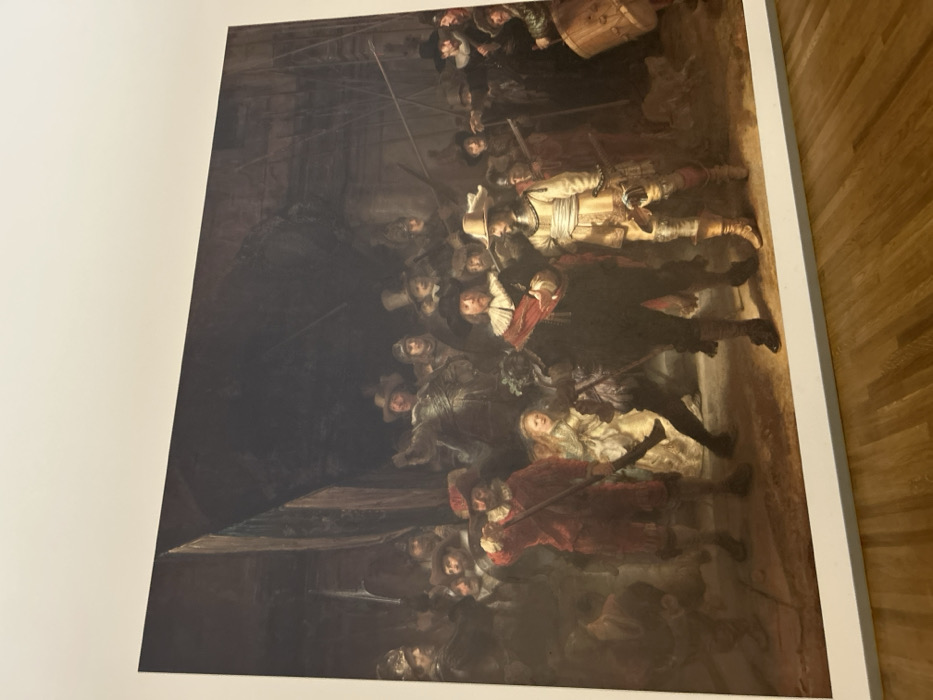
The image displays a photograph of a large, dark painting, recognized as Rembrandt's "The Night Watch." This iconic Dutch Golden Age artwork depicts a bustling civic militia company, likely the company of Captain Frans Banninck Cocq and Lieutenant Willem van Ruytenburch.

The painting features a crowded scene with numerous subjects, primarily men in 17th-century military attire, including musketeers and officers. They wear elaborate hats, plumed helmets, and various uniforms, carrying objects such as muskets, pikes, swords, and a drum visible in the upper right. In the foreground, a small girl in a bright yellow dress and a younger boy are visible among the legs of the soldiers.

The activity captured is a dynamic moment, suggesting the company is either preparing for a parade or being called to action and marching out. Captain Banninck Cocq, dressed in dark clothing with a red sash, is centrally located, extending his hand as if giving an order. Beside him, Lieutenant van Ruytenburch, in a strikingly bright yellow uniform, moves forward.

Notable details include the dramatic use of chiaroscuro, with strong contrasts between light and shadow that create depth and emphasize key figures. Despite its common name, the painting originally depicted a daytime scene, but centuries of varnish darkened its appearance. The central figures are brightly illuminated against a much darker, shadowy background, which appears to be an archway or a large hall. The girl in yellow, a mascot figure, has a dead chicken hanging from her belt, a symbol for the Kloveniers (arquebusiers). The emotions conveyed are varied, from stern determination to lively action, all contributing to a sense of urgency and organized chaos. There is no visible text within the painting itself. The style and subjects strongly place the setting within 17th-century Amsterdam.
F
FM-uqmbw2

Dec 30, 2024

Amsterdam, Netherlands

Stake attention in this memory

The image displays a photograph of a large, dark painting, recognized as Rembrandt's "The Night Watch." This iconic Dutch Golden Age artwork depicts a bustling civic militia company, likely the company of Captain Frans Banninck Cocq and Lieutenant Willem van Ruytenburch. The painting features a crowded scene with numerous subjects, primarily men in 17th-century military attire, including musketeers and officers. They wear elaborate hats, plumed helmets, and various uniforms, carrying objects such as muskets, pikes, swords, and a drum visible in the upper right. In the foreground, a small girl in a bright yellow dress and a younger boy are visible among the legs of the soldiers. The activity captured is a dynamic moment, suggesting the company is either preparing for a parade or being called to action and marching out. Captain Banninck Cocq, dressed in dark clothing with a red sash, is centrally located, extending his hand as if giving an order. Beside him, Lieutenant van Ruytenburch, in a strikingly bright yellow uniform, moves forward. Notable details include the dramatic use of chiaroscuro, with strong contrasts between light and shadow that create depth and emphasize key figures. Despite its common name, the painting originally depicted a daytime scene, but centuries of varnish darkened its appearance. The central figures are brightly illuminated against a much darker, shadowy background, which appears to be an archway or a large hall. The girl in yellow, a mascot figure, has a dead chicken hanging from her belt, a symbol for the Kloveniers (arquebusiers). The emotions conveyed are varied, from stern determination to lively action, all contributing to a sense of urgency and organized chaos. There is no visible text within the painting itself. The style and subjects strongly place the setting within 17th-century Amsterdam.

transactions
revenues
stakers
Earliest
Latest
Highest stake

No transactions found

More from this user

More from Amsterdam

FFM-uqmbw2

Dec 30, 2024

Amsterdam, Netherlands

Licensed under Creative Commons Attribution 4.0 International License. You are free to share and adapt this content with proper attribution.