
Sign in
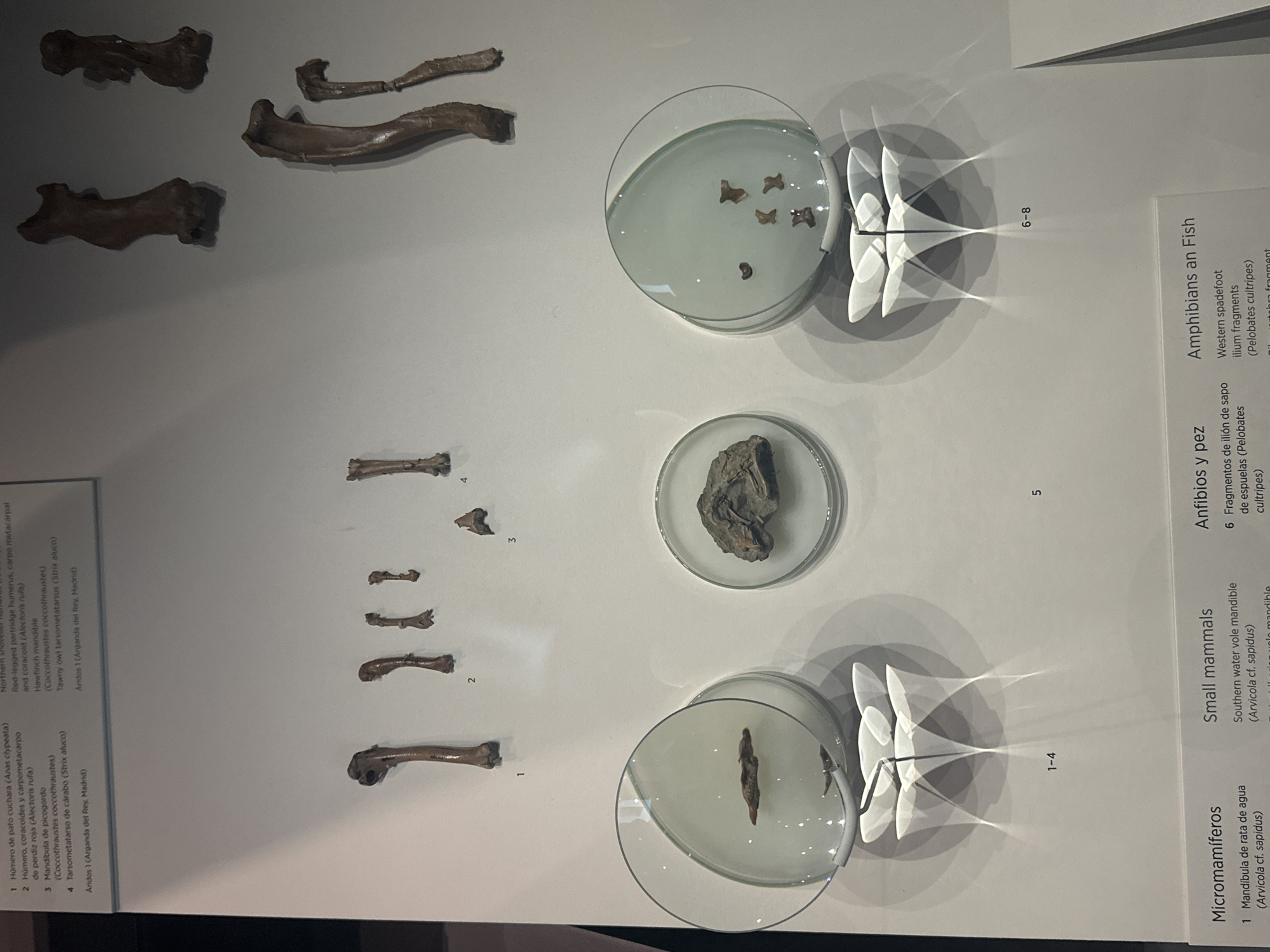
This is a photograph of a museum exhibit displaying fossilized animal bones. The exhibit is set against a plain white wall. The bones are arranged in several clusters and are some are displayed under glass bowls and magnifying lenses. Some of the bones are labeled with numbers.

There is also text in Spanish and English. The Spanish text refers to "Micromamíferos" (Micromammals), "Anfibios y pez" (Amphibians and fish), and names specific animals like "pato cuchara" (spoonbill duck), "perdiz roja" (red-legged partridge), "picogordo" (hawfinch), "carabo" (tawny owl), and "rata de agua" (water vole). The English text provides translations for some of these, including "Northern shoveler humerus", "Red-legged partridge humerus", "Hawfinch mandible", "Tawny owl tarsometatarsus", and "Southern water vole mandible". Some of the labels indicate the origin of the fossils as "Aridos 1 (Arganda del Rey, Madrid)".

The overall impression is an educational display showcasing paleontological finds, possibly from the Arganda del Rey area near Madrid, Spain. The lighting in the photograph is somewhat dramatic, creating shadows from the magnifying lenses and highlighting the texture of the bones. There are no people visible in the photograph.
Tati

Jun 30, 2026

Madrid, Spain

Moment

Stake attention in this memory

curious
analytical
academic
solemn
thoughtful

This is a photograph of a museum exhibit displaying fossilized animal bones. The exhibit is set against a plain white wall. The bones are arranged in several clusters and are some are displayed under glass bowls and magnifying lenses. Some of the bones are labeled with numbers. There is also text in Spanish and English. The Spanish text refers to "Micromamíferos" (Micromammals), "Anfibios y pez" (Amphibians and fish), and names specific animals like "pato cuchara" (spoonbill duck), "perdiz roja" (red-legged partridge), "picogordo" (hawfinch), "carabo" (tawny owl), and "rata de agua" (water vole). The English text provides translations for some of these, including "Northern shoveler humerus", "Red-legged partridge humerus", "Hawfinch mandible", "Tawny owl tarsometatarsus", and "Southern water vole mandible". Some of the labels indicate the origin of the fossils as "Aridos 1 (Arganda del Rey, Madrid)". The overall impression is an educational display showcasing paleontological finds, possibly from the Arganda del Rey area near Madrid, Spain. The lighting in the photograph is somewhat dramatic, creating shadows from the magnifying lenses and highlighting the texture of the bones. There are no people visible in the photograph.

transactions
revenues
stakers
Earliest
Latest
Highest stake

No transactions found

More from this user

More from Madrid

Tati

Jun 30, 2026

Madrid, Spain

Licensed under Creative Commons Attribution 4.0 International License. You are free to share and adapt this content with proper attribution.