
Sign in
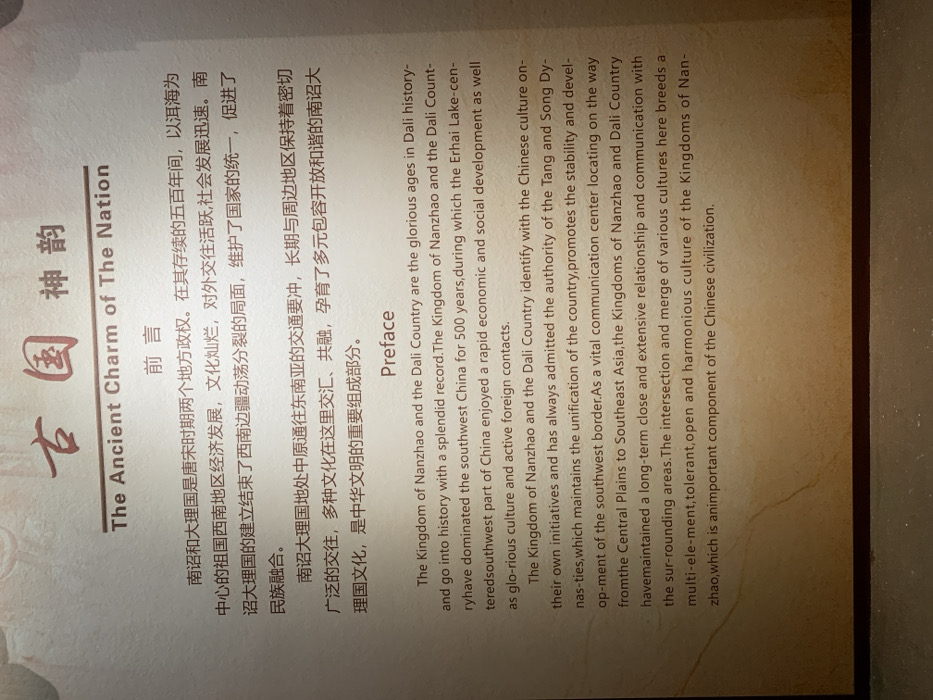
The image displays a close-up of a printed page, likely from a brochure, book, or informational panel in a museum or cultural center. The page features text in both Chinese and English, presented as a "Preface" under the main title "The Ancient Charm of The Nation."

The visible Chinese text, titled "古国神韵" (Gǔguó Shényùn - The Ancient Charm of The Nation), introduces the Nanzhao and Dali Kingdoms. It describes them as two local regimes during the Tang and Song Dynasties that existed for 500 years. The text highlights their economic development centered on Erhai Lake in southwest China, vibrant culture, active foreign relations, and rapid social progress. It states that the establishment of these kingdoms unified the southwestern frontier, promoted national unity, and fostered ethnic integration. Furthermore, it emphasizes their location as a crucial communication hub between the Central Plains and Southeast Asia, leading to extensive cultural exchange and the development of a diverse, inclusive, and harmonious culture that is a significant component of Chinese civilization.

The English "Preface" provides a similar account, detailing the Nanzhao and Dali Country's "glorious ages" and their 500-year dominance in southwest China. It mentions their rapid economic and social development, "glorious culture," and active foreign contacts. The English text also notes their identification with Chinese culture, acceptance of the Tang and Song Dynasties' authority, and their role in maintaining national unification and promoting stability in the southwest border region. It reiterates their position as a vital communication center, fostering a multi-element, tolerant, open, and harmonious culture that is an important component of Chinese civilization.

The page has a slight warm tone and appears to be well-preserved, suggesting its display in an exhibition context.
Emma🇨🇳💕

Feb 1, 2025, 6:00 AM

Da Li Bai Zu Zi Zhi Zhou, China

Stake attention in this memory

The image displays a close-up of a printed page, likely from a brochure, book, or informational panel in a museum or cultural center. The page features text in both Chinese and English, presented as a "Preface" under the main title "The Ancient Charm of The Nation." The visible Chinese text, titled "古国神韵" (Gǔguó Shényùn - The Ancient Charm of The Nation), introduces the Nanzhao and Dali Kingdoms. It describes them as two local regimes during the Tang and Song Dynasties that existed for 500 years. The text highlights their economic development centered on Erhai Lake in southwest China, vibrant culture, active foreign relations, and rapid social progress. It states that the establishment of these kingdoms unified the southwestern frontier, promoted national unity, and fostered ethnic integration. Furthermore, it emphasizes their location as a crucial communication hub between the Central Plains and Southeast Asia, leading to extensive cultural exchange and the development of a diverse, inclusive, and harmonious culture that is a significant component of Chinese civilization. The English "Preface" provides a similar account, detailing the Nanzhao and Dali Country's "glorious ages" and their 500-year dominance in southwest China. It mentions their rapid economic and social development, "glorious culture," and active foreign contacts. The English text also notes their identification with Chinese culture, acceptance of the Tang and Song Dynasties' authority, and their role in maintaining national unification and promoting stability in the southwest border region. It reiterates their position as a vital communication center, fostering a multi-element, tolerant, open, and harmonious culture that is an important component of Chinese civilization. The page has a slight warm tone and appears to be well-preserved, suggesting its display in an exhibition context.

Loading AttnAds…

transactions
revenues
stakers
Earliest
Latest
Highest stake

No transactions found

More from this user

More from Da Li Bai Zu Zi Zhi Zhou

Emma🇨🇳💕

Feb 1, 2025, 6:00 AM

Da Li Bai Zu Zi Zhi Zhou, China

Licensed under Creative Commons Attribution 4.0 International License. You are free to share and adapt this content with proper attribution.