Stake attention in this memory
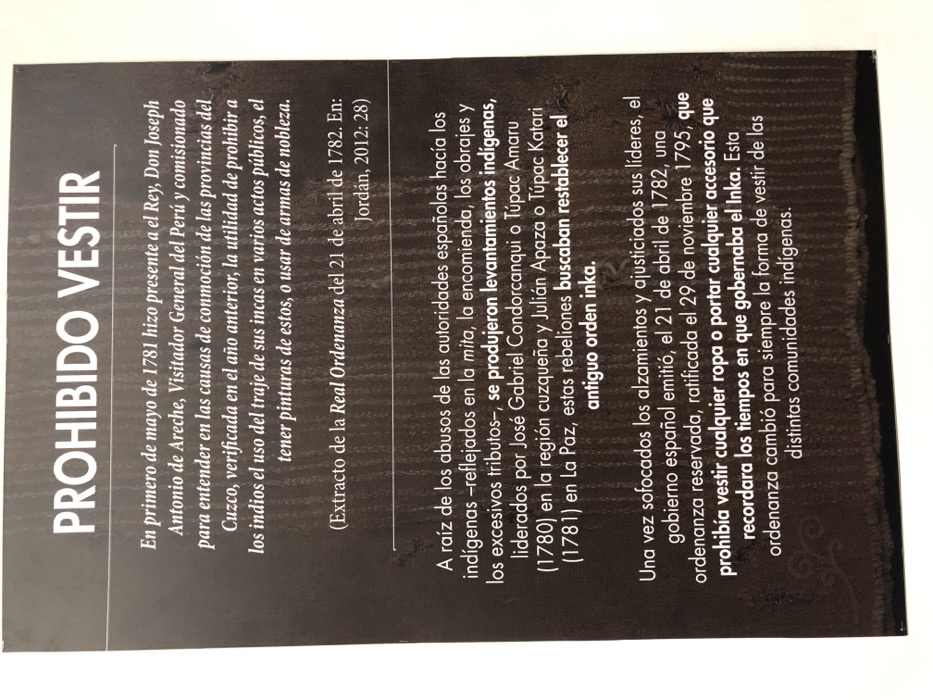
The image displays a vertically oriented informational panel with white text against a dark background, likely from a museum or exhibition. The prominent title reads "PROHIBIDO VESTIR" (Forbidden to Dress). The text details a historical edict from the Spanish colonial period in South America. It states that in May 1781, Don Joseph Antonio de Areche proposed prohibiting indigenous people (referred to as "indios") from wearing traditional Inca attire, displaying Inca paintings, or using noble weapons. This proposal was a direct response to unrest in the provinces of Cusco. The panel further explains that these measures were taken after significant indigenous uprisings, notably those led by José Gabriel Condorcanqui (Túpac Amaru) in the Cusco region (1780) and Julián Apaza (Túpac Katari) in La Paz (1781). These rebellions, fueled by Spanish abuses such as the mita, encomienda, obrajes, and excessive tributes, aimed to re-establish the "antiguo orden inka" (ancient Inca order). Following the suppression of these uprisings and the execution of their leaders, the Spanish government issued a "Real Ordenanza" (Royal Ordinance) on April 21, 1782, later ratified on November 29, 1795. This ordinance explicitly prohibited wearing any clothing or accessories that harked back to the times when the Inca governed. The text concludes by noting that this ordinance permanently altered the dressing customs of various indigenous communities. The source cited is Jordán, 2012: 28.
Loading AttnAds…
No transactions found