
Sign in
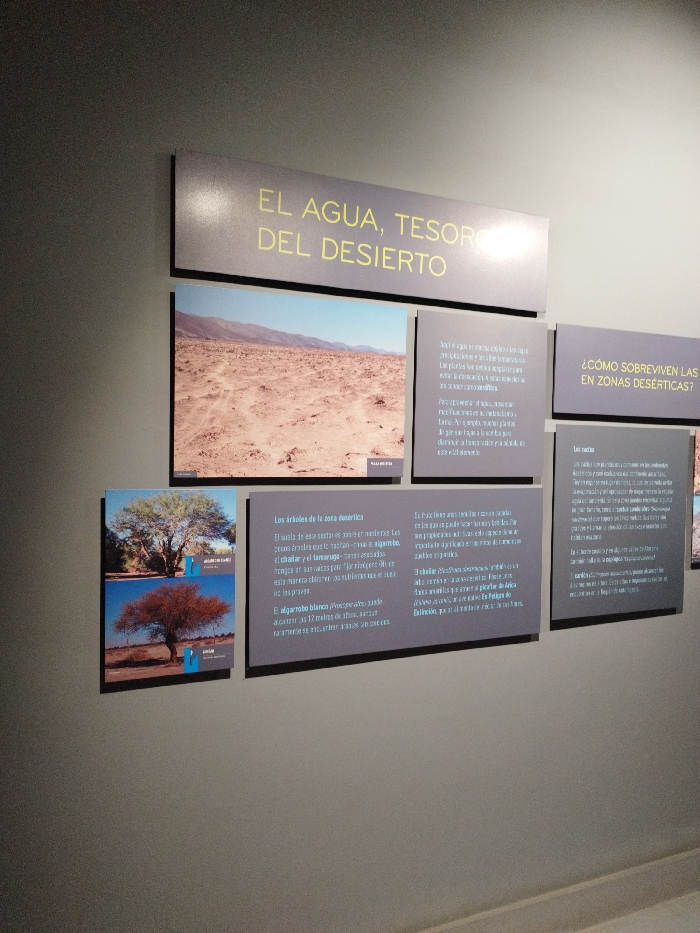
This image captures an indoor exhibition display mounted on a dark gray wall. The exhibit focuses on desert environments, featuring several informational panels with text and images.

The prominent title panel at the top reads "EL AGUA, TESORO DEL DESIERTO" (THE WATER, TREASURE OF THE DESERT) in yellow capital letters. To its right, another panel poses the question, "¿CÓMO SOBREVIVEN LAS EN ZONAS DESERTICAS?" (HOW DO THEY SURVIVE IN DESERT ZONES?).

Below these titles, a large rectangular photograph depicts a desolate desert landscape with a vast expanse of sandy, dry ground and distant mountains under a pale blue sky. Adjacent to this landscape image are several smaller text panels in Spanish, providing detailed information about the topic. One panel is titled "Los árboles de la flora desértica" (Trees of the desert flora), discussing how specific trees like "algarrobo" (carob tree) and "challar" adapt to arid conditions. Another section mentions "El algarrobo blanco" (The white carob tree) and its characteristics.

Further down, two smaller, stacked photographs showcase individual trees. The upper image features a green-leaved tree, while the lower one displays a tree with reddish foliage, illustrating different types of desert flora. These images are accompanied by more text panels, explaining how plants extract nutrients and water in harsh desert environments.

The lighting is artificial, causing some glare on the reflective surfaces of the panels. The display appears to be part of an educational exhibit, possibly in a museum or cultural center, relevant to the geographic context of Santiago, Chile, which is near prominent desert regions. There are no people visible in the scene.
Melani

Jan 7, 2025

Santiago, Chile

Stake attention in this memory

This image captures an indoor exhibition display mounted on a dark gray wall. The exhibit focuses on desert environments, featuring several informational panels with text and images. The prominent title panel at the top reads "EL AGUA, TESORO DEL DESIERTO" (THE WATER, TREASURE OF THE DESERT) in yellow capital letters. To its right, another panel poses the question, "¿CÓMO SOBREVIVEN LAS EN ZONAS DESERTICAS?" (HOW DO THEY SURVIVE IN DESERT ZONES?). Below these titles, a large rectangular photograph depicts a desolate desert landscape with a vast expanse of sandy, dry ground and distant mountains under a pale blue sky. Adjacent to this landscape image are several smaller text panels in Spanish, providing detailed information about the topic. One panel is titled "Los árboles de la flora desértica" (Trees of the desert flora), discussing how specific trees like "algarrobo" (carob tree) and "challar" adapt to arid conditions. Another section mentions "El algarrobo blanco" (The white carob tree) and its characteristics. Further down, two smaller, stacked photographs showcase individual trees. The upper image features a green-leaved tree, while the lower one displays a tree with reddish foliage, illustrating different types of desert flora. These images are accompanied by more text panels, explaining how plants extract nutrients and water in harsh desert environments. The lighting is artificial, causing some glare on the reflective surfaces of the panels. The display appears to be part of an educational exhibit, possibly in a museum or cultural center, relevant to the geographic context of Santiago, Chile, which is near prominent desert regions. There are no people visible in the scene.

transactions
revenues
stakers
Earliest
Latest
Highest stake

No transactions found

More from this user

More from Santiago

Melani

Jan 7, 2025

Santiago, Chile

Licensed under Creative Commons Attribution 4.0 International License. You are free to share and adapt this content with proper attribution.