
Sign in
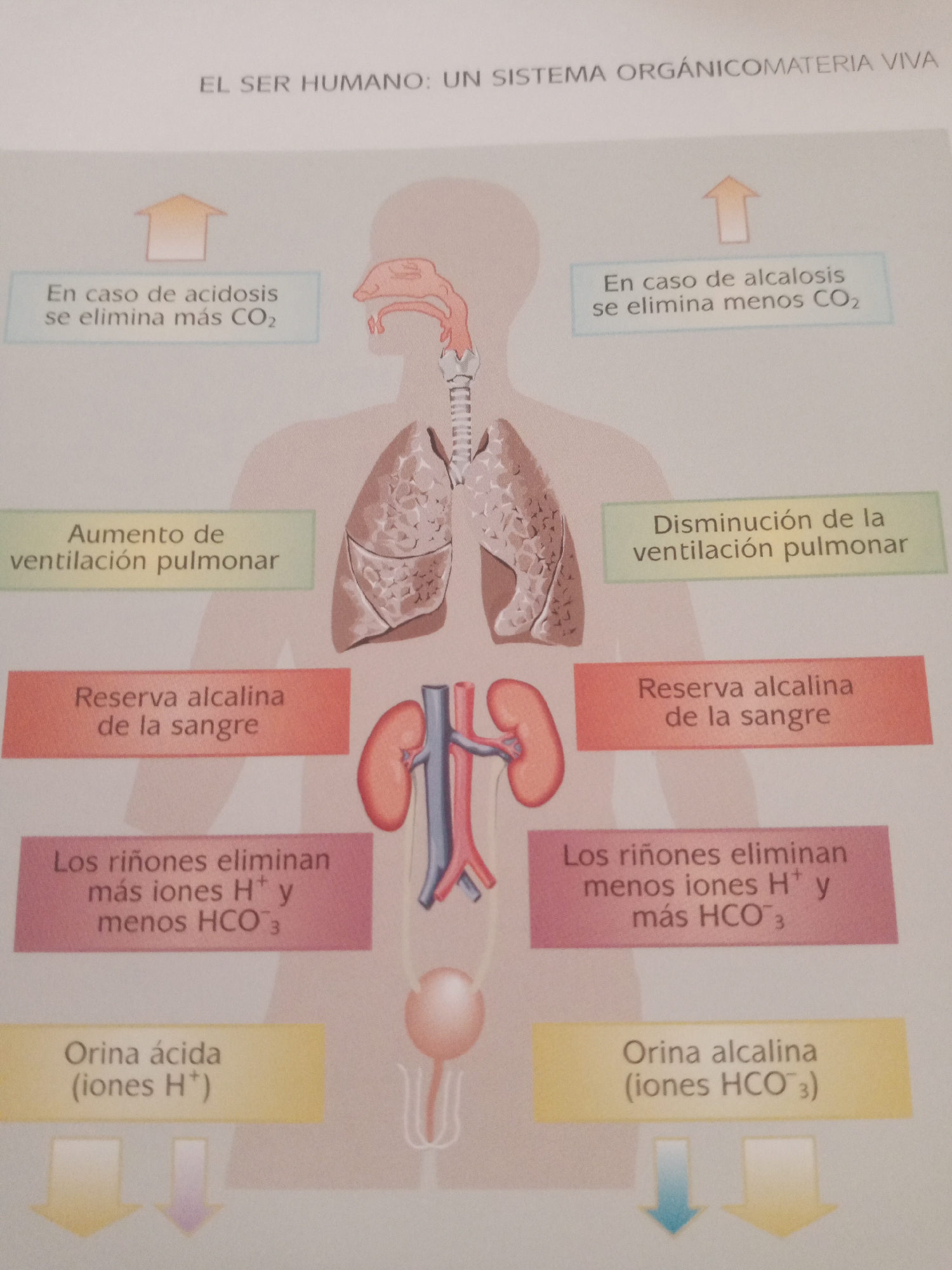
This image depicts a diagram illustrating the human body's systems for regulating acid-base balance, specifically focusing on the lungs and kidneys. The diagram shows stylized representations of the respiratory system (lungs, trachea, mouth, nose) and the urinary system (kidneys, bladder, ureters).

The diagram is divided into two main scenarios, one for "acidosis" and one for "alkalosis."

In the case of acidosis, the text indicates that more CO₂ is eliminated, leading to increased pulmonary ventilation. The kidneys are shown to eliminate more H⁺ ions and less HCO₃⁻, resulting in acidic urine (containing H⁺ ions).

In the case of alkalosis, the text states that less CO₂ is eliminated, resulting in decreased pulmonary ventilation. The kidneys are shown to eliminate less H⁺ ions and more HCO₃⁻, leading to alkaline urine (containing HCO₃⁻ ions).

There are also general labels indicating "Reserva alcalina de la sangre" (Alkaline reserve of the blood) associated with both scenarios, suggesting the blood's buffering capacity.

The overall presentation is a scientific or educational illustration, likely from a textbook or teaching material, explaining physiological processes related to pH regulation. The background is a plain, light-colored surface. No specific time of day, weather, or emotional cues are present, and the location context of Santa Ana, Venezuela, is not visually indicated within the image itself. The text is in Spanish.
cucha

Jun 23, 2026, 11:32 AM

Santa Ana, Venezuela

Short Term

Stake attention in this memory

informative
educational
scientific
diagrammatic
neutral

This image depicts a diagram illustrating the human body's systems for regulating acid-base balance, specifically focusing on the lungs and kidneys. The diagram shows stylized representations of the respiratory system (lungs, trachea, mouth, nose) and the urinary system (kidneys, bladder, ureters). The diagram is divided into two main scenarios, one for "acidosis" and one for "alkalosis." In the case of acidosis, the text indicates that more CO₂ is eliminated, leading to increased pulmonary ventilation. The kidneys are shown to eliminate more H⁺ ions and less HCO₃⁻, resulting in acidic urine (containing H⁺ ions). In the case of alkalosis, the text states that less CO₂ is eliminated, resulting in decreased pulmonary ventilation. The kidneys are shown to eliminate less H⁺ ions and more HCO₃⁻, leading to alkaline urine (containing HCO₃⁻ ions). There are also general labels indicating "Reserva alcalina de la sangre" (Alkaline reserve of the blood) associated with both scenarios, suggesting the blood's buffering capacity. The overall presentation is a scientific or educational illustration, likely from a textbook or teaching material, explaining physiological processes related to pH regulation. The background is a plain, light-colored surface. No specific time of day, weather, or emotional cues are present, and the location context of Santa Ana, Venezuela, is not visually indicated within the image itself. The text is in Spanish.

Symbol

40A6A

Volume

11,550

Creator

+$0.09

Revenue

+$0.13

TVL

$7.37

1D
1W
1M
All

Loading AttnAds…

transactions
revenues
stakers
Earliest
Latest
Highest stake

1

RIKO

Staked 12d ago

$7.31 USD

+$0.05 USD

+0.7%

2

Rev Bot 🤖💰

Injected revenue 12d ago

Revenue bonus for the last stake.

+$0.14 USD

More from this user

More from Santa Ana

cucha

Jun 23, 2026, 11:32 AM

Santa Ana, Venezuela

Licensed under Creative Commons Attribution 4.0 International License. You are free to share and adapt this content with proper attribution.