
Sign in
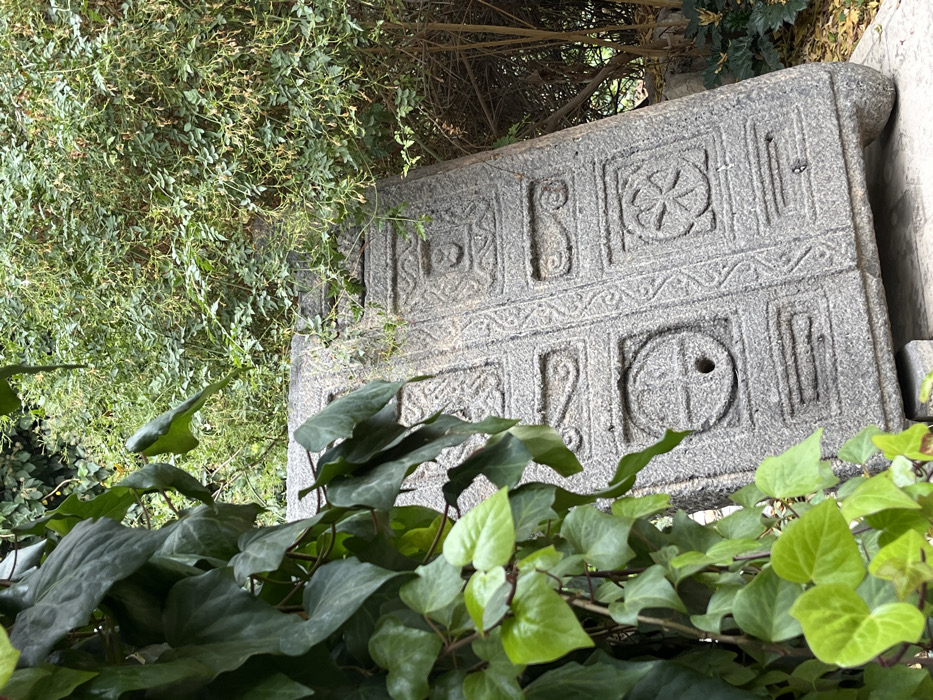
The image displays an ancient, rectangular stone slab, possibly a sarcophagus lid or a decorative panel, largely covered and surrounded by lush green vegetation. The slab, made of weathered grey stone, is richly adorned with relief carvings arranged in a grid pattern.

The main body of the slab features two rows, each containing four square panels with distinct symbols. A horizontal band of intricate, interlocking geometric patterns separates these two rows. In the upper row, visible motifs include stylized "S" or "C" shapes, a rosette or wheel-like cross (possibly a Chrismon), and a panel with vertical linear designs. The lower row continues with similar "S" or "C" motifs and a prominent circular design enclosing a cross with a central hole, which could be an early Christian symbol. The carvings exhibit a clear, albeit worn, detail.

The stone artifact is set outdoors amidst dense foliage. In the immediate foreground and extending into the mid-ground, large-leafed, dark green ivy obscures parts of the stone slab. Behind and around the slab, lighter green, fine-leafed bushes or vines create a thick, natural backdrop. The vibrant greenery contrasts sharply with the ancient, rough-hewn texture of the stone.

No human figures or discernible activities are present. The scene is static, highlighting the historical artifact within its natural environment. The soft, natural lighting suggests daytime conditions. The location context of Damascus, Syria, implies the stone's potential archaeological or historical significance, possibly dating back to Roman, Byzantine, or early Islamic periods, given the symbolic imagery. No alphabetic text is visible, only symbolic and geometric carvings.
Zain othman

Dec 24, 2024

Damascus, Syria

Stake attention in this memory

The image displays an ancient, rectangular stone slab, possibly a sarcophagus lid or a decorative panel, largely covered and surrounded by lush green vegetation. The slab, made of weathered grey stone, is richly adorned with relief carvings arranged in a grid pattern. The main body of the slab features two rows, each containing four square panels with distinct symbols. A horizontal band of intricate, interlocking geometric patterns separates these two rows. In the upper row, visible motifs include stylized "S" or "C" shapes, a rosette or wheel-like cross (possibly a Chrismon), and a panel with vertical linear designs. The lower row continues with similar "S" or "C" motifs and a prominent circular design enclosing a cross with a central hole, which could be an early Christian symbol. The carvings exhibit a clear, albeit worn, detail. The stone artifact is set outdoors amidst dense foliage. In the immediate foreground and extending into the mid-ground, large-leafed, dark green ivy obscures parts of the stone slab. Behind and around the slab, lighter green, fine-leafed bushes or vines create a thick, natural backdrop. The vibrant greenery contrasts sharply with the ancient, rough-hewn texture of the stone. No human figures or discernible activities are present. The scene is static, highlighting the historical artifact within its natural environment. The soft, natural lighting suggests daytime conditions. The location context of Damascus, Syria, implies the stone's potential archaeological or historical significance, possibly dating back to Roman, Byzantine, or early Islamic periods, given the symbolic imagery. No alphabetic text is visible, only symbolic and geometric carvings.

transactions
revenues
stakers
Earliest
Latest
Highest stake

No transactions found

More from this user

More from Damascus

Zain othman

Dec 24, 2024

Damascus, Syria

Licensed under Creative Commons Attribution 4.0 International License. You are free to share and adapt this content with proper attribution.