
Sign in
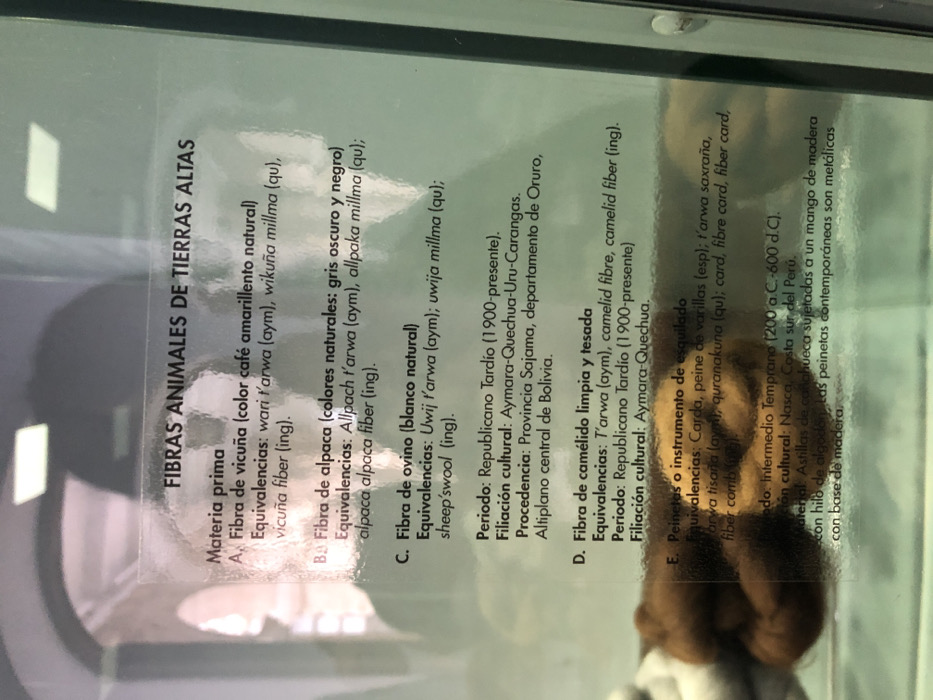
The image displays an informational panel, likely from a museum or exhibition, detailing various animal fibers. The text is oriented sideways, suggesting the photo was taken with the camera rotated. At the bottom right, a person's head with brown hair is partially visible, indicating someone is viewing or photographing the display.

The panel's main subject is "FIBRAS ANIMALES DE TIERRAS ALTAS" (Animal Fibers from the Highlands). It describes different raw materials: Vicuña fiber (natural yellowish-brown), Alpaca fiber (natural dark grey and black), and Sheep's wool (natural white), providing their equivalents in Aymara, Quechua, and English. These fibers are dated to the "Republicano Tardío" (Late Republican) period (1900-present) and attributed to Aymara-Quechua-Uru-Carangas cultures from Bolivia's central Altiplano, specifically Sajama Province, Oruro Department.

Further down, the panel describes "Fibra de camélido limpia y tesada" (Cleaned and combed camelid fiber), also from the Late Republican period with Aymara-Quechua cultural affiliation. The final section, "Peinetas o instrumento de esquilado" (Combs or shearing tools), details tools from the Early Intermediate Period (200 BCE - 600 CE), associated with the Nasca culture from Peru's South Coast. These tools were made from cane/bamboo splinters on a wooden handle with cotton thread, contrasting with contemporary metallic combs. Below the text panel, a sample of dark brown, fluffy fiber is visible, likely one of the described animal fibers.
MNela

Jan 9, 2025, 7:47 PM

La Paz, Bolivia

Stake attention in this memory

The image displays an informational panel, likely from a museum or exhibition, detailing various animal fibers. The text is oriented sideways, suggesting the photo was taken with the camera rotated. At the bottom right, a person's head with brown hair is partially visible, indicating someone is viewing or photographing the display. The panel's main subject is "FIBRAS ANIMALES DE TIERRAS ALTAS" (Animal Fibers from the Highlands). It describes different raw materials: Vicuña fiber (natural yellowish-brown), Alpaca fiber (natural dark grey and black), and Sheep's wool (natural white), providing their equivalents in Aymara, Quechua, and English. These fibers are dated to the "Republicano Tardío" (Late Republican) period (1900-present) and attributed to Aymara-Quechua-Uru-Carangas cultures from Bolivia's central Altiplano, specifically Sajama Province, Oruro Department. Further down, the panel describes "Fibra de camélido limpia y tesada" (Cleaned and combed camelid fiber), also from the Late Republican period with Aymara-Quechua cultural affiliation. The final section, "Peinetas o instrumento de esquilado" (Combs or shearing tools), details tools from the Early Intermediate Period (200 BCE - 600 CE), associated with the Nasca culture from Peru's South Coast. These tools were made from cane/bamboo splinters on a wooden handle with cotton thread, contrasting with contemporary metallic combs. Below the text panel, a sample of dark brown, fluffy fiber is visible, likely one of the described animal fibers.

Loading AttnAds…

transactions
revenues
stakers
Earliest
Latest
Highest stake

No transactions found

More from this user

More from La Paz

MNela

Jan 9, 2025, 7:47 PM

La Paz, Bolivia

Licensed under Creative Commons Attribution 4.0 International License. You are free to share and adapt this content with proper attribution.