Sign in
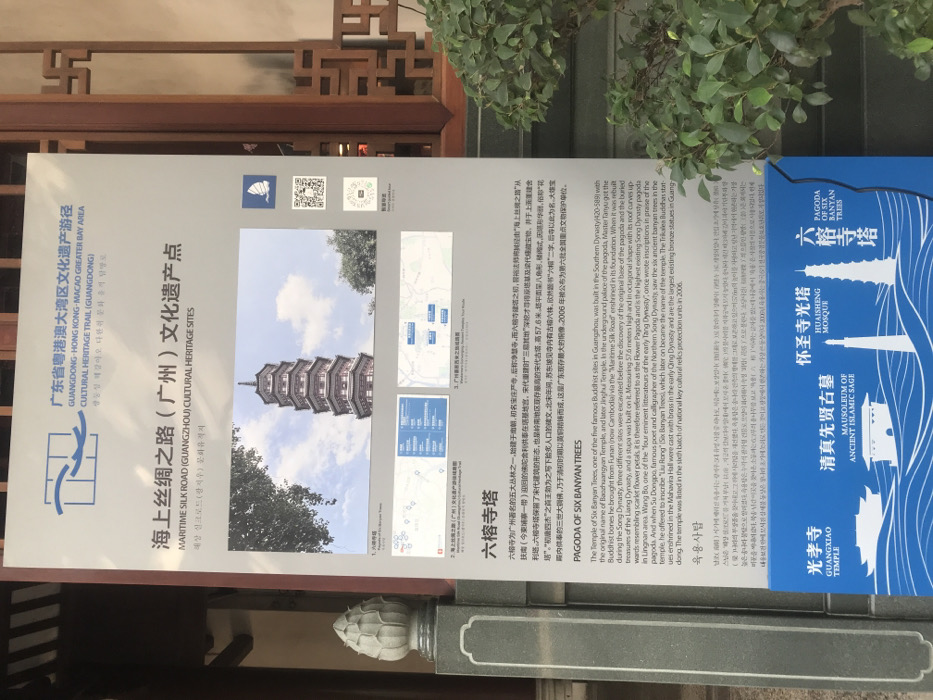
An upright outdoor information board, displaying cultural heritage information, is the central subject of the image. The board is partially framed by a dark wooden structure on the left and top, suggesting traditional architecture, and flanked by green foliage from plants or bushes on the right.

The board features a prominent title in Chinese, English, and Korean: "GUANGDONG-HONG KONG MACAO GREATER BAY AREA CULTURAL HERITAGE TRAIL (GUANGDONG)" and "MARITIME SILK ROAD (GUANGZHOU) CULTURAL HERITAGE SITES." A large image of a multi-tiered pagoda under a clear blue sky dominates the upper-middle section, accompanied by smaller map inserts showing locations. To its right, a QR code and other small logos are visible.

A significant portion of the board is dedicated to a detailed description of the "PAGODA OF SIX BANYAN TREES" (六榕寺塔), provided in Chinese, English, and Korean. The text outlines its history, mentioning its construction during the Southern Dynasty, its original names, the discovery of Buddhist relics from Funan (Cambodia) via the Maritime Silk Road, its reconstruction in the Song Dynasty, its 57.6-meter height, octagonal shape, and its nickname "Flower Pagoda." It also references historical figures like Wang Bo and Su Dongpo and its designation as a national key cultural relic protection unit in 2006.

The rightmost section of the board lists other cultural sites with silhouette illustrations: "GUANGXIAO TEMPLE" (光孝寺), "MAUSOLEUM OF ANCIENT ISLAMIC SAGE" (清真先贤古墓), "HUAISHENG MOSQUE" (怀圣寺光塔), and a repeated entry for "PAGODA OF SIX BANYAN TREES" (六榕寺塔). The scene appears to be set outdoors during daytime, likely at a historical or cultural attraction in Guangzhou, China.
F
FM-qn0Jb2

Dec 11, 2024, 6:54 AM

Guang Zhou Shi, China

Stake attention in this memory

An upright outdoor information board, displaying cultural heritage information, is the central subject of the image. The board is partially framed by a dark wooden structure on the left and top, suggesting traditional architecture, and flanked by green foliage from plants or bushes on the right. The board features a prominent title in Chinese, English, and Korean: "GUANGDONG-HONG KONG MACAO GREATER BAY AREA CULTURAL HERITAGE TRAIL (GUANGDONG)" and "MARITIME SILK ROAD (GUANGZHOU) CULTURAL HERITAGE SITES." A large image of a multi-tiered pagoda under a clear blue sky dominates the upper-middle section, accompanied by smaller map inserts showing locations. To its right, a QR code and other small logos are visible. A significant portion of the board is dedicated to a detailed description of the "PAGODA OF SIX BANYAN TREES" (六榕寺塔), provided in Chinese, English, and Korean. The text outlines its history, mentioning its construction during the Southern Dynasty, its original names, the discovery of Buddhist relics from Funan (Cambodia) via the Maritime Silk Road, its reconstruction in the Song Dynasty, its 57.6-meter height, octagonal shape, and its nickname "Flower Pagoda." It also references historical figures like Wang Bo and Su Dongpo and its designation as a national key cultural relic protection unit in 2006. The rightmost section of the board lists other cultural sites with silhouette illustrations: "GUANGXIAO TEMPLE" (光孝寺), "MAUSOLEUM OF ANCIENT ISLAMIC SAGE" (清真先贤古墓), "HUAISHENG MOSQUE" (怀圣寺光塔), and a repeated entry for "PAGODA OF SIX BANYAN TREES" (六榕寺塔). The scene appears to be set outdoors during daytime, likely at a historical or cultural attraction in Guangzhou, China.

Loading AttnAds…

transactions
revenues
stakers
Earliest
Latest
Highest stake

No transactions found

More from this user

More from Guang Zhou Shi

FFM-qn0Jb2

Dec 11, 2024, 6:54 AM

Guang Zhou Shi, China

Licensed under Creative Commons Attribution 4.0 International License. You are free to share and adapt this content with proper attribution.