
Sign in
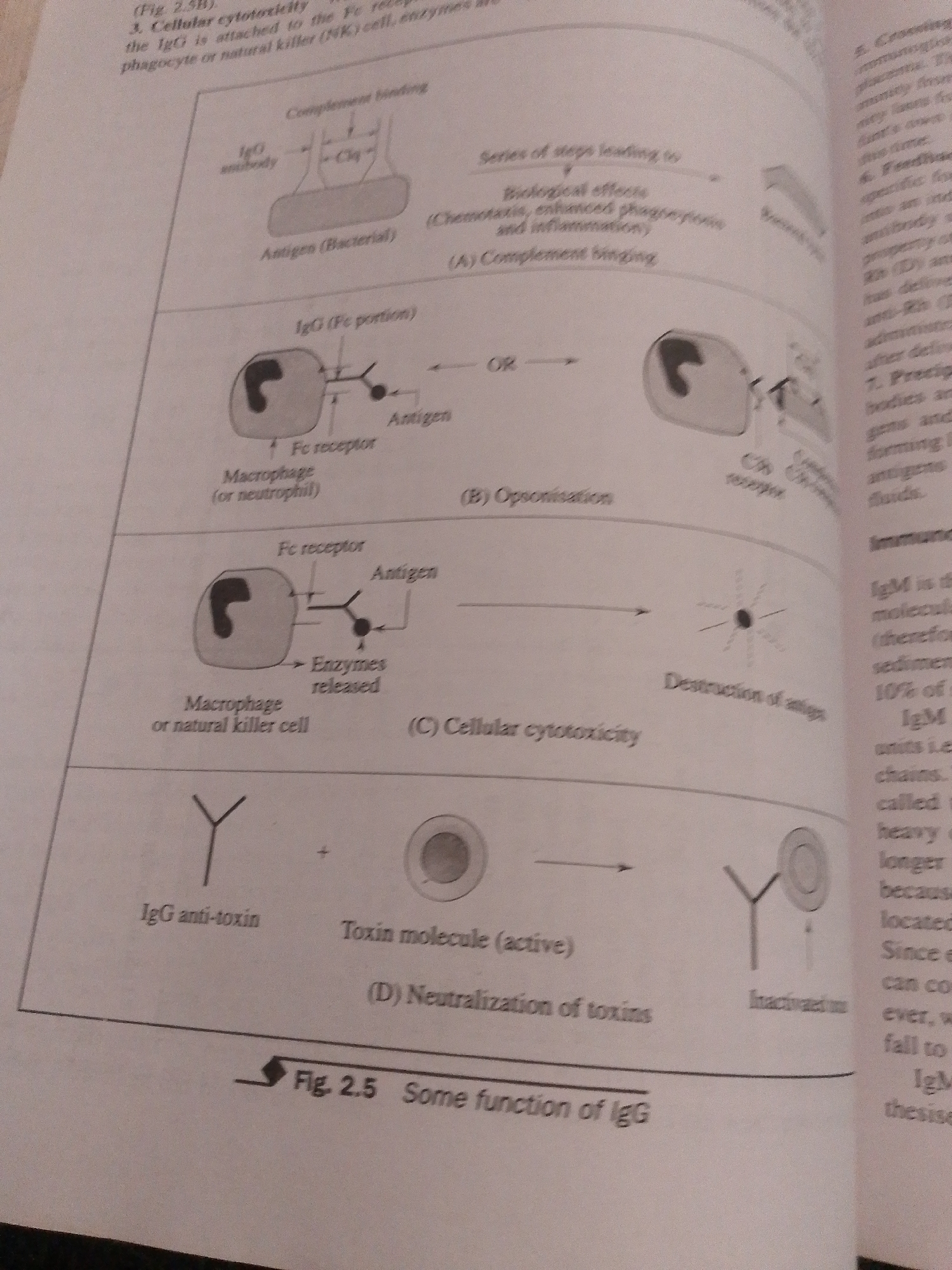
The image is a page from a textbook, likely on immunology, featuring diagrams illustrating the functions of IgG antibodies. The page is divided into sections, each depicting a different mechanism of action for IgG.

The subjects are not people but rather schematic representations of cells and molecules. We see diagrams of IgG antibodies binding to antigens, macrophages interacting with antibody-coated pathogens, and antibodies neutralizing toxins. The objects depicted are abstract biological components such as antibodies (Y-shaped structures), antigens (represented by dots and small shapes), cell receptors (marked as "Fc receptor"), and bacterial or toxin molecules.

The activity taking place is the explanation of biological processes. The diagrams illustrate concepts such as complement binding, opsonization, cellular cytotoxicity, and neutralization of toxins. These are fundamental immune responses.

There are no discernible details about time of day, weather, or specific emotions. The setting is a printed page from a book, indicated by the crisp lines of the diagrams and the presence of text.

Visible text includes labels for the diagrams and explanatory captions. Key text includes: "IgG antibody," "Antigen (Bacterial)," "Complement binding," "Macrophage (or neutrophil)," "Fc receptor," "Opsonisation," "IgG anti-toxin," "Toxin molecule (active)," "Neutralization of toxins," and "Some function of IgG." There are also numbered sections like "3. Cellular cytotoxicity" and references to figures like "Fig. 2.5b" and "Fig. 2.5." On the right side of the page, there is a column of text discussing "IgM" and its properties.
FM-qTLKq1

Jun 29, 2026, 3:31 PM

Jauro Yinu, Nigeria

Stake attention in this memory

academic
analytical
focused
informative
serious

The image is a page from a textbook, likely on immunology, featuring diagrams illustrating the functions of IgG antibodies. The page is divided into sections, each depicting a different mechanism of action for IgG. The subjects are not people but rather schematic representations of cells and molecules. We see diagrams of IgG antibodies binding to antigens, macrophages interacting with antibody-coated pathogens, and antibodies neutralizing toxins. The objects depicted are abstract biological components such as antibodies (Y-shaped structures), antigens (represented by dots and small shapes), cell receptors (marked as "Fc receptor"), and bacterial or toxin molecules. The activity taking place is the explanation of biological processes. The diagrams illustrate concepts such as complement binding, opsonization, cellular cytotoxicity, and neutralization of toxins. These are fundamental immune responses. There are no discernible details about time of day, weather, or specific emotions. The setting is a printed page from a book, indicated by the crisp lines of the diagrams and the presence of text. Visible text includes labels for the diagrams and explanatory captions. Key text includes: "IgG antibody," "Antigen (Bacterial)," "Complement binding," "Macrophage (or neutrophil)," "Fc receptor," "Opsonisation," "IgG anti-toxin," "Toxin molecule (active)," "Neutralization of toxins," and "Some function of IgG." There are also numbered sections like "3. Cellular cytotoxicity" and references to figures like "Fig. 2.5b" and "Fig. 2.5." On the right side of the page, there is a column of text discussing "IgM" and its properties.

Loading AttnAds…

transactions
revenues
stakers
Earliest
Latest
Highest stake

No transactions found

More from this user

More from Jauro Yinu

FM-qTLKq1

Jun 29, 2026, 3:31 PM

Jauro Yinu, Nigeria

Licensed under Creative Commons Attribution 4.0 International License. You are free to share and adapt this content with proper attribution.