Stake attention in this memory
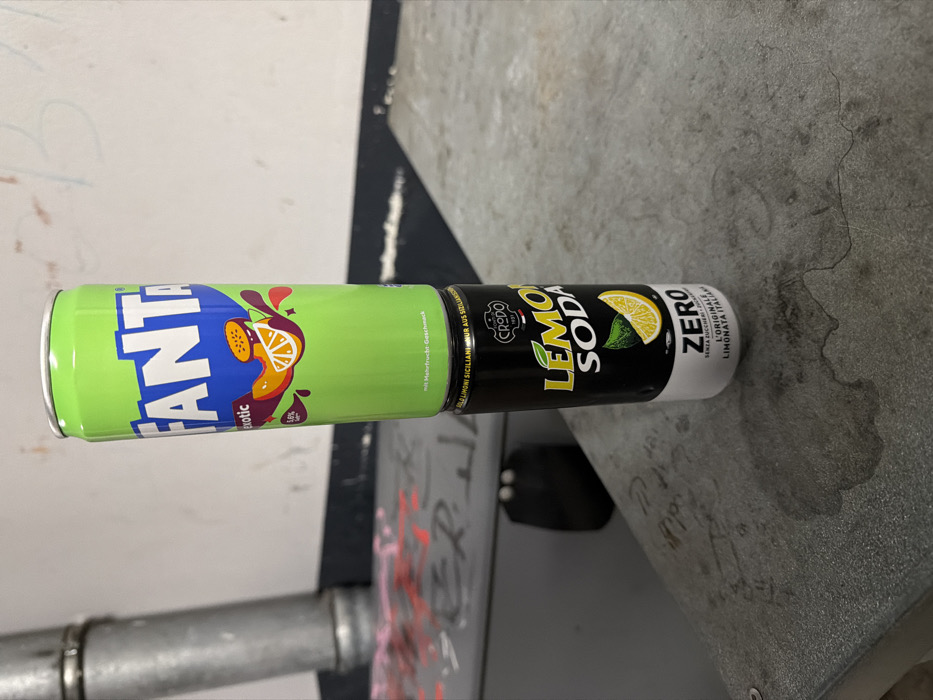
This image depicts two beverage cans stacked vertically on a light gray, textured surface within an unspecified utilitarian urban space in Apolda, Germany. The top can is a vibrant lime green Fanta "exotic" variety, featuring the Fanta logo in blue and white, the word "exotic," and stylized fruit graphics including orange, passionfruit, and possibly mango. Text at the bottom of its label reads "mit Mehrfrucht-Geschmack" (with multi-fruit flavor). The bottom can is a black Crodino "Lemon Soda Zero," displaying the "CREDO 1931" logo, "LEMON SODA ZERO" in yellow and white text, and a graphic of a lime wedge and a lemon half. Text visible on its label includes "SENZA ZUCCHERI E DOLCIFICANTI" (without sugars and sweeteners) and "L'ORIGINALE LIMONATA ITALIANA" (the original Italian lemonade). The cans rest on a light gray surface, likely concrete or weathered metal, which shows visible scratches, dust, and dried liquid stains. Faint, indecipherable markings or graffiti are present on this surface. Directly behind the cans is a darker, likely horizontal, surface. In the background, a white wall exhibits faint blue or white graffiti, including a partial "B" character. To the left, a large, vertically oriented metallic pipe, possibly galvanized, ascends the frame, indicating industrial or building infrastructure. Further left, partially obscured, is another dark, graffiti-like marking. In the midground-left, between the gray surfaces, a small, dark, rounded object with two distinct white spots, resembling eyes, is visible. No individuals are present in the scene, and no actions or interactions are depicted beyond the static arrangement of the cans.
Loading AttnAds…
No transactions found