Stake attention in this memory
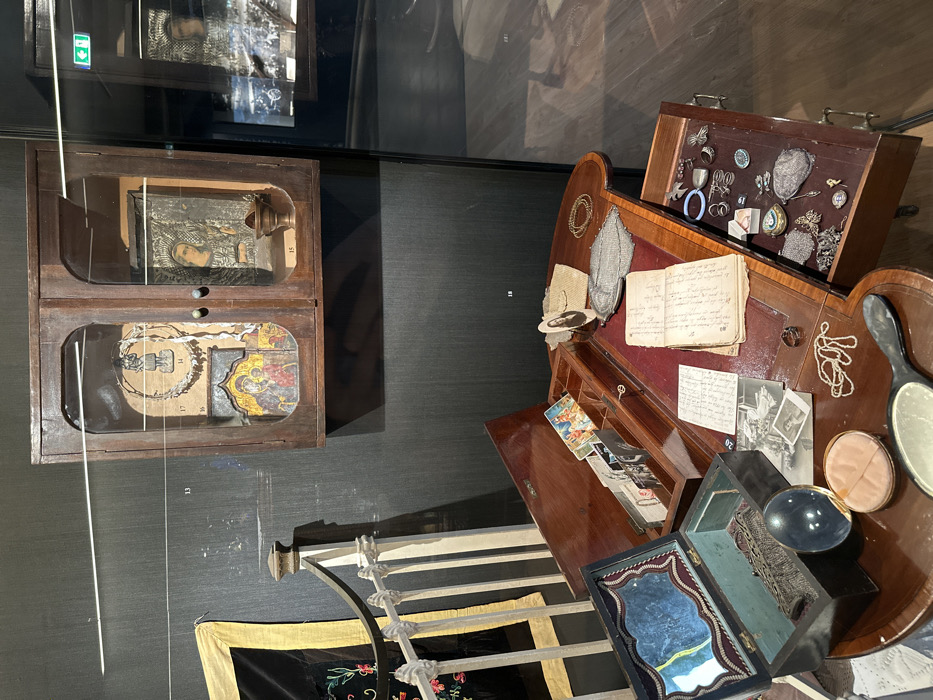
This image captures an indoor exhibition scene, likely within a museum or historical display, showcasing a collection of antique artifacts. The background is dark, and reflections on glass indicate items are protected within display cases. On the left, a vertical wooden display case with two compartments is visible. The upper compartment houses a religious icon, possibly depicting the Virgin Mary, adorned with a decorative metal overlay (riza or oklad) that frames the painted faces and hands. A small, ornate metallic object rests beside it. The lower compartment contains fragmented pieces of what appear to be Byzantine or post-Byzantine religious art, featuring intricate designs and golden hues. Inventory numbers like "14," "15," "17," and "18" are visible near these items. To the right, an antique wooden writing desk or vanity table is featured. Its surface is covered with a reddish material, possibly velvet. An open notebook with handwritten script in an old European language (likely Greek) lies on the desk, alongside an embroidered textile or pouch, and several old photographs or postcards. One postcard illustrates a classical or religious scene. Various items of personal adornment are scattered across the desk, including necklaces, rings, and a compact or round container. An old hand mirror and a dark wooden box with a mirrored lid are also present. An open drawer above the main desk surface reveals a collection of numerous pieces of jewelry, including rings, pendants, medallions, and brooches, carefully arranged on a fabric lining. In the bottom-center foreground, part of a white or light-colored metal railing with decorative spindles can be seen. Beneath it, a dark textile with yellow borders and colorful floral embroidery, possibly a rug or tapestry, is displayed. No direct activity is taking place; the scene is a static presentation of historical objects. The overall impression evokes a sense of heritage and personal history. The combination of Greek Orthodox icons, antique furniture, and embroidered textiles strongly suggests a focus on Greek cultural or historical artifacts, possibly related to a specific family or a period in Greek history, consistent with the location context of Nea Filadelfia, Greece. A green exit sign symbol is faintly reflected in the top-left glass.
Loading AttnAds…
No transactions found