Sign in
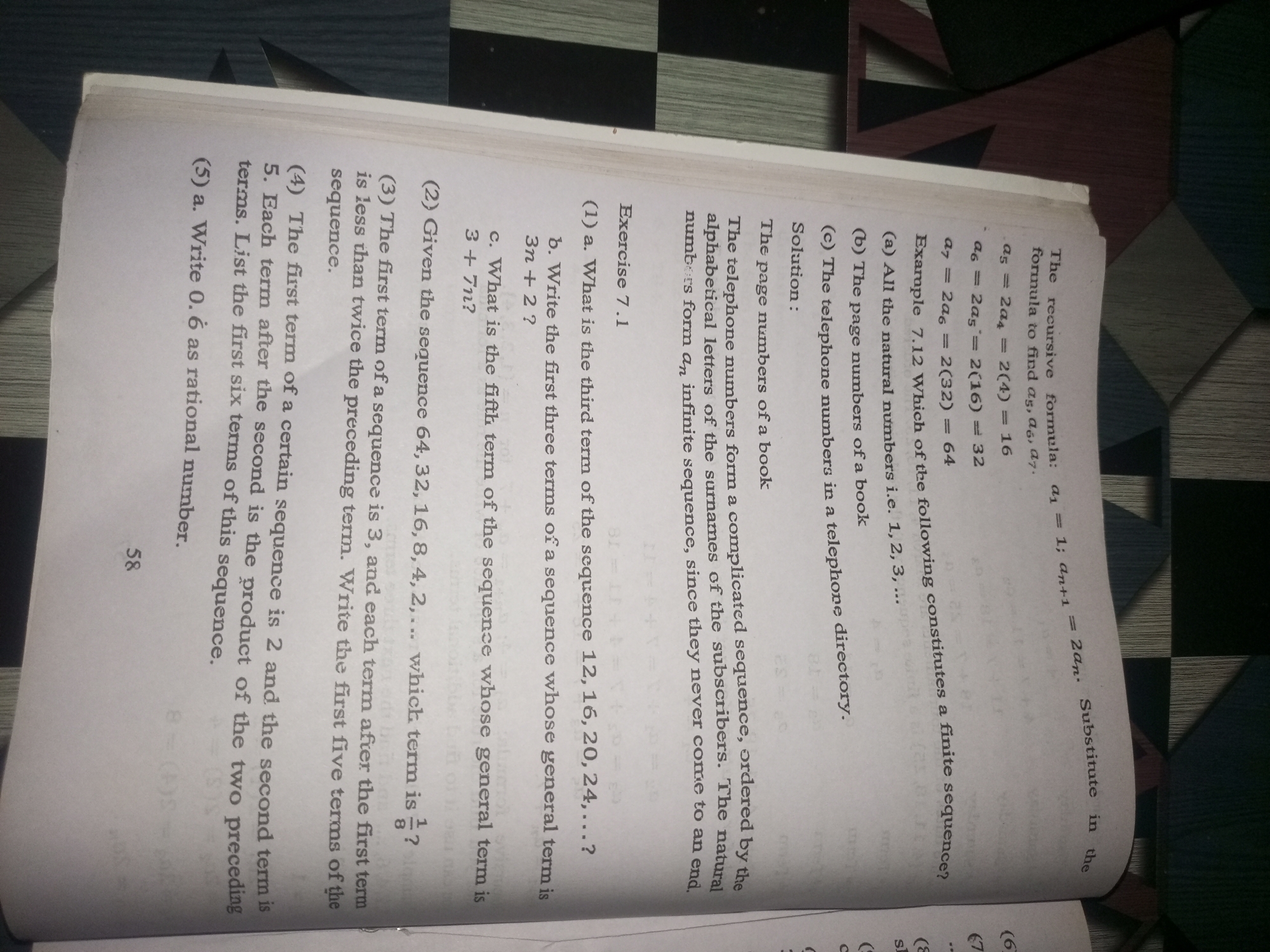
The image shows a page from a textbook, likely a mathematics book, with several problems and examples. The page is oriented such that the text is angled upwards from left to right. There is a page number "58" at the bottom left corner.

On the right side of the page, there is a section titled "The recursive formula: $a_1=1, a_{n+1}=2a_n$. Substitute in the formula to find $a_5, a_6, a_7$." Following this are calculations for these terms: $a_5 = 2a_4 = 2(4)=16$, $a_6 = 2a_5 = 2(16)=32$, and $a_7 = 2a_6 = 2(32)=64$. Below this is "Example 7.12 Which of the following constitutes a finite sequence? (a) All the natural numbers i.e. 1, 2, 3,... (b) The page numbers of a book (c) The telephone numbers in a telephone directory."

On the left side of the page, there is a section labeled "Exercise 7.1" with several numbered problems:
(1) a. What is the third term of the sequence 12, 16, 20, 24, ...?
b. Write the first three terms of a sequence whose general term is $3+7n$
c. What is the fifth term of the sequence $3+7n$?

(2) Given the sequence 64, 32, 16, 8, 4, 2, ..., which term is $\frac{1}{8}$?

(3) The first term of a sequence is 3, and each term after the first term is less than twice the preceding term. Write the first five terms of the sequence.

(4) The first term of a certain sequence is 2 and the second term is 5. Each term after the second term is the product of the two preceding terms. List the first six terms of this sequence.

(5) a. Write 0.6 as rational number.

The image does not contain any information about Jalingo, Nigeria.
FM-FzB8r2

Jun 28, 2026, 8:42 PM

Jalingo, Nigeria

Stake attention in this memory

curiosity
focus
learning
analytical
concentration

The image shows a page from a textbook, likely a mathematics book, with several problems and examples. The page is oriented such that the text is angled upwards from left to right. There is a page number "58" at the bottom left corner. On the right side of the page, there is a section titled "The recursive formula: $a_1=1, a_{n+1}=2a_n$. Substitute in the formula to find $a_5, a_6, a_7$." Following this are calculations for these terms: $a_5 = 2a_4 = 2(4)=16$, $a_6 = 2a_5 = 2(16)=32$, and $a_7 = 2a_6 = 2(32)=64$. Below this is "Example 7.12 Which of the following constitutes a finite sequence? (a) All the natural numbers i.e. 1, 2, 3,... (b) The page numbers of a book (c) The telephone numbers in a telephone directory." On the left side of the page, there is a section labeled "Exercise 7.1" with several numbered problems: (1) a. What is the third term of the sequence 12, 16, 20, 24, ...? b. Write the first three terms of a sequence whose general term is $3+7n$ c. What is the fifth term of the sequence $3+7n$? (2) Given the sequence 64, 32, 16, 8, 4, 2, ..., which term is $\frac{1}{8}$? (3) The first term of a sequence is 3, and each term after the first term is less than twice the preceding term. Write the first five terms of the sequence. (4) The first term of a certain sequence is 2 and the second term is 5. Each term after the second term is the product of the two preceding terms. List the first six terms of this sequence. (5) a. Write 0.6 as rational number. The image does not contain any information about Jalingo, Nigeria.

Loading AttnAds…

transactions
revenues
stakers
Earliest
Latest
Highest stake

No transactions found

More from this user

More from Jalingo

FM-FzB8r2

Jun 28, 2026, 8:42 PM

Jalingo, Nigeria

Licensed under Creative Commons Attribution 4.0 International License. You are free to share and adapt this content with proper attribution.