Sign in
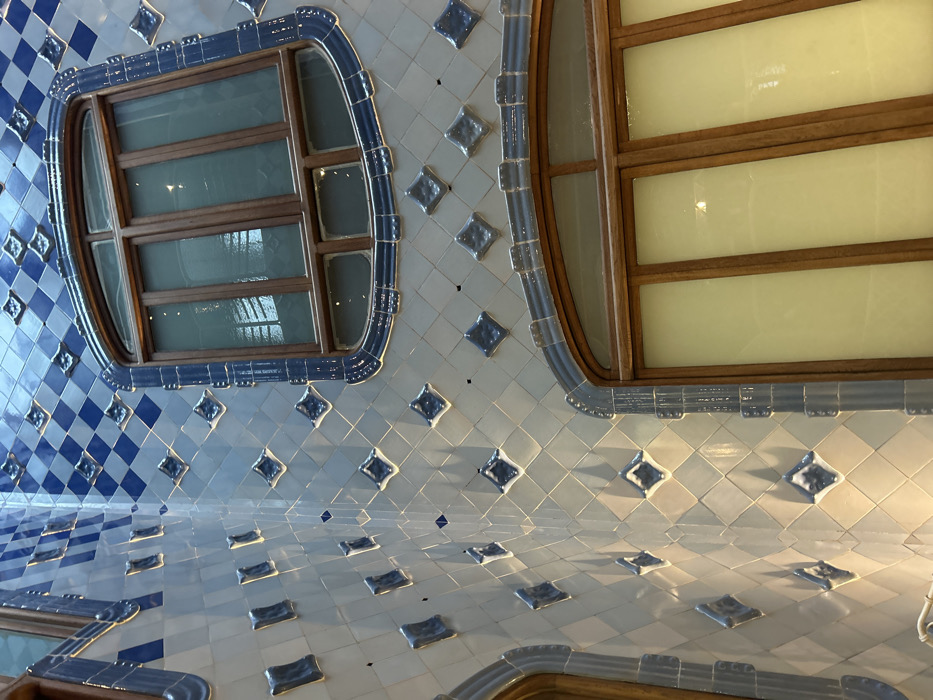
This image captures an intricate and colorful architectural interior, showcasing two distinctive windows set into a surface entirely covered with ceramic tiles. The perspective is looking upwards, suggesting a ceiling or a highly curved wall.

The dominant feature is the tile work, which consists of small, light blue-grey square tiles arranged in a grid pattern. Interspersed among these are darker blue, raised, diamond-shaped accent tiles that create a visually textured and rhythmic pattern across the surface. The tiles have a glossy finish, reflecting light and creating subtle variations in tone.

Two windows break the tiled expanse. The window on the left is irregularly shaped, with soft, rounded corners and a wavy, organic frame made of dark blue ceramic tiles. Its interior features a grid of wooden mullions dividing clear glass panes, through which reflections of the interior can be seen. The window on the right is also framed by a similar dark blue ceramic border, but its shape is more elongated and less defined within the frame, curving along the ceiling. This window contains light-colored, translucent or frosted glass, possibly yellowish, also divided by wooden mullions.

The entire surface, from the bottom foreground extending upwards and across, exhibits a strong curvature, giving the impression of an organic, cave-like, or fluid architectural space. The lighting appears to be natural, possibly daylight, illuminating the tiled surfaces and highlighting their reflective qualities. No people or specific activities are visible, focusing solely on the architectural details. The artistic style, with its undulating lines and extensive use of decorative ceramics, strongly suggests the work of Antoni Gaudí, consistent with the location context of Barcelona, Spain. There is no visible text in the image.
FM-rCzL43

Feb 7, 2025

Barcelona, Spain

Stake attention in this memory

This image captures an intricate and colorful architectural interior, showcasing two distinctive windows set into a surface entirely covered with ceramic tiles. The perspective is looking upwards, suggesting a ceiling or a highly curved wall. The dominant feature is the tile work, which consists of small, light blue-grey square tiles arranged in a grid pattern. Interspersed among these are darker blue, raised, diamond-shaped accent tiles that create a visually textured and rhythmic pattern across the surface. The tiles have a glossy finish, reflecting light and creating subtle variations in tone. Two windows break the tiled expanse. The window on the left is irregularly shaped, with soft, rounded corners and a wavy, organic frame made of dark blue ceramic tiles. Its interior features a grid of wooden mullions dividing clear glass panes, through which reflections of the interior can be seen. The window on the right is also framed by a similar dark blue ceramic border, but its shape is more elongated and less defined within the frame, curving along the ceiling. This window contains light-colored, translucent or frosted glass, possibly yellowish, also divided by wooden mullions. The entire surface, from the bottom foreground extending upwards and across, exhibits a strong curvature, giving the impression of an organic, cave-like, or fluid architectural space. The lighting appears to be natural, possibly daylight, illuminating the tiled surfaces and highlighting their reflective qualities. No people or specific activities are visible, focusing solely on the architectural details. The artistic style, with its undulating lines and extensive use of decorative ceramics, strongly suggests the work of Antoni Gaudí, consistent with the location context of Barcelona, Spain. There is no visible text in the image.

transactions
revenues
stakers
Earliest
Latest
Highest stake

No transactions found

More from this user

More from Barcelona

FM-rCzL43

Feb 7, 2025

Barcelona, Spain

Licensed under Creative Commons Attribution 4.0 International License. You are free to share and adapt this content with proper attribution.