
Sign in
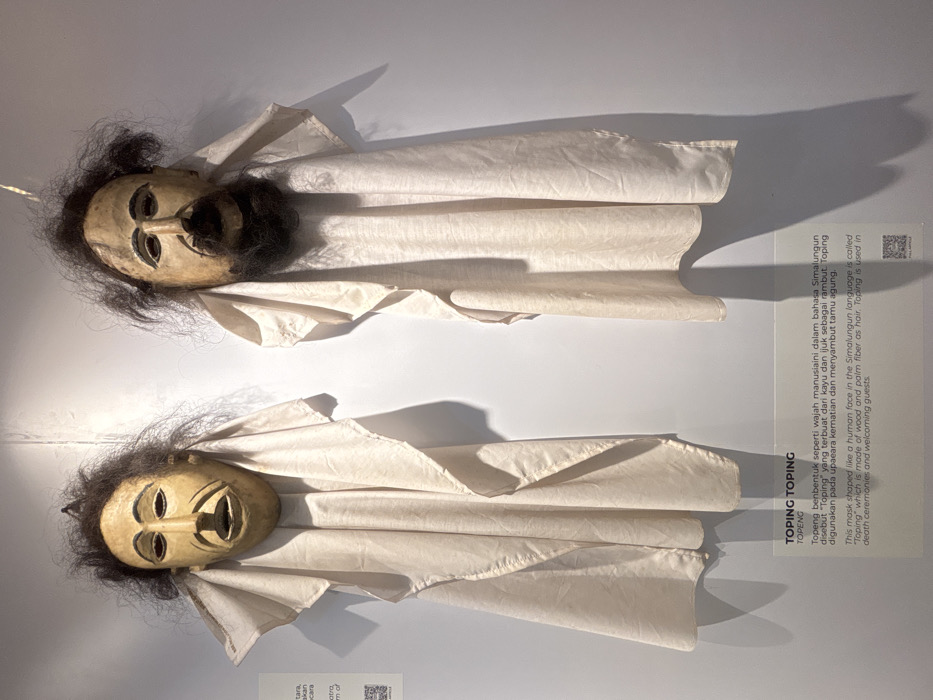
Two mask-like figures are prominently displayed against a plain, light-colored wall in what appears to be a museum or exhibition setting in West Jakarta, Indonesia. The image is taken from a slightly elevated, angled perspective.

The subjects are two "Toping" masks, each featuring a stylized human face carved from wood. The faces are pale, with deep-set, wide eyes and distinct noses. The upper mask has a closed mouth and a carved beard and mustache, giving it a somber or serious expression. The lower mask displays an open mouth, resembling a wide smile or chant, and lacks a beard. Both masks feature dark, shaggy hair, which the accompanying text identifies as being made from palm fiber.

Each mask is draped with a simple, off-white or cream-colored fabric that flows downwards, creating a shroud-like or body-like form. The fabric has natural folds and creases. The display is well-lit, casting clear shadows of the masks and drapery onto the wall behind them.

An informational plaque is visible to the right of the lower mask. The text identifies the objects as "TOPING TOPING" or "Topeng." The Indonesian text states that the masks are shaped like human faces, called "Toping" in the Simalungun language, made of wood and palm fiber for hair, and used in death ceremonies and for welcoming important guests. An English translation reiterates this, stating, "This mask shaped like a human face in the Simalungun language is called 'Toping' which is made of wood and palm fiber as hair. Toping is used in death ceremonies and welcoming guests." This context indicates the masks are cultural artifacts with significant ceremonial use.
FM-DONBALE

Jan 10, 2025, 7:46 AM

West Jakarta, Indonesia

Stake attention in this memory

Two mask-like figures are prominently displayed against a plain, light-colored wall in what appears to be a museum or exhibition setting in West Jakarta, Indonesia. The image is taken from a slightly elevated, angled perspective. The subjects are two "Toping" masks, each featuring a stylized human face carved from wood. The faces are pale, with deep-set, wide eyes and distinct noses. The upper mask has a closed mouth and a carved beard and mustache, giving it a somber or serious expression. The lower mask displays an open mouth, resembling a wide smile or chant, and lacks a beard. Both masks feature dark, shaggy hair, which the accompanying text identifies as being made from palm fiber. Each mask is draped with a simple, off-white or cream-colored fabric that flows downwards, creating a shroud-like or body-like form. The fabric has natural folds and creases. The display is well-lit, casting clear shadows of the masks and drapery onto the wall behind them. An informational plaque is visible to the right of the lower mask. The text identifies the objects as "TOPING TOPING" or "Topeng." The Indonesian text states that the masks are shaped like human faces, called "Toping" in the Simalungun language, made of wood and palm fiber for hair, and used in death ceremonies and for welcoming important guests. An English translation reiterates this, stating, "This mask shaped like a human face in the Simalungun language is called 'Toping' which is made of wood and palm fiber as hair. Toping is used in death ceremonies and welcoming guests." This context indicates the masks are cultural artifacts with significant ceremonial use.

Loading AttnAds…

transactions
revenues
stakers
Earliest
Latest
Highest stake

No transactions found

More from this user

More from West Jakarta

FM-DONBALE

Jan 10, 2025, 7:46 AM

West Jakarta, Indonesia

Licensed under Creative Commons Attribution 4.0 International License. You are free to share and adapt this content with proper attribution.