
Stake attention in this memory
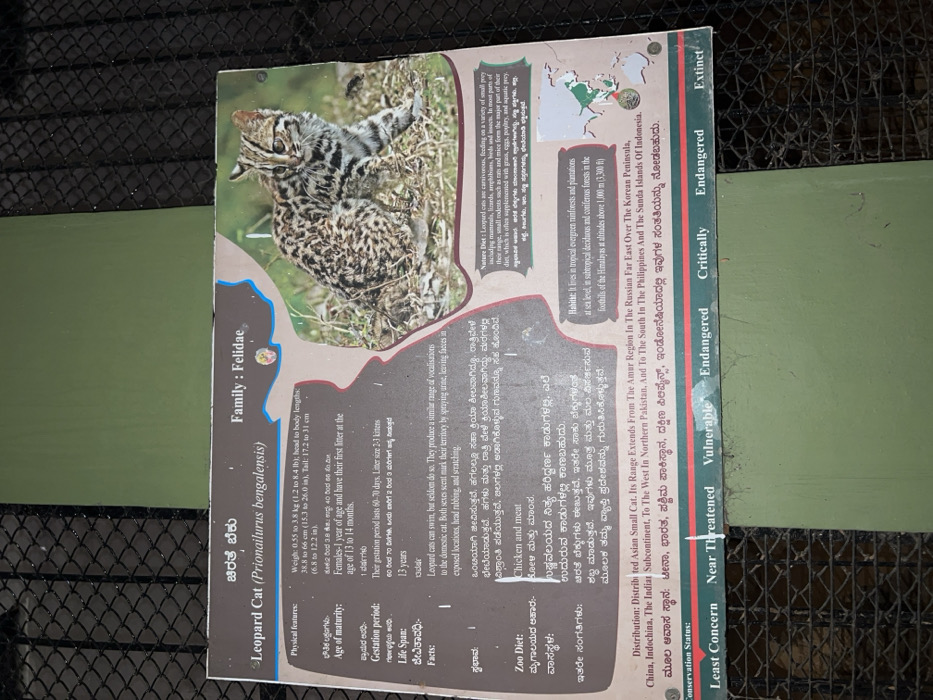
An informational display board about the Leopard Cat (Prionailurus bengalensis) is depicted, oriented ninety degrees counter-clockwise. The board, likely located at a zoo or wildlife park in Mysuru, India, features text in both English and Kannada. The main subject of the board is a detailed image of a Leopard Cat, a small, spotted wild cat. The accompanying text provides comprehensive information about the species. Key details include its family (Felidae), physical features (weight 0.55 to 3.8 kg, body length 38.8 to 66 cm, tail 17.2 to 31 cm), and life history characteristics like age of maturity (females at 1 year, first litter at 13-14 months), gestation period (60-70 days for 2-3 kittens), and life span (13 years). Behavioral facts explain that Leopard Cats can swim, produce vocalizations similar to domestic cats, and scent mark their territory. They are solitary and can be active day and night, resting in trees or dens. The board also lists their diet: chicken and meat in captivity (Zoo Diet) and a carnivorous natural diet (Nature Diet) consisting of small prey like mammals, lizards, amphibians, birds, insects, and often supplemented with grass, eggs, and poultry. Their habitat is described as tropical evergreen rainforests, plantations, subtropical deciduous, and coniferous forests, including the foothills of the Himalayas. The distribution highlights their range as an "Asian Small Cat," extending from the Russian Far East to the Korean Peninsula, China, Indochina, the Indian Subcontinent, Northern Pakistan, the Philippines, and the Sunda Islands of Indonesia. A conservation status bar at the bottom indicates that the Leopard Cat is currently of "Least Concern." The background of the image shows a green painted surface and a black mesh or fencing, consistent with an animal enclosure. No specific activity beyond the display of information is occurring, and no people are visible.
No transactions found