
Sign in
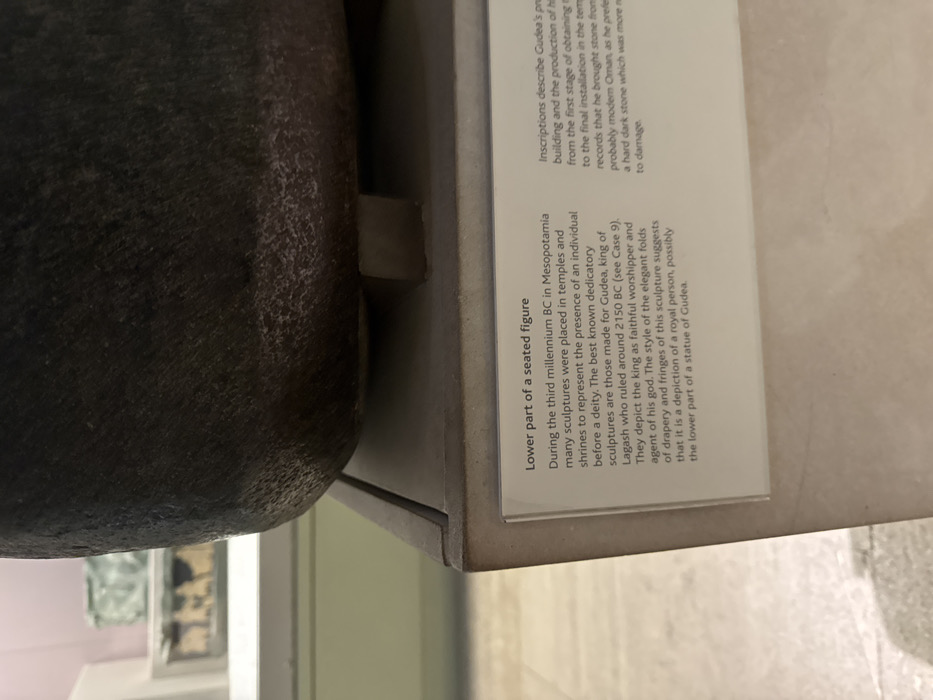
The image displays a close-up of an ancient, dark, and textured stone artifact, appearing to be the lower part of a seated figure. The object rests on a light-colored plinth or display stand within what seems to be a museum or gallery setting. To the right of the artifact, a clear informational text panel provides context for the exhibit.

The visible text, titled "Lower part of a seated figure," explains that during the third millennium BC in Mesopotamia, sculptures like this were placed in temples and shrines to represent individuals before a deity. It highlights Gudea, king of Lagash (who ruled around 2150 BC), as a notable figure for whom many such dedicatory sculptures were made, depicting him as a faithful worshipper. The text notes that the style, particularly the drapery and fringes, suggests a royal person, possibly Gudea himself. Further inscriptions mentioned describe Gudea's building projects and his preference for a hard, dark stone, likely from modern Oman, for its durability.

The overall scene captures an artifact on display, emphasizing its historical and cultural significance through the accompanying detailed explanation. The location is London, United Kingdom.
punit03

Dec 13, 2024, 3:31 PM

London, UK

Stake attention in this memory

The image displays a close-up of an ancient, dark, and textured stone artifact, appearing to be the lower part of a seated figure. The object rests on a light-colored plinth or display stand within what seems to be a museum or gallery setting. To the right of the artifact, a clear informational text panel provides context for the exhibit. The visible text, titled "Lower part of a seated figure," explains that during the third millennium BC in Mesopotamia, sculptures like this were placed in temples and shrines to represent individuals before a deity. It highlights Gudea, king of Lagash (who ruled around 2150 BC), as a notable figure for whom many such dedicatory sculptures were made, depicting him as a faithful worshipper. The text notes that the style, particularly the drapery and fringes, suggests a royal person, possibly Gudea himself. Further inscriptions mentioned describe Gudea's building projects and his preference for a hard, dark stone, likely from modern Oman, for its durability. The overall scene captures an artifact on display, emphasizing its historical and cultural significance through the accompanying detailed explanation. The location is London, United Kingdom.

Loading AttnAds…

transactions
revenues
stakers
Earliest
Latest
Highest stake

No transactions found

More from this user

More from London

punit03

Dec 13, 2024, 3:31 PM

London, UK

Licensed under Creative Commons Attribution 4.0 International License. You are free to share and adapt this content with proper attribution.